· Portfolio · 4 min read
Portfolio WIP — It's Not About Limits
Every time I introduce a portfolio Kanban, somebody asks about WIP limits. My recommendation at the portfolio level is often: don't limit WIP. At least not the way you're thinking about it.
 Click image to open full size
 How should we limit WIP on the Portfolio Kanban? How many initiatives should we allow in each column?”
Every time I introduce a portfolio Kanban system to better manage an organization’s initiatives, the question of managing work in progress comes up.
At the team level, WIP limits make intuitive sense. Work items are roughly right-sized. You can say “three items in progress” and it means something concrete about focus and flow. It has a direct connection to throughput.
How is a Portfolio-level kanban system different when it comes to limiting WIP?
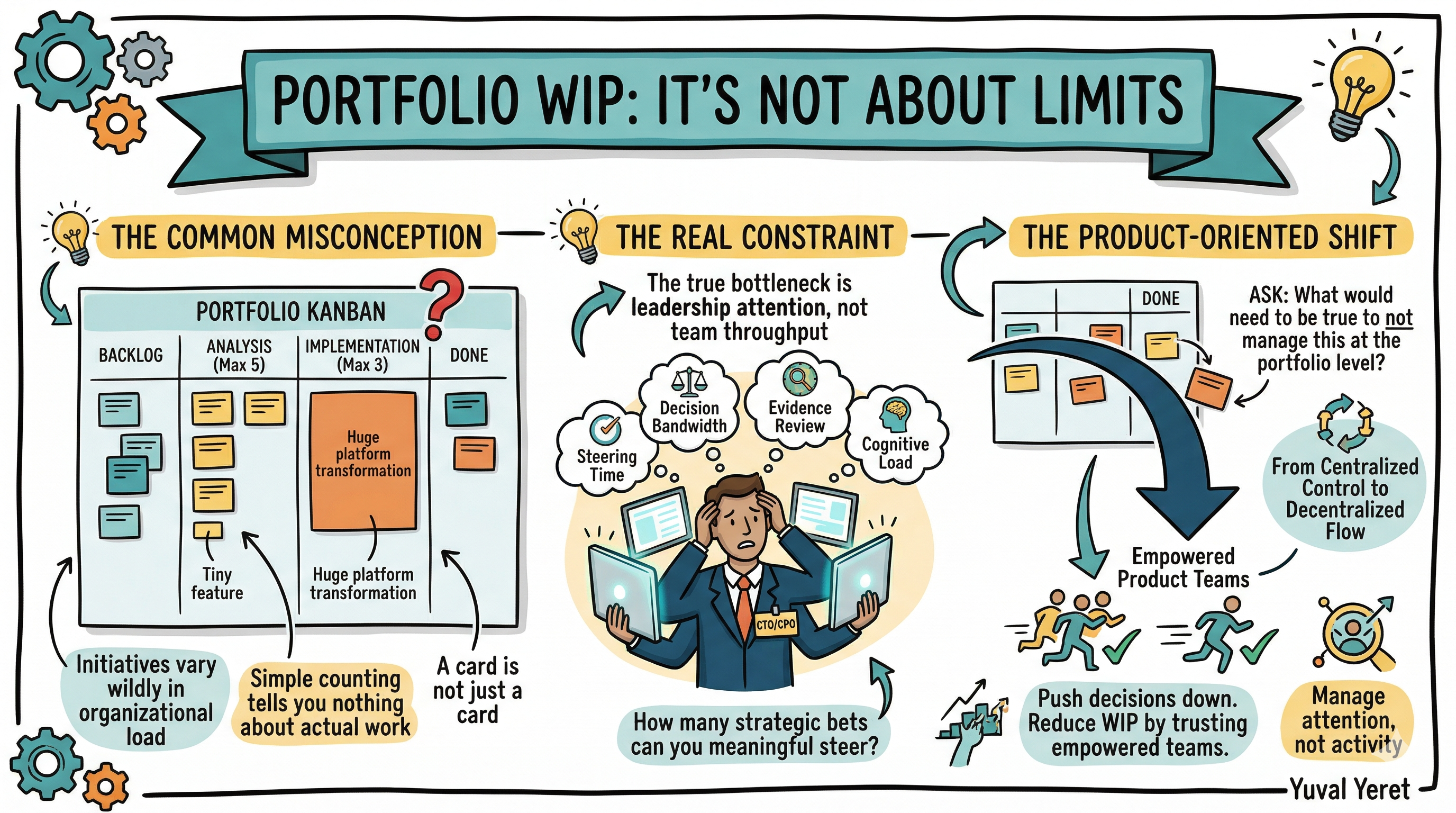
But portfolio initiatives? One might represent five person-months of work. Another might represent five hundred. A WIP limit of “four initiatives in progress” tells you almost nothing about the actual load on the organization.
What it does tell you something about is cognitive load on the leadership team.
And that’s a real constraint worth managing.
Every card on that portfolio board — regardless of how much organizational effort it represents — requires leadership attention. Discussion time in portfolio reviews. Steering conversations. Evidence reviews. Decision-making bandwidth.
Limiting WIP - Not just about capacity management - also a focusing mechanism
If you’re a product leader, a CIO, or running a PMO that’s trying to bring product thinking to the portfolio level, this is a critical distinction. You’re not doing the work on these initiatives. You’re providing strategic focus and governance. The bottleneck isn’t team capacity — it’s your capacity to meaningfully steer.
So the question isn’t “what’s our WIP limit?” The question is: How many strategic bets can this leadership team actually pay attention to?
How many initiative owners do you have who can think holistically about a cross-product bet? How many discovery efforts can you run with real attention? Is the same person juggling five strategic initiatives and doing justice to none of them?
Reframing from activity to intent - From Limiting to Reducing WIP
I’ll go a step further. I actually have a problem with how WIP limits are typically framed. “Limit WIP” is an activity. Reducing work in process is the outcome. A number in a column header is one technique. But at the portfolio level, the better technique is honest conversation about what you can actually steer — and what you should push down to empowered product teams instead.
How should we approach managing work in process on a portfolio kanban?
Reduce, don’t limit. The most useful portfolio WIP question isn’t “how many should we allow?” It’s: what would need to be true for us to NOT manage this initiative at the portfolio level? That question is what starts to flip the pyramid — pushing decisions and ownership closer to the teams who can actually move fast on them.
Manage your attention, not just the organization’s throughput. The portfolio Kanban manages the focus of the leadership team. Most of the actual work across the organization isn’t managed at this level — or shouldn’t be. When you set WIP constraints here, you’re protecting leadership bandwidth, not throttling teams. That reframe changes the conversation entirely.
Let the board create the aha moment. The most powerful WIP reduction I’ve seen didn’t come from a policy. It came from a leadership team looking at their portfolio board for the first time and asking two questions: How are we doing so many things? And: Do we really need to manage all of these?
That second question is where the real shift starts. Because once leaders start to think about what they can safely push down — once they start defining guardrails that make it comfortable to let teams run — you’ve started the transition from centralized portfolio management to something much more product-oriented.
The irony is that the PMO instinct — let’s get everything visible and manage it tightly — is actually the right first step. You need to see the swamp before you can shape it into a river. But the next step isn’t tighter management. It’s deciding what deserves your strategic attention and what deserves your trust.
The key question therefore is How many of the cards on your portfolio board actually need to be there?

About Yuval Yeret
Yuval is a rare practitioner who has shaped the agility path of dozens of organizations and influenced the frameworks used across the industry. He helps product and technology leaders move from agile theater to evidence-informed, outcome-oriented delivery that creates better value sooner, safer, and happier.