· Company Agility · 5 min read
Agility is about efficiently seeking alpha
What if the real role of agility is to help organizations seek alpha more efficiently by making it cheaper and faster to test, learn, and steer strategic bets?
Cycling with my son to school is one of my favorite morning rituals.
Beyond the quick ride to school, I usually turn it into a longer loop with a couple of neighborhood hills. Nothing too aggressive. Just enough fresh air and headspace to think.
One recent ride led me to a thought that has been rattling around in my head since:
Agility is about efficiently seeking alpha.
That probably requires some explanation.
In investing, alpha is excess return. In the world of product development and business initiatives more broadly, I think of alpha as the excess return from developing new capabilities. That could be a new product, a feature, a new internal capability, a new go-to-market motion, a better pricing model, whatever.
If your organization is doing anything beyond pure keep-the-lights-on work, you’re probably already seeking alpha.
The question is whether you’re doing it in a smart way or an expensive way.
Here’s what I mean:
Agility doesn’t magically create alpha.
What it does is help you seek alpha more efficiently. It helps you learn faster and cheaper whether an idea is worth pursuing, reshaping, or killing.
That might sound subtle, but I think it’s actually the whole game.
Speculative investing became a lot easier once transaction costs dropped. You can place a bet, see what happens, and adjust without paying huge tolls on every move.
Speculative investing in products, capabilities, and strategic initiatives becomes easier when the cost of learning drops.
When you can test earlier, integrate faster, get feedback sooner, and change direction without a bureaucratic drama festival, you can place more meaningful bets and manage them better.
That is a big part of what agility is about.
When I shared this thought on LinkedIn, Ed Kless made a good point. Why “efficiently” and not “effectively”?
He’s right that if you do something ineffective more efficiently, you can make the situation worse faster.
I’m using efficiently on purpose.
At the level of a single product idea or feature, effectiveness matters more. If you’re building the wrong thing, doing it faster is not inherently useful.
But at the portfolio level, and certainly at the operating-system level, efficiency matters a lot because it changes the economics of search.
If we can seek alpha more efficiently, the overall system can become more effective because we can:
- place more bets
- get evidence sooner
- sift weak ideas out earlier
- invest more in the ideas that are actually showing promise
And to be clear, good agility should improve effectiveness as well, because it isn’t just about speed. It is also about empiricism. It helps you select and steer better, not just move faster.
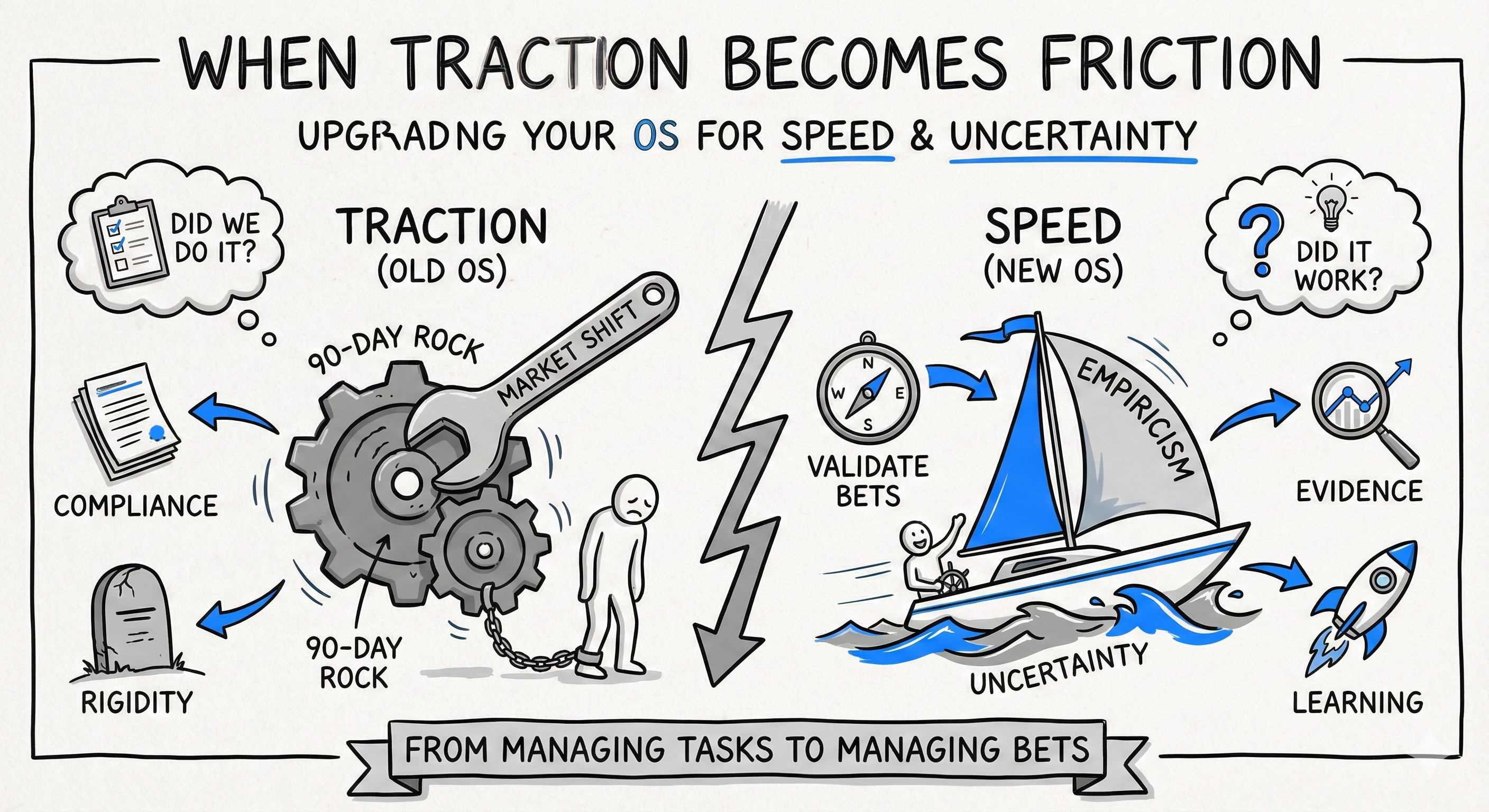
This is one reason I keep thinking about EOS and similar business operating systems.
EOS is great at bringing discipline and structure when a founder is stretched too thin. Same for other operating systems and management frameworks. They can dramatically improve alignment, accountability, and traction.
But more and more leadership teams I talk to are asking a deeper question:
Where’s the entrepreneurial in the operating system?
Is the system helping us seek organizational alpha?
Is it helping us navigate hard shifts that require cross-functional collaboration, fast feedback loops, and evidence-informed steering?
Or is it mostly helping us track commitments and run cleaner meetings?
The leadership team of a brewery collective I’m working with is wrestling with exactly this. They’re leveraging techniques and mindsets from the product/agility world to scale entrepreneurship across the organization.
What seems to matter most is not adding more project management.
It is replacing project management with:
- outcome orientation
- evidence-informed efficient experimentation
- faster cycles
- cross-functional collaboration around real bets
That’s the entrepreneurial upgrade.
You can see a similar shift right now with AI vibe coding.
It doesn’t guarantee a good business idea. What it does is make it much cheaper to test one.
That changes the game. It makes bootstrapping viable in places where previously you’d need a bigger budget, a bigger team, or more investor patience just to get to first evidence.
Agility plays a similar role inside organizations.
It doesn’t guarantee insight.
It doesn’t guarantee product-market fit.
It doesn’t guarantee strategic judgment.
What it can do is reduce the cost of finding out whether you’re onto something.
And when you can do that repeatedly, cross-functionally, and without excessive friction, you’re in a much better position to create real alpha.
So when I say agility is about efficiently seeking alpha, I don’t mean “go faster no matter what.”
I mean build an operating system that makes it cheaper and easier to:
- pursue promising bets
- inspect reality early
- adapt based on evidence
- stop protecting weak ideas just because they’re already on the plan
That’s a much more useful definition of agility than ceremonies, velocity, or whether teams are following the script.
That’s also where I think the next generation of operating systems is headed.
Not abandoning EOS, OKRs, or other systems.
Upgrading them with stronger outcome orientation, more empiricism, and better support for entrepreneurial search.
That’s the thought, anyway.
Curious whether this framing resonates with you.
Moving from agile theater to real business agility takes more than a framework — it takes a deliberate operating model shift. Explore Business Agility advisory or let’s talk.

About Yuval Yeret
Yuval is a rare practitioner who has shaped the agility path of dozens of organizations and influenced the frameworks used across the industry. He helps product and technology leaders move from agile theater to evidence-informed, outcome-oriented delivery that creates better value sooner, safer, and happier.