· Agility · 4 min read
In the Spotlight - Building and Operating Your Revenue Machine
A practical conversation on why strong sales and GTM leaders must run today's business while continuously improving the system that creates tomorrow's results.
 Click image to open full size
 Most revenue leaders I work with are not struggling with effort. They are struggling with leverage.
There is plenty of activity: pipeline reviews, enablement decks, tool rollouts, process updates. But for many organizations, the system keeps producing the same bottlenecks. Forecasts stay noisy. Hand-offs stay brittle. Adoption of “new and improved” ways of working fades after the first push.
That was the core topic in my recent conversation with Roi Carmel on In the Spotlight: if you want durable GTM performance, you need to do two jobs at once:
- Operate today’s revenue machine.
- Build the next version of the machine while you run it.
Why “rollout thinking” keeps failing in GTM
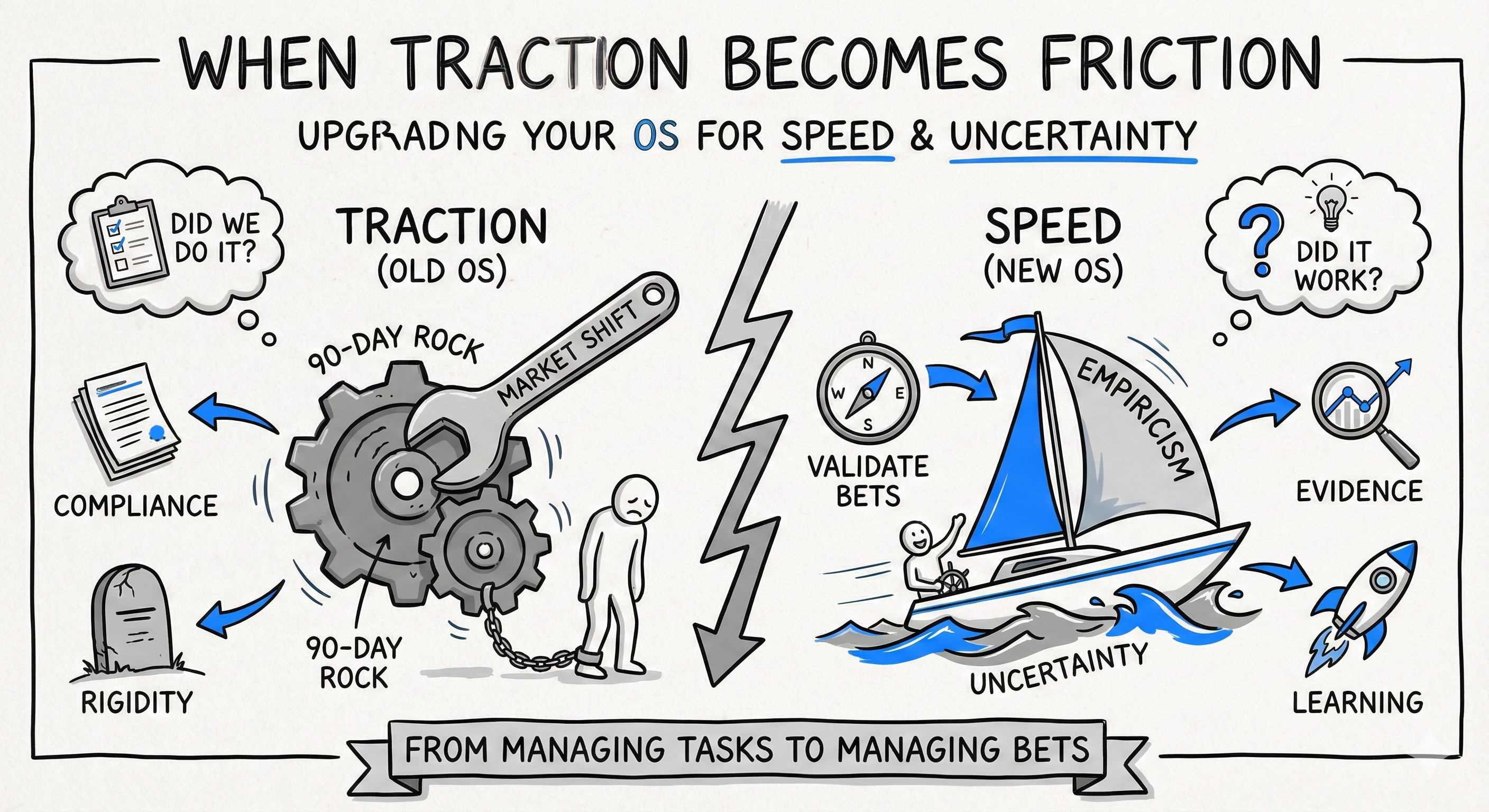
Many change initiatives fail quietly because they are designed as one-time deployments. New CRM workflow. New qualification framework. New operating cadence. Then leadership expects immediate adoption and measurable impact.
In reality, GTM systems are living systems. Buyer behavior shifts. Team composition changes. New channels appear. AI changes how teams work week to week. If the change model is static while the environment is dynamic, ROI will usually disappoint.
The pattern I see repeatedly is this: organizations treat operating model change as a project to complete, not a capability to cultivate.
Key Insights
“In parallel to building the product, you need to build the organization that is building the product.”
For revenue teams, that means building better decision loops, better cross-functional coordination, and better adaptation habits, not only better plans.
“People don’t really like being inflicted change upon. They like to be part of the process.”
Adoption is not communication. Adoption is co-creation. Teams are far more likely to sustain behavior change when they help shape it.
“If people fail, then that’s a failure of the system.”
When execution is inconsistent, start with system design before blaming individuals. Usually there is a policy, interface, incentive, or workload issue hiding under the symptoms.
A practical operating approach
If you lead sales, marketing, RevOps, or product marketing, here is a pragmatic pattern:
- Pick one business-critical outcome (for example: forecast reliability, win-rate in a segment, or cycle-time to qualified pipeline).
- Map the current system that produces this outcome across functions.
- Run small experiments in the operating model, not just in messaging or tactics.
- Review both business outcomes and adoption signals.
- Keep what works, adapt what does not, and repeat.
This is the same logic strong product teams use: short cycles, evidence over opinions, and continuous learning in context.
Watch the full conversation here: In the Spotlight - with Yuval Yeret
Keep exploring in the insights library
If this topic resonates, these pieces go deeper:
A few other questions that often come up in conversations about applying continuous learning/adaptation to the revenue/GTM machine
Is this mainly relevant for large enterprises?
Not necessarily. The pattern appears in scaleups, mid-market firms, and enterprise contexts. The size changes; the operating-system dynamics are similar. At the extreme, even soloists like me have to run the revenue machine in parallel to evolving it.
Should RevOps lead this alone?
RevOps is central, but not sufficient alone. Durable change needs shared ownership across sales leadership, marketing, product marketing, and supporting functions. That’s one of the key insights - change participants need to feel and show up as players, not pawns, if you want the change to stick and to really serve the needs of the organization.
How fast should we expect results?
Well, this is an interesting one. On one hand participatory evolutionary change might seem slower because you have to involve more people, and plan for iteration rather than one big bang. On the other hand, the right plan could leverage this iterative incremental nature to show quick progress and value along the way. Ideally you can front load value, seeing much faster results, and even trim the tail - skipping some aspects of the change that you initially planned for but are realizing aren’t needed after trying some things out.
Moving from agile theater to real business agility takes more than a framework — it takes a deliberate operating model shift. Explore Business Agility advisory or let’s talk.

About Yuval Yeret
Yuval is a rare practitioner who has shaped the agility path of dozens of organizations and influenced the frameworks used across the industry. He helps product and technology leaders move from agile theater to evidence-informed, outcome-oriented delivery that creates better value sooner, safer, and happier.