· Developing Your Company Like a Product · 4 min read
Think It Build It Ship It Tweak It - a Business Fable
A practical fable for running business initiatives as evidence-based bets using a right-to-left Think/Build/Ship/Tweak flow.
 Click image to open full size
FlowImpact Yoga is a rising power in the fitness industry. A PE firm has just purchased it, and its leadership is hard at work, making the best of the holding period to grow and improve the business.
There are many ideas on the table. The leadership team realized that 1. They need to focus, and 2. Many of these ideas are business bets they would do well to validate/learn from.
Jim, the CPO, recalls a mode he read about once in an article about how Spotify Builds Products. It talks about “Think it, Build it, Ship it, and Tweak it.” He suggests to the COO, Ella, that they use it to start managing their business initiative portfolio. This model works for any business initiative portfolio, not just software product teams, as long as leaders can define hypotheses and explicit signals.
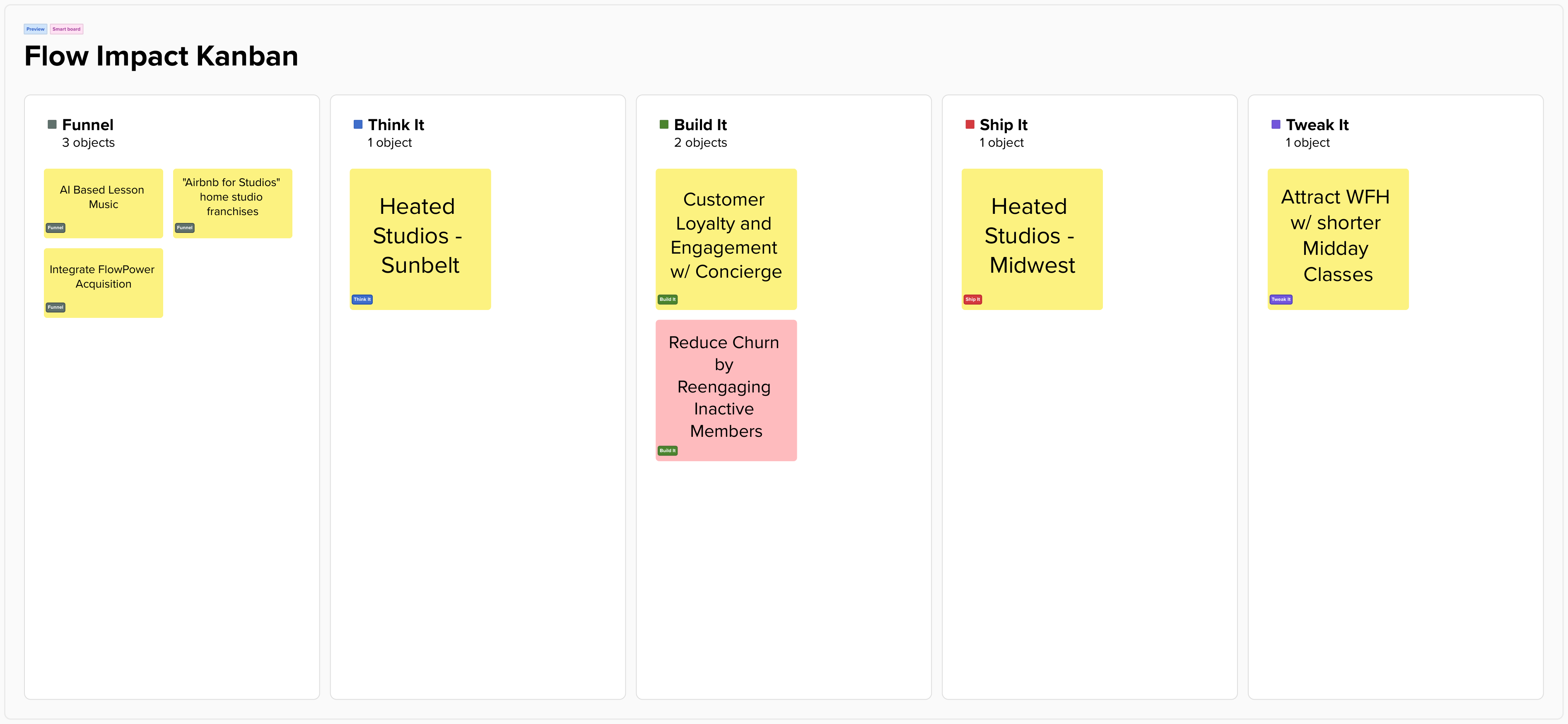
They set up a high-level Kanban board in their management tool, plugging in all of the inflight initiatives and categorizing them according to their current state. There’s too much in the “Build It” category, which is worrying but unsurprising. They decide to stop starting new initiatives until the queue clears up.
In their leadership meetings, they walk this Kanban board right to left. Ella suggested this based on her experience in Lean. Walking the board right to left forces learning-first decisions and reduces the temptation to keep starting new initiatives.
They start from ideas in “Tweak It” to see if they’re ready to move on to “business as usual.” Have we achieved our outcome hypothesis? What can we learn from the metrics? Are we still moving the needle, or are we seeing diminishing returns? Is this still the business constraint?
The new shorter midday class schedule aimed at the WFH crowd seems to be proven and well-tuned and ready to become part of SOP.
Then, they talk about business initiatives in the process of “Ship It.” The heated yoga studios are being deployed throughout studios in the Midwest. Ella asked the leader for this initiative some questions about the learning curve of deploying the heated studios and whether the classes in ready studios are filling up according to expectations. They are acting like a mini-founder—excited about this bet, learning and adjusting along the way.
They then discuss the initiatives in “Build It.” They discuss outcome-oriented leading indicators from the “concierge” experiment in the Boston studio. Enough evidence warrants “Shipping” this service across the network.
Jim is worried that the “inactivity-based churn call from the studio head” feature doesn’t seem like its moving the needle. Because churn is a crucial metric they ask the team to continue to experiment. The biggest mistake at this stage is treating the categories as labels rather than decision gates. Each stage should include evidence checks and capacity discipline.
Then they get to the bets in “Think it.” They look at the initiative to run a Yoga for Winter Sports class. What is the insight? What is the satisfaction gap this idea is aiming at? Ella, Jim and the rest of the leadership team review the body of evidence and decide that while the idea is interesting, there’s too much going on right now.
Every month, the leadership team gets together and reviews their portfolio of business bets. Some of these are digital-heavy. Some have no digital aspect in sight. That doesn’t matter—because they are all business bets that benefit from outcome-oriented, evidence-informed decision making.
Ella and Jim are invited to the PE firm Portco Summit to present how they’ve applied a Product Operating Model to the business. While fewer business initiatives are in motion, more initiatives impact the metrics that matter, and the business has improved traction overall.
Dare we say there’s more Flow and more Impact?
If you want to apply this operating rhythm in a real portfolio context, explore Portfolio Agility Advisory or Strategic Alignment with OKRs.

About Yuval Yeret
Yuval is a rare practitioner who has shaped the agility path of dozens of organizations and influenced the frameworks used across the industry. He helps product and technology leaders move from agile theater to evidence-informed, outcome-oriented delivery that creates better value sooner, safer, and happier.