Spotify Squad Health Check Beyond the Squad
using the spotify squad health check beyond the squadPractical ways to run the Spotify Squad Health Check at leadership, tribe, and cross-team levels, including facilitation patterns for larger groups.
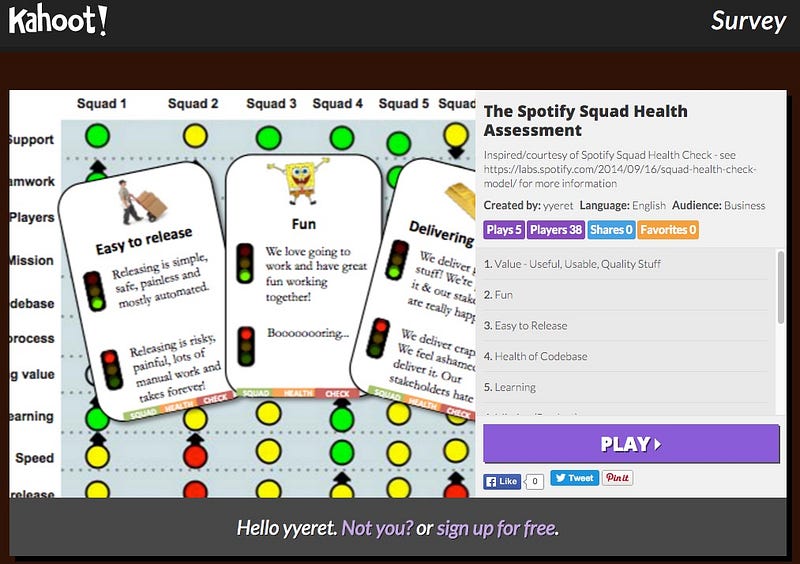 Click image to open full size
 I’m on my way from Boston to Manhattan. Tomorrow I’m facilitating an executive workshop for a client with the goal of kicking off the next level of agility. Before that I’m meeting some of the Spotify Agile Coaches in NYC. I thought this would be a good opportunity to write about a Spotify Squad-level tool I started using in Executive/Management workshops as well as all-hands sessions.
What is the Spotify Squad Health Check model?

I’m talking about the Spotify Squad Health Check model that Henrik Kniberg blogged about in 2014. I loved this model the moment I saw it. For years now I’ve been trying to go beyond practice-level assessments like the Scrum Checklist.
One problem with checklists is that it is hard for teams using different practices (e.g., from Kanban) to connect to them. Another is that practices can be “faked” by the team as part of an “Agile Theater.” The Spotify Squad Health Check is simpler, cooler, and resonates better with both teams and leaders. Crucially, it focuses on team health dimensions that apply in most environments, even if your structure is not squad/tribe based.
How do you use the Squad Health Check beyond individual teams?
Since much of my work is at the group/enterprise level across several teams, my first opportunities to try the model were for different usage than that documented by Spotify. A practical cadence is every 6 to 12 weeks, or at key change points, so you can compare trends and inspect progress over time.
- Plan/Initiate Phase: When trying to help a group of leaders understand the pains in their organization. I found it makes sense to ask them to predict how their people would answer. This can be used to establish the right language for goals (e.g., “we want to become awesome at Learning”).
- Kickoff: When training a group of teams in agile (inspired by the SAFe™ QuickStart), run the health check with all of them to establish pains and language.
- Steering the Initiative, With the steering forum. One obvious option is to look for common trends across teams that should pull the attention of leaders.
- Implementation Summaries: The health check can be a good way to summarize where you are. Using the “Open Space Agility” spirit, you can use the health check as pre-amble to an open space discussing “What’s next on the journey to improve the health of how we work?”
How do you run the Spotify Squad Health Check at scale?
When we decided to run the health check with a group of 50 people, we experimented with using Kahoot. Peter Ungaro created a Kahoot Survey from it.
The cool thing about Kahoot is that it feels like a “game show.” It is easy to participate on a mobile phone without installing anything, and the timer countdown helps maintain rhythm. I only ran it with everyone in the same room so far, but I think it can do a reasonable job for a distributed group as well.
The survey is available for free use. Experiment with it, add your own questions, and see if it helps move from health-check theater to concrete improvement. The biggest mistake when using the health check at scale is treating it as a one-off scorecard. The real value comes from follow-up conversations, concrete actions, and re-checking whether the system improved.
If you want to move from health-check theater to concrete improvement, explore Fixing Your Agility or Professional Scrum and Kanban support.
Practical thinking on turning AI pilots, adoption, and portfolio work into business impact - by finding the constraint, changing the work, and proving value as you go.
Yuval Yeret helps product and tech leaders move from agile theater to evidence-informed delivery. Work with Yuval →