Organizing Around Product Outcomes: Why, When, and How
when and why do we need a product operating modelWhy scaling slows delivery down and how to flip the inverted coordination pyramid to organize around real product outcomes in the age of AI.
The Illusion of the Engineering Bottleneck
You found product-market fit. You scaled by hiring strong product managers and the best engineers you could find. You adopted agile ways of working. Yet shipping a simple change today takes quarters instead of days.
The standard diagnosis from leadership is predictable: “Engineering is our bottleneck. If we just make coding faster, we will deliver faster.”
Today, that instinct has taken on a new shape. Organizations look at AI coding agents, vibe-coding, and “10x tiny pods” and assume they can bypass the entire delivery problem. The dream is tempting: give an engineer an AI agent, have them generate features in hours, and cut through the organizational bloat.
It does not work. When an enterprise accelerates code generation without fixing its operating model, delivery does not accelerate. It stalls harder.
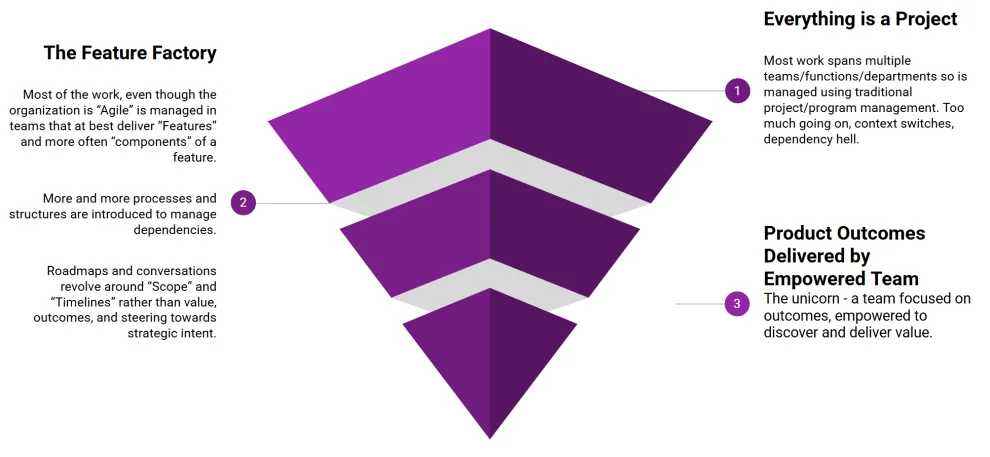
The bottleneck in modern product organizations was rarely the speed of typing code. The bottleneck is the coordination tax between teams, shared data architectures, regulatory gates, and handoffs. If your organization requires 4 portfolios, 8 value chains, and 16 pods to align before a single customer epic can ship, 10x-ing code generation just produces more unintegrated PRs and longer dependency queues.
You do not get agility. You just get torture faster.
Why Do Product Organizations Stall?
The lifecycle of an unmanaged product organization follows a familiar decay curve:
- Early Days: One team, minimal dependencies, clear customer proximity. You test ideas directly with users and ship value in days.
- Growth Phase: Demand grows, teams specialize into functional silos (UI, backend, data, clearing, compliance), and alignment starts requiring coordination meetings.
- Scaling Chaos: Sprawling cross-team dependencies dominate the calendar. A single business outcome requires choreography across half the org chart.
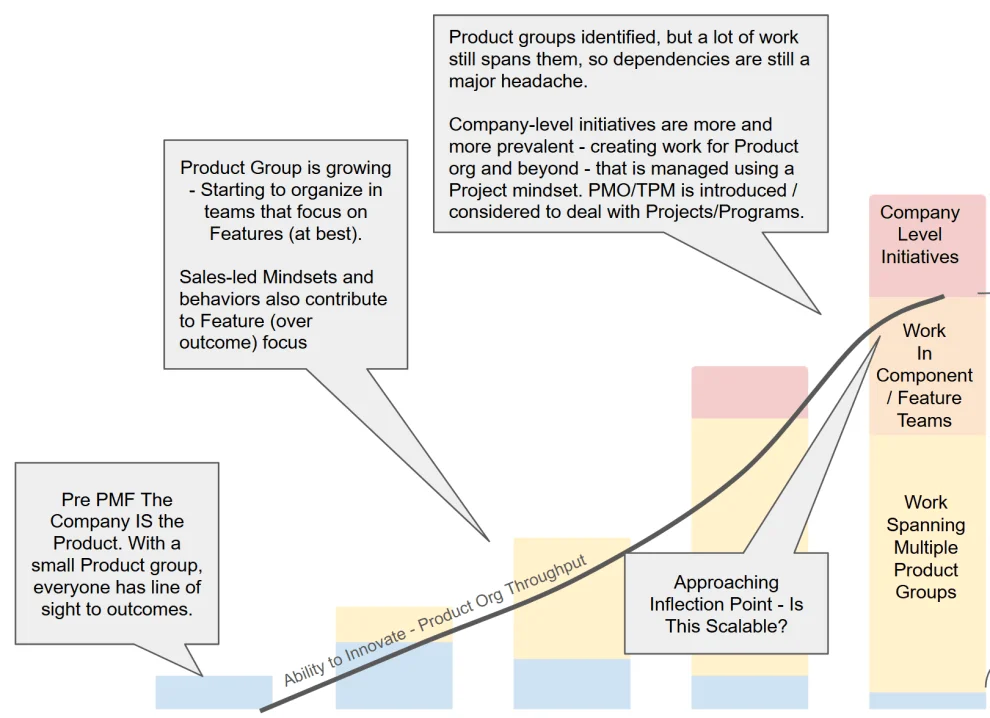
When this happens, the organization becomes inverted. Only a tiny fraction of team capacity actually delivers customer value. The rest is consumed by coordination tax: alignment syncs, dependency mapping, backlog grooming across siloed teams, and waiting on shared services.
Flipping the Pyramid: From Managing Dependencies to Eliminating Them
A Product Operating Model is not a cosmetic reorganization. It is a fundamental shift in how work, ownership, and architecture are structured to restore flow:
- Empowered Stream-Aligned Teams (The Foundation): Cross-functional teams that own customer outcomes end-to-end with minimal external dependencies.
- Product Groups: Focused groupings where multiple teams share a common mission and can resolve trade-offs locally without escalating up the management chain.
- Strategic Initiatives (The Capstone): A small, strictly limited portfolio of cross-cutting business bets managed with flow principles and evidence-based governance.
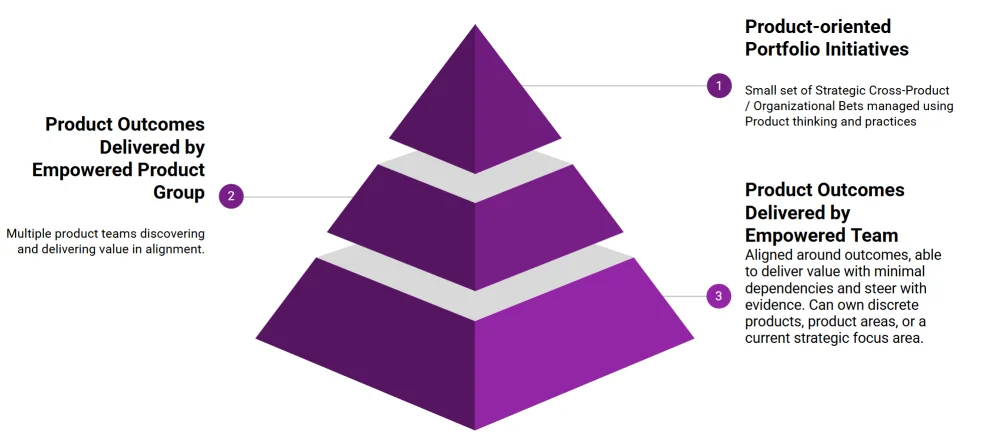
(This flipped pyramid mirrors the Test Automation Pyramid: push the bulk of your capability down to fast, autonomous units so the high-coordination apex stays small.)
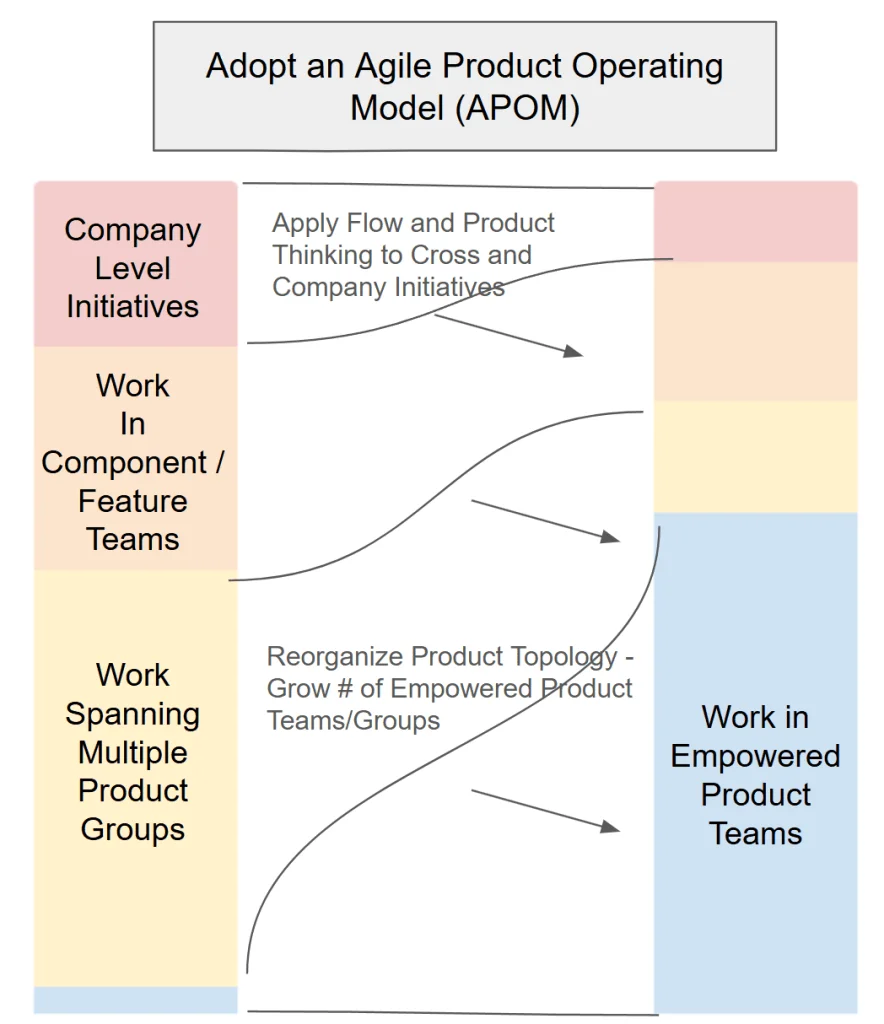
Note: The visual above is inspired by John Cutler’s work on Work Shape Mix.
The AI Multiplier: From Defending Capacity to “Unreasonable Agility”
In traditional enterprise setups, the Product Operating Model was largely defensive: its purpose was to protect scarce engineering capacity from being squandered on low-value requests, shifting priorities, and thrash.
When you bring AI into a healthy Product Operating Model, that posture flips from defense to offense.
If a stream-aligned team can use AI to build a working prototype in a day rather than six weeks, you unlock what Will Guidara calls unreasonable hospitality, translated to software: unreasonable agility. When a customer mentions a friction point over dinner, you can put a working, testable solution in front of them the next day.
But that only happens if the team does not have to wait on three other departments to approve the database schema, update the reference data, and clear compliance.
Traditional Inverted Model + AI:
[Tiny Pod + AI] --> [Blocked on RefData] --> [Blocked on Compliance] --> [Integration Hell in Staging]
(Result: Vanity velocity, zero customer impact)

Flipped Product Operating Model + AI:
[Stream-Aligned Pod] --> [Context / Platform as a Service] --> [Shipped Outcome & Rapid Validation]
(Result: Unreasonable agility)
Context as a Platform
How do stream-aligned pods operate autonomously without breaking enterprise architecture or regulatory compliance?
In Team Topologies terms, complicated subsystem teams (such as reference data, trading engine core, or regulatory compliance) must stop acting as gatekeepers and start acting as internal platforms.
In an AI-native operating model, Context becomes the Platform. Instead of scheduling a meeting with a reference data architect or waiting on legal:
- Enterprise architecture, compliance rules, and domain constraints are codified into discoverable skills, test suites, and context repositories.
- AI agents executing within the pod consume these context rules directly during planning and implementation.
- Code reviews shift from rubber-stamping syntax to validating boundary contracts and architectural invariants.
Where the Bottleneck Actually Moves
When you eliminate coordination tax and leverage AI execution, the constraint in your system shifts rapidly:
- From Coding to Upstream Problem Selection: When building is cheap, the cost of generating features drops to near zero. But building the wrong thing faster is worthless. The bottleneck moves to problem discovery: identifying the expensive customer problem and formulating crisp outcome hypotheses.
- From Deployment to Downstream Validation: “Working software” is no longer the finish line. The question is whether it is useful, used software. Can you validate behavioral change and customer impact in days rather than waiting quarters for an annual business review?
- From Output Metrics to Flow Metrics: If you evaluate teams on PR counts or story points completed, AI will give you an explosion of output theater. Measure end-to-end flow time for real customer outcomes, flow efficiency, and cycle time from hypothesis to verified impact.
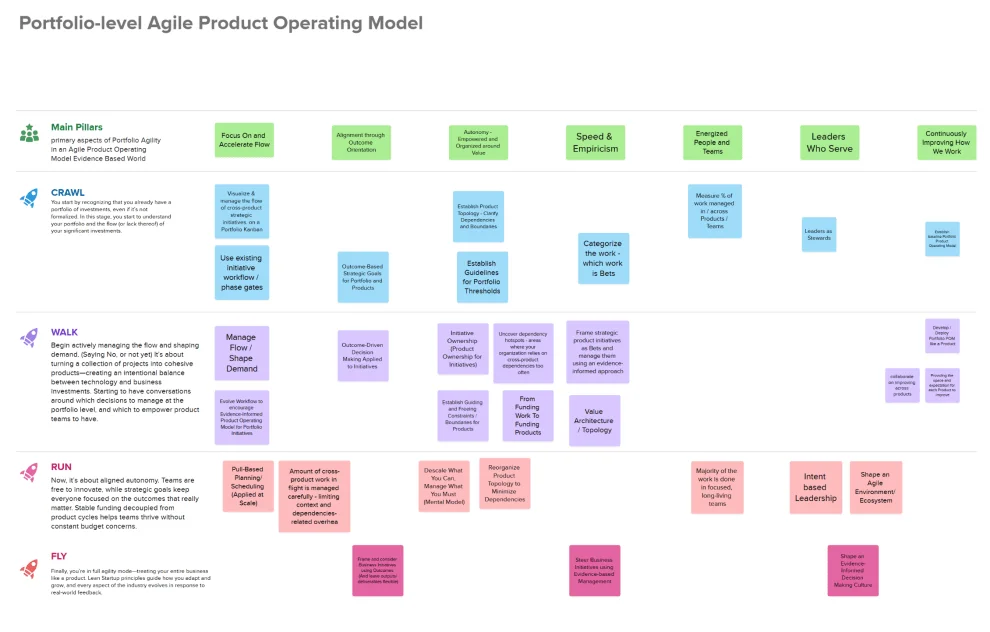
Impact Corner
The Operating Model Shift: Defending Capacity vs Unreasonable Agility
| Dimension | Traditional Scaling (Inverted Pyramid) | AI-Enabled Product Operating Model |
|---|---|---|
| Primary Bottleneck | Perceived as engineering coding speed; actually cross-team coordination tax. | Upstream problem selection and downstream customer outcome validation. |
| Team Structure | Functional/layered pods with high dependency on shared specialist queues. | Stream-aligned pods empowered by internal platforms and codified context. |
| Role of Subsystems | Gatekeepers requiring manual sync meetings and ticket handoffs. | Platforms providing self-service APIs, automated guardrails, and context rules. |
| Velocity Focus | Output volume (PRs merged, story points completed, feature checklists). | Outcome flow (lead time from customer problem to validated behavioral change). |
Prompt for Auditing Cross-Team Coordination Tax
Evaluate our current product organization structure against the Flipped Pyramid and Team Topologies models.

Given our team structure and recent epic delivery history:
1. Identify a recent major initiative and map the full dependency chain: how many portfolios, value streams, and distinct pods had to coordinate to ship it?
2. Calculate the ratio between active creation time and waiting/coordination time (flow efficiency).
3. Identify the shared subsystem or compliance gate that created the longest wait state.
4. Define how that shared capability could be converted into a self-service platform or codified context repository to enable stream-aligned autonomy.
Get the Free Audio Series
I created a short, no-fluff audio series to help product and technology leaders get clarity on the path from an agile theater feature factory to becoming an empowered, outcome-oriented, and scalable product organization.
Listen to the episode
This came out of an episode of Scaling AI: From Activity to Impact.
Listen on the episode page or directly on Spotify.
If you want to operationalize this, see my Product Operating Model Playbook or explore Strategic Agility advisory.
A free audio series navigating the product operating model landscape: for leaders building modern product-oriented technology organizations.
Yuval Yeret helps product and tech leaders move from agile theater to evidence-informed delivery. Work with Yuval →
- 01 The Value Of The Feature Factory 2 min
- 02 Reviews in a Product Operating Model 1 min
- 03 Managing a Product Transformation like a Project 2 min