Your AI Portfolio Needs Less WIP, Not More Ideas
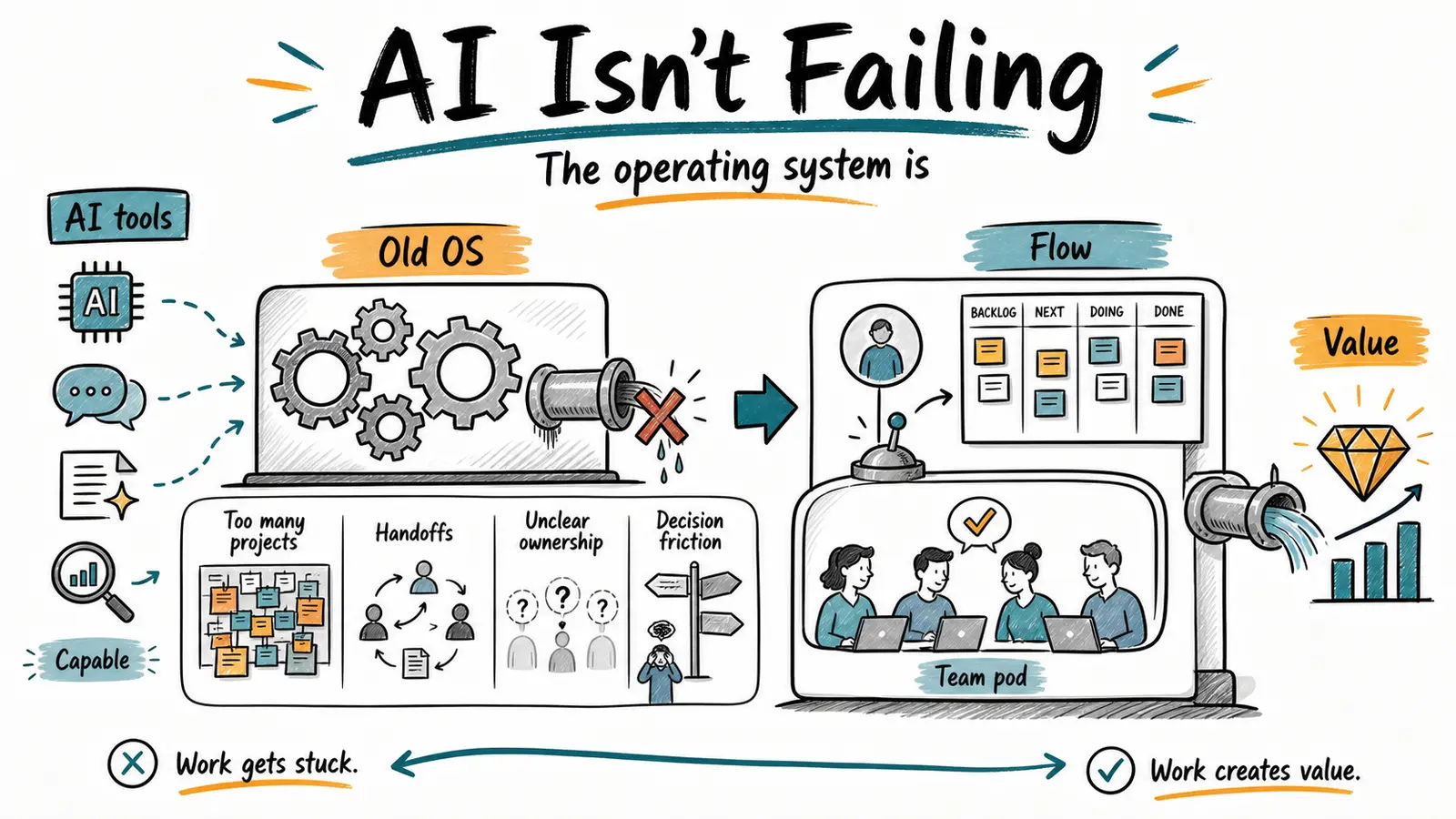
Most AI portfolios suffer from the same disease: too many pilots, too many ideas, not enough kill criteria. Portfolio flow beats AI idea theater.
I have yet to see an under-idea’d AI portfolio.
That is not the problem.
The usual problem is the opposite:
- too many ideas
- too many pilots
- too much executive enthusiasm
- too little focus
- too few kill decisions
Everyone has an AI use case. Every function has a wishlist. Every vendor has a deck.
So the portfolio fills up fast.
And then leaders say:
“We need a process to evaluate more opportunities.”
Maybe.
But what most AI portfolios need first is less work in progress.
Busy is not the same as strategic
A busy AI portfolio can look impressive:
- innovation council
- steering committee
- pilot pipeline
- use case intake form
- prioritization workshop
There is usually a lot to report.
But when you look closer:
- pilots linger
- nobody kills anything
- teams get spread thin
- dependencies pile up
- governance gets heavier
- the same people are dragged into every bet
That is not strategic focus.
That is portfolio theater.
Why AI portfolios are especially vulnerable
AI makes this worse because the cost of saying “yes” feels low at first.
Maybe the model is cheap enough to test. Maybe a vendor demo makes it look easy. Maybe the first prototype comes together fast.
So leaders say yes to more things.
But meaningful AI bets are rarely cheap for long.
They bring:
- data work
- security review
- workflow redesign
- adoption effort
- model monitoring
- maintenance
- exceptions
- risk decisions
That is why a bloated AI portfolio becomes expensive in a hurry.
Not just in dollars. In leadership attention and organizational drag.
What a healthier AI portfolio looks like
A healthier portfolio is not the one with the best intake form.
It is the one that can make hard decisions.
That means:
1. Small number of active cross-company bets
Do not run fifteen strategic AI efforts at once.
Pick the few that matter enough to deserve real focus.
2. Explicit leading indicators
Before funding the bet, ask:
- what should move first?
- what would tell us this is promising?
- what would tell us to stop?
If nobody can answer, the bet is not ready.
3. Right-to-left review
Do not spend all your time discussing the shiny stuff entering the funnel.
Start with the work closest to impact:
- what is stuck near rollout?
- what is blocked on adoption?
- what is waiting on a decision?
- what should be killed because the signal is weak?
That is where portfolio leadership actually matters.
4. Real invest / maintain / retire calls
Most portfolios are good at adding. They are bad at subtracting.
AI portfolios need:
- invest
- continue carefully
- narrow the scope
- pause
- retire
Without retire decisions, the portfolio becomes a museum of executive hopes.
The conversation leaders should be having
Here are better questions than “what other AI ideas do we have?”
Ask:
- Which AI bets are closest to meaningful impact?
- Which ones are blocked, and why?
- Which ones are consuming attention without enough signal?
- Which bottlenecks keep showing up across multiple bets?
- What should we stop so the serious work can breathe?
Those are portfolio questions.
And they are usually more valuable than another brainstorm.
One awkward truth
Some AI portfolios are overloaded because leaders are still shopping for certainty.
If we run enough pilots, surely one will prove the answer.
But portfolio sprawl usually does the opposite.
It reduces learning.
Why?
Because every extra active bet adds:
- coordination
- switching costs
- review overhead
- dependency load
- diluted ownership
So instead of learning faster, the organization learns slower.
A practical first step
Pull up your current AI portfolio and sort the work into three groups:
- real strategic bets
- local experiments
- theater
The theater bucket is not evil.
It is just the work that sounds exciting but has weak ownership, weak signal, or weak connection to an important business constraint.
Once you do that, ask:
What would happen if we cut active strategic AI work by a third?
In many organizations, the answer is:
The remaining work would finally have a chance.
This is not anti-experimentation
I am not arguing for caution theater.
Run experiments. Try things. Stay curious.
But do that in a way the organization can absorb.
The portfolio should create focus for learning, not traffic.
If you want the broader portfolio version of this conversation, see Actively Managing Portfolio Flow and Visualizing Portfolio Flow (Or Lack Thereof).
If your AI portfolio feels energetic but strangely unproductive, the answer might not be better ideation.
It might be less WIP.
Practical thinking on turning AI pilots, adoption, and portfolio work into business impact - by finding the constraint, changing the work, and proving value as you go.
Yuval Yeret helps product and tech leaders move from agile theater to evidence-informed delivery. Work with Yuval →
- 01 Actively Managing Portfolio Flow 2 min
- 02 Visualizing Portfolio Flow (Or Lack Thereof) 3 min
- 03 AI Isn’t Failing — Our Operating Systems Are 12 min