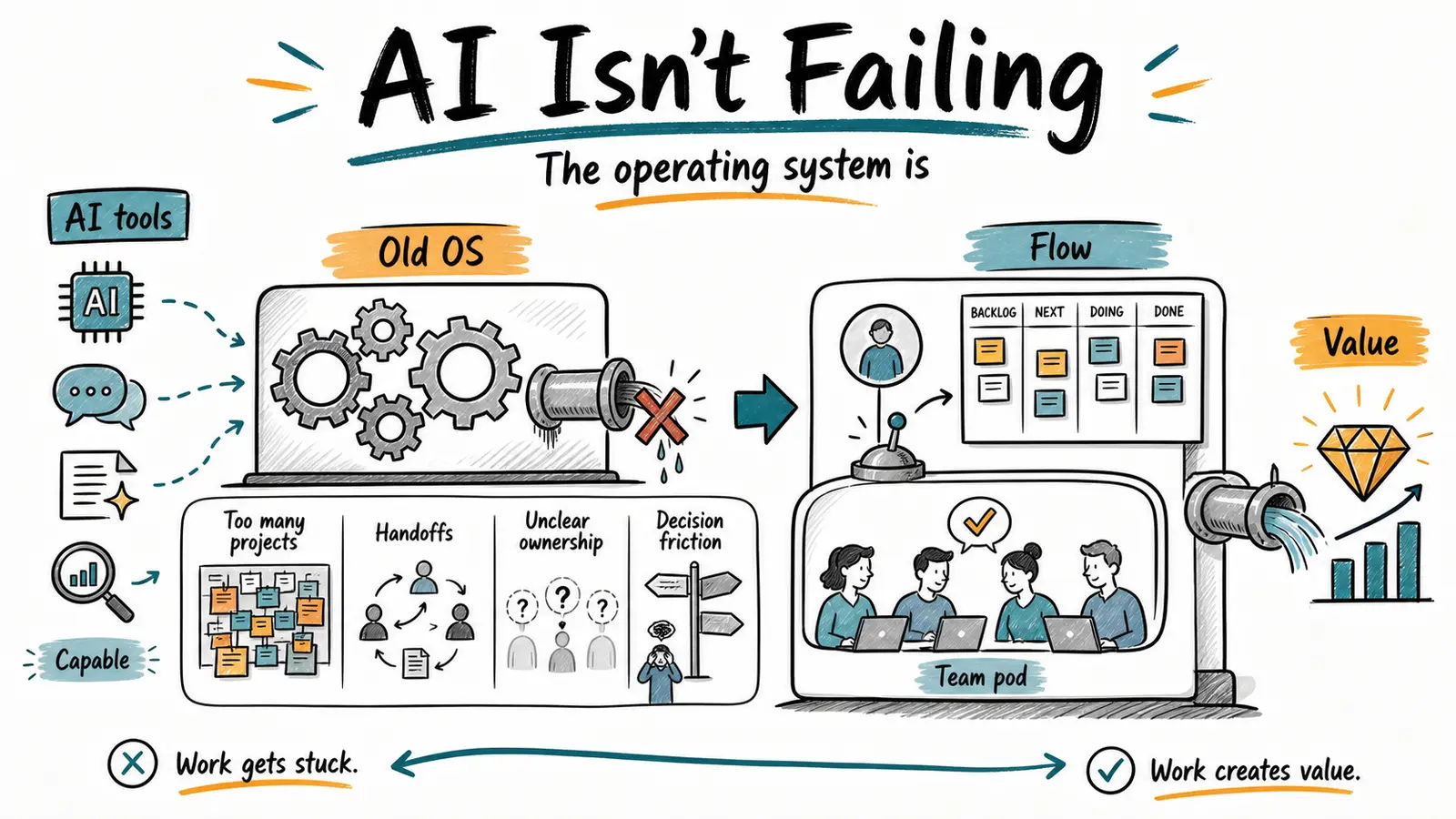
Find The Business Problem Before The AI Agent
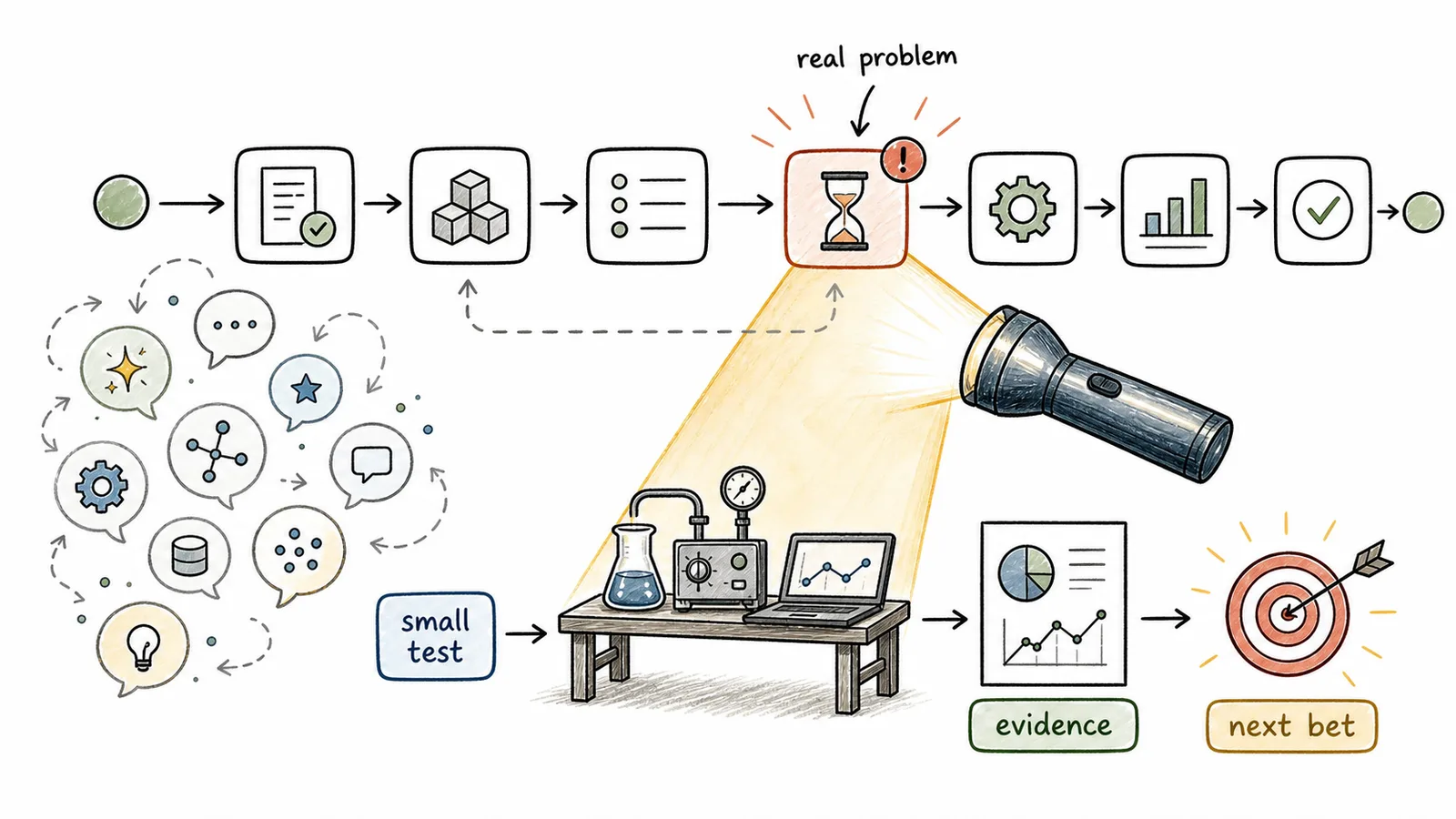
before you build the ai agent find the real business problemAI work pays off when it starts from a real business constraint, not a tool wishlist. Run a small test and check the problem is worth solving.
 Click image to open full size
 Start With The Real Constraint, Not The AI Idea
Most AI conversations jump too quickly from “AI can do something here” to “let’s build the bot.” That is how organizations end up with expensive pilots, clever demos, and very little business impact. A better starting point is the real business constraint: where value is currently stuck, which behavior needs to change, and what would count as evidence that AI helped.
The practical move is simple. Treat the AI effort as a bet that needs evidence, not as a technology project that deserves funding just because AI is involved. Pick the outcome, identify the riskiest assumption, and run the smallest useful test before you build the full workflow, agent, or integration. AI might be part of the solution, but it is not the goal. The goal is a better business result with enough confidence to justify the next bet.
The AI Gold Rush Is Real, But The Gold Is Not Everywhere
There is clearly an AI gold rush happening. Some companies are making very real money building the hardware, platforms, and tools. Inside most organizations, though, the question is more uncomfortable: where is the gold for us? Where does AI actually improve the business, not just create another demo?
That question matters because a lot of AI work still starts from the tool. Leaders ask which platform to buy, which model to use, which data needs to be connected, or whether they should build an agent. Those are not bad questions, but they are not the first questions. The first question is what outcome needs to change.
If you start with the tool, almost everything looks like an opportunity. If you start with the business constraint, the conversation gets much sharper. You can ask where work is stuck, where customers are getting frustrated, where experts are overloaded, where decisions take too long, or where the organization keeps spending money without seeing enough movement.
Look At The Business Loop
One useful way to look for AI opportunities is to map the basic business loop: how people find you, become real prospects or customers, get value, stay, and send others your way. When that loop works well, the business gets easier to grow. When one part of it is stuck, improving another part may feel productive while doing very little for the business.
For example, if you do not have enough qualified opportunities, using AI to improve renewal conversations is probably not the first move. If you are bringing in plenty of customers but many leave quickly, using AI to generate more leads may only pour more water into a leaky bucket. If customers are happy but nobody refers you, the opportunity may be somewhere else again.
The point is not that every company has the same bottleneck. The point is that the AI conversation gets much better once you name what is actually limiting progress. “Where can we use AI?” creates a massive list. “Where is the business stuck?” creates a decision.
Strategy Means Choosing Where AI Will Help First
AI can be used almost anywhere, which is exactly why it needs focus. If everything is an AI opportunity, nothing is a strategic AI bet. You need to decide where AI will help first: sales, marketing, onboarding, support, delivery, internal operations, decision flow, talent, or some other part of the system.
That choice is not only about where AI is easiest to use. It is about where the business needs movement. In my own business, for example, keeping clients happy is not the current problem. If clients come in, they tend to stay happy and see value. The more interesting question is how to turn people who hear me on podcasts, watch videos, read articles, or visit the site into real conversations.
That focus changes the AI discussion. Instead of asking whether I can use AI for everything, I can ask whether it helps with a specific business result: understanding which conversations are worth following up with, preparing in a way that matches my style, or turning long-form content into useful starting points for the people trying to solve a real problem.
AI Is Not The Objective
One of the biggest traps is making AI the objective. “Use AI in sales.” “Launch an AI agent.” “Automate onboarding.” Those may be useful activities, but they are not the business result. The result might be a better close rate, shorter time to first value, fewer handoff delays, faster expert onboarding, better customer retention, or more qualified conversations.
Once the result is clear, AI becomes one possible way to get there. Maybe the answer uses AI. Maybe it uses AI plus a change in how the work is done. Maybe the first useful step does not use AI at all. That is fine. If AI is the means rather than the goal, you are free to learn your way toward the result instead of defending the tool.
This is especially important because AI makes it easy to create impressive activity. A demo can look convincing. A bot can answer questions. A workflow can appear magical in a controlled setting. None of that proves the work will change behavior, fit into the real workflow, or improve the business result you care about.
Ask What Could Make The Bet Fail
When leaders jump to building an AI capability, they often start with technical questions: can we connect the data, build the agent, make the model handle the task. Those are important, but not always the riskiest questions. Sometimes the bigger risk is whether people will want it, trust it, use it, or change their work because of it.
Imagine a fast-growing services business where the constraint is bringing the right people on board and getting them productive quickly. One bet might be that AI can help with recruiting. Another might be that AI can help new hires learn how the business works. Another might be that AI can help the existing team serve more clients without hiring as quickly.
Those are different bets, and they carry different risks. Before building the full thing, ask what would need to be true: whether clients trust AI in this kind of work, whether internal experts can explain their judgment well enough for AI to help, whether the data is there, and whether new hires would actually use the guidance once it existed. The sharpest version of the question is the one that decides everything, which assumption, if it turns out wrong, kills the idea?
Learn Before You Spend Too Much
Not every idea deserves the same level of testing. When something could create a lot of value but you are not sure it will work, slow down just enough to test it. When the value is just as high and the risk is low, go do it and measure. The low-value cases tend to sort themselves out: high risk for a small upside is usually a distraction, and small-and-easy is either a quick improvement or something that can wait.
This helps you avoid two common traps. One trap is endless analysis. The other is jumping into action just because the technology is exciting. You do not want to spend months debating. You also do not want to burn leadership attention, money, and trust on ideas that could have been ruled out cheaply.
The phrase I like here is “learn before you burn.” Every hour spent working on the business is expensive. Every AI pilot consumes attention. Every integration creates follow-on work. If confidence is low, buy learning first. Once confidence grows, then build more.
The First Version May Still Be Too Big
People often jump from idea to a working first version. In AI work, that might mean building a chatbot, connecting an agent to internal systems, or giving a team a new AI workflow. But even that first version can be too much if the real question is whether anyone wants the thing or whether the behavior change makes sense.
Sometimes you can learn with something much smaller. You can simulate the experience. You can have a person do the work manually for a few users. You can create a short demo, a one-page description, a lightweight prompt, or a rough workflow that gives people a taste of what the future capability might feel like.
For AI agents, I often think about this as “be the bot before you build the bot.” If you cannot create value manually with the same inputs and outputs, the agent is unlikely to save you. If people do not want the result when a human helps produce it, they probably will not want it because an agent produced it.
Build The Context Before You Build The Agent
Before building full agents, use cheaper and more controlled ways to learn. A well-shaped AI workspace, assistant, or prompt can teach you a lot. It forces you to decide what context the AI needs, what inputs matter, what output is actually useful, what decisions should stay with a human, and what good enough looks like.
I use this myself for sales coaching. I do not want generic hard-sell advice. I want help that understands my business, my style, the kind of advisory work I do, the problems I care about, and the sales coaches whose thinking resonates with me. That context makes a simple AI interaction much more useful than a generic “coach me on sales” request.
This is one of the hidden benefits of doing the work carefully. The notes, examples, decision rules, customer patterns, and business context you create while exploring the opportunity become useful later. They make future AI work better. The search for value creates the context that helps you find more value.
Watch The Talk
This article is the plain-language version of a LinkedIn Live / YouTube talk where I walked through how to find real AI value without jumping straight to tools and agents.
The Real Prize Is Better Business Impact
The real prize is not an AI agent, a better prompt, a cleaner demo, or a longer list of use cases. The prize is business impact. A constraint moves. A customer gets value sooner. A team learns faster. A leader makes a better decision. A costly delay shrinks.
That does not happen because an organization spreads AI everywhere. It happens when leaders aim AI at the right problem, treat the work as a bet that needs evidence, and build confidence before they scale it. That is how you find AI gold without mistaking every shiny rock for value.
AI is powerful. The leadership work is deciding where that power is worth aiming.
Practical thinking on turning AI pilots, adoption, and portfolio work into business impact - by finding the constraint, changing the work, and proving value as you go.
Yuval Yeret helps product and tech leaders move from agile theater to evidence-informed delivery. Work with Yuval →