Product Operating Model, or Just Stage-Gates?
is it a product operating model or is it stage gatesMany orgs claim a Product Operating Model but keep stage-gate thinking under the surface. How to tell the difference and what to do about it.
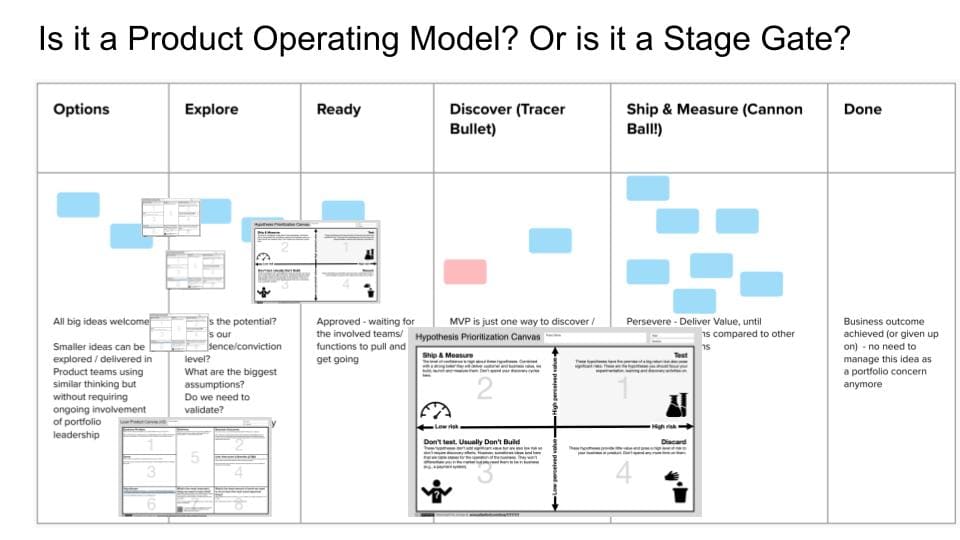 Click image to open full size
 Navigating the opportunity-rich environment of the AI age, when your company is considering dozens of “finding AI gold” initiatives, requires discipline and product-orientation.
I’m working with a PMO leader to develop a product-oriented portfolio management approach in an organization with deep roots in pharma, chemistry, and hardware development.
Meaning an ongoing clash between stage gates and agility/product-orientation.
I’m recalling an exercise we included in the Scrum.org Professional Scrum w/ Kanban. The “Is it Waterfall? Is it Kanban?” exercise is one of my favorites because it explores the folly of extreme views on this.
Being product-oriented and iterative doesn’t preclude the use of stage gates.
It precludes big-batch stage gates that lock in too much up front.
It actually benefits from the right sort of stage gates, those that focus on flushing out risks/leap-of-faith assumptions.
That enables, and even forces, explicit choice between discovery (tracer bullets) and delivery (cannon balls) depending on the risk profile.
Curious: how are you thinking about the role and evolution of stage gates in the AI age?
If you are navigating this tension right now, see Figure Out Your Product Operating Model Strategy and Portfolio Agility.
A free email course on building an agile portfolio operating model: from recognizing your portfolio to achieving true strategic flow.
Yuval Yeret helps product and tech leaders move from agile theater to evidence-informed delivery. Work with Yuval →