Can AI Really Speed Up Product Discovery?
can you really run product discovery experiments more effectively with aiAI tools promise to speed up product discovery, but do they? A close look at where AI actually helps, and where the bottleneck is still human judgment.
AI helps discovery most before you touch the real product
In yesterday’s post on how AI can really help you build better products, I said GenAI can make experimentation cheaper and faster. It can compress the truth curve by reducing the cost of pretotyping-style discovery work. That line hit a nerve with Elad, a product leader at a cybersecurity scaleup: “Not everyone can do this… New companies, sure. Larger, established companies are knee-deep in mountains of code, dependencies, and tech debt. Whenever you need to build an MVP that depends on your existing product, good luck…”
Elad is right. The jury is still out on how useful “vibe coding” and GenAI-generated code are inside large brownfield products with heavy dependencies. If the only meaningful experiment requires touching the real product, integrating with production systems, and navigating years of architectural decisions, AI may not be the thing that changes the economics much.
The opportunity I meant is earlier than that. GenAI can help product teams run more pre-MVP discovery experiments before they make the expensive move into real product code. Some of those experiments do not require coding at all: landing pages, fake doors, explainer videos, clickable prototypes, concierge workflows, mock sales material, or other pretotyping techniques that help test whether the problem and demand are real.
When enough confidence exists, vibe coding might help build a throwaway MVP meant to validate or invalidate a specific assumption. But if that MVP has to integrate deeply with the existing product, the team may be better off spending more time building conviction through lower-cost discovery first.
Greenfield product development is easier in some ways. Existing product teams have one huge advantage, though: they already have customers. They can talk to people with real problems, real workflows, real constraints, and real stakes. That should make the discovery side faster, even when the implementation side is harder.
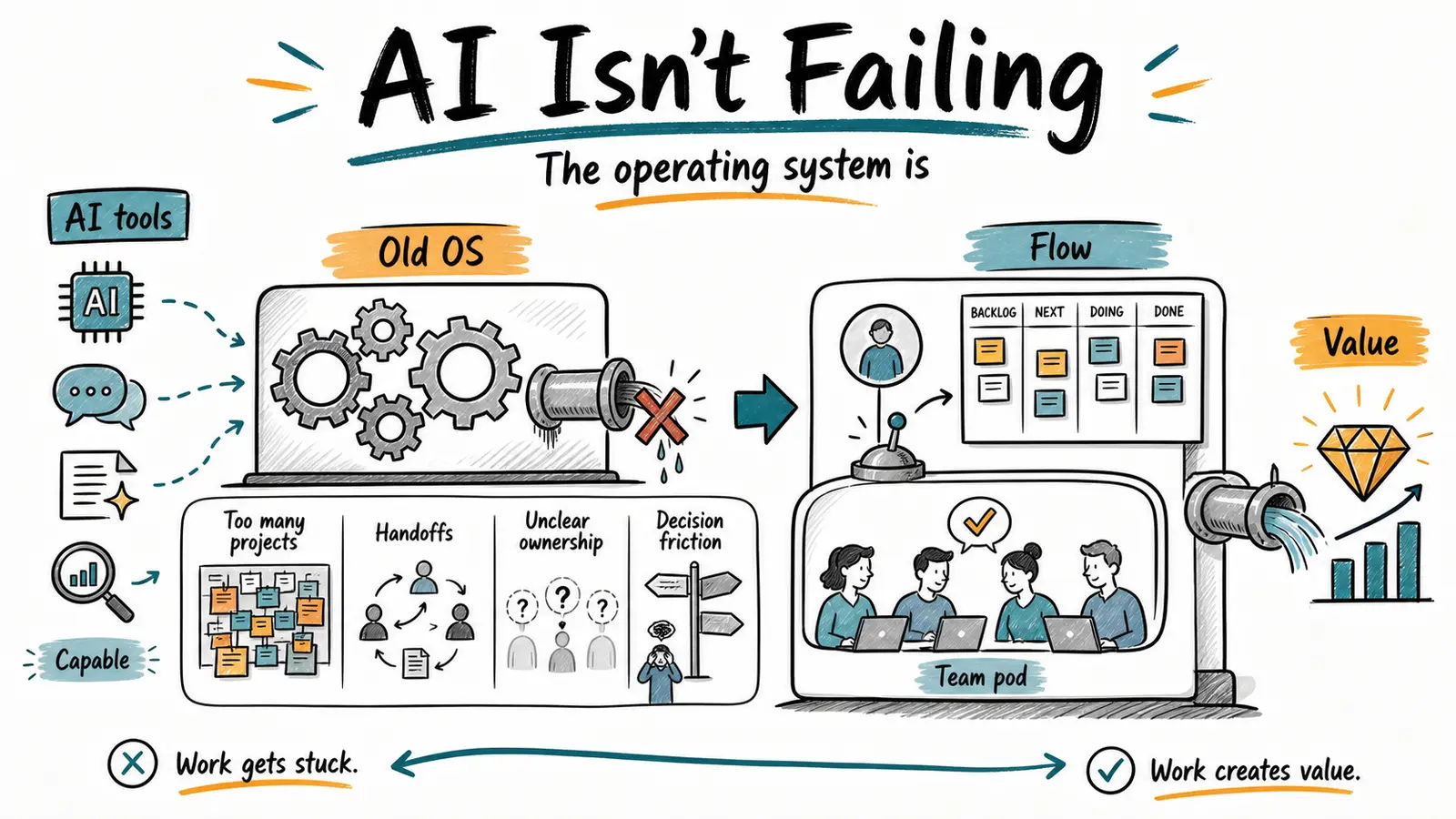
So yes, AI can help you run discovery experiments more effectively. Just be clear about which bottleneck you are trying to move. If the bottleneck is learning what customers will care about, AI can help. If the bottleneck is your existing architecture, dependencies, and release path, AI is probably not magic.
Practical thinking on turning AI pilots, adoption, and portfolio work into business impact - by finding the constraint, changing the work, and proving value as you go.
Yuval Yeret helps product and tech leaders move from agile theater to evidence-informed delivery. Work with Yuval →