How can AI REALLY help you build better products?
Practical patterns for using AI across the product development flywheel — from discovery and validation to faster build cycles and better feedback loops.
 Click image to open full size
 AI helps when it improves the product flywheel
I am still cautious about claims that GenAI and vibe coding will change mission-critical enterprise product development overnight. Brownfield code, architectural debt, security constraints, and release paths do not disappear because a model can generate code faster.
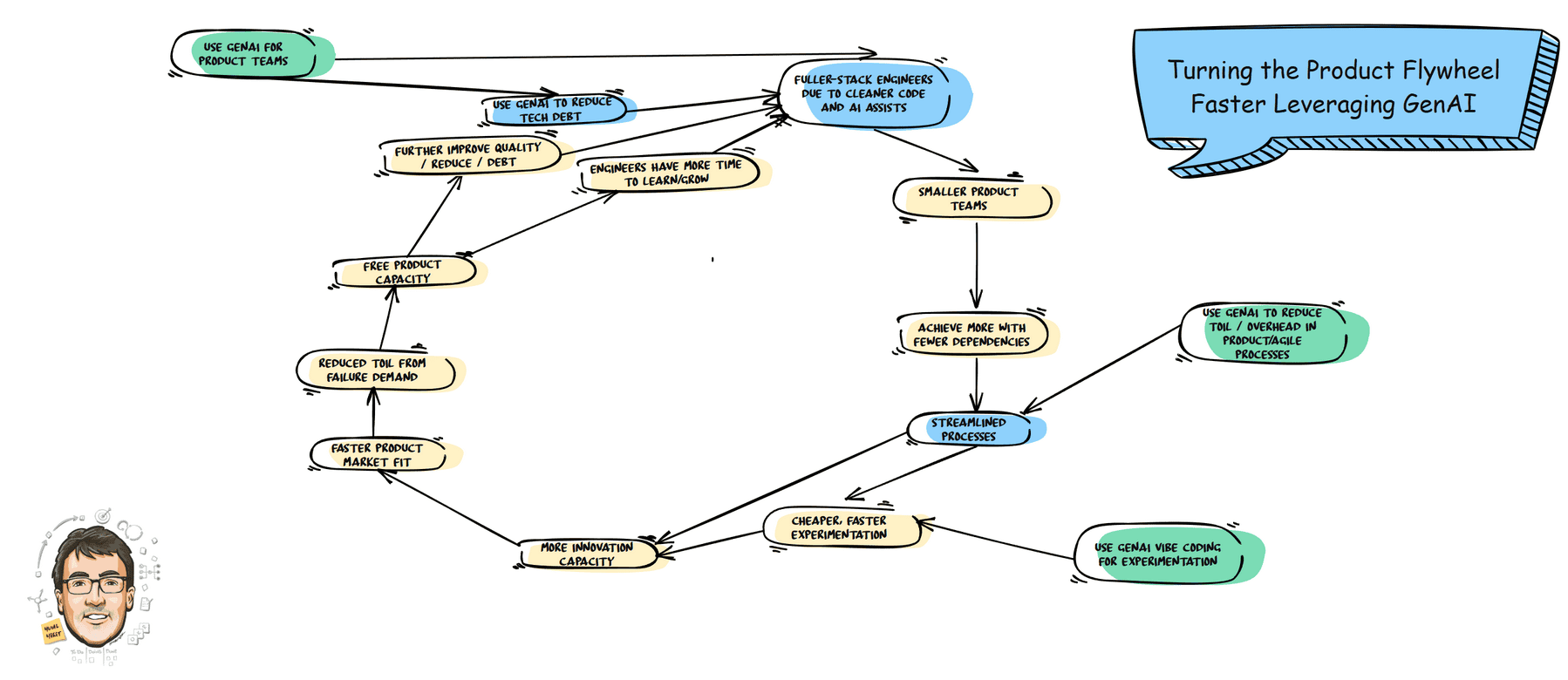
But AI can still help product organizations build better products if it improves the product flywheel instead of just producing more local activity. The useful question is not “where can we use AI?” It is “where can AI reduce friction between learning, building, shipping, and improving?”
One path is engineering lift. GenAI can help engineers work across a wider slice of the stack, understand unfamiliar code faster, clean up small pockets of tech debt, and reduce the effort required to make routine changes. That can make smaller, more outcome-oriented teams more realistic because fewer handoffs are needed to get useful work done.
Another path is discovery lift. AI can make early experiments cheaper: landing pages, fake doors, prototypes, explainer videos, interview synthesis, and other low-cost ways to test whether a problem or product idea is worth more investment. Cheaper experiments create more shots on goal for the same innovation capacity.
If those loops work, the product organization learns faster, reaches product-market or product-feature fit faster, and reduces the failure demand created by misunderstood products, bad fit, and avoidable rework. Some of the recovered capacity can then go back into discovery, customer understanding, architecture, and reducing the next constraint.
That is the promise worth paying attention to: not AI as another layer of theater, but AI as a way to make the product operating system simpler, faster, and more focused on outcomes.
Practical thinking on turning AI pilots, adoption, and portfolio work into business impact - by finding the constraint, changing the work, and proving value as you go.
Yuval Yeret helps product and tech leaders move from agile theater to evidence-informed delivery. Work with Yuval →