Managing a Product Transformation like a Project
the irony of managing a product transformation like a projectSelling a product transformation but managing it like a project (vanity metrics, no kill criteria, output measures) is exactly what you tell others to stop.
 Click image to open full size
 The next time a big consultancy pitches a transformation - let’s say a project-to-product transformation - ask them how they recommend managing it.
Then listen for whether what they describe looks more like a project or a product.
For example, will they measure vanity metrics or product metrics?
It just goes to show how tempting vanity metrics are. They are easier to collect, easier to explain, and easier to defend than the real question: is the change actually improving how the organization creates value?
That real why can be uncomfortable, especially when the honest answer is “because a big consultancy firm sold us on it.” It is also frightening to look at the actual outcomes of our initiatives instead of the activity around them.
Here’s the thing.
As change agents driving a product operating model, we are asking people to behave differently. We should show them how that looks:
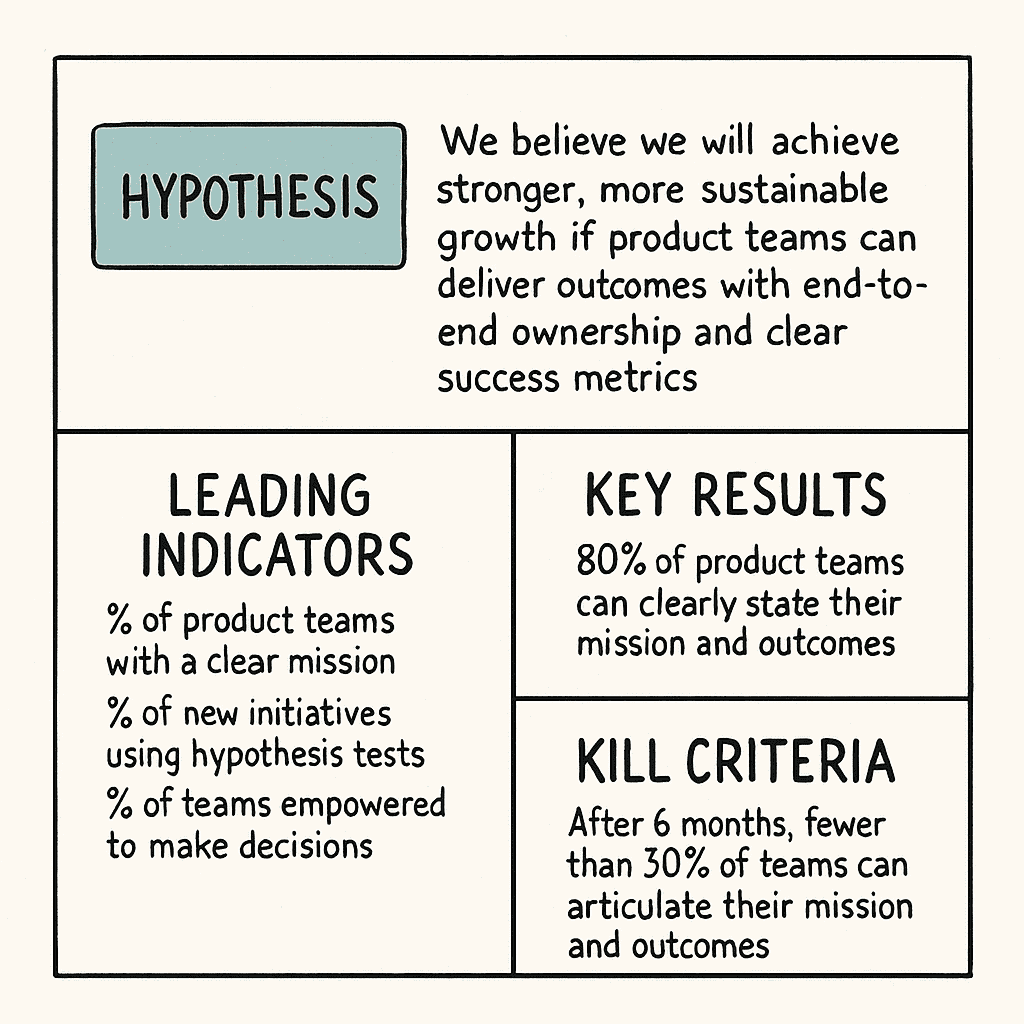
Starting with a hypothesis: We believe that we will achieve stronger, more sustainable growth if product teams can deliver measurable customer outcomes with a product operating model that gives them end-to-end ownership and clear success metrics. (Don’t copy-paste - create your own!)
Provide leading indicators, for example -
-
% of product teams who can clearly state their product mission and intended outcomes (ideally without looking it up)
-
% of new product initiatives that go through hypothesis prioritization to determine whether to test, ship and measure, or drop
-
% of new product initiatives that require testing undergo a discovery/truth curve process.
-
% of product teams report they are empowered at the right level to make decisions
-
% of product teams report less dependency overhead
For Key Results / Success Criteria, move from % to a discrete result, e.g., 80% of product teams can …
And don’t forget Kill Criteria, such as after 6 months, fewer than 30% of teams can articulate their mission and outcome metrics
What do you think will happen once you start treating your product operating model transformation as a product initiative instead of a project?
If you want a deeper path through this, the Product-Oriented Portfolio Agility Trail Map digs into applying product thinking to the transformation itself.
Practical thinking on turning AI pilots, adoption, and portfolio work into business impact - by finding the constraint, changing the work, and proving value as you go.
Yuval Yeret helps product and tech leaders move from agile theater to evidence-informed delivery. Work with Yuval →