Escaping the Feature Factory After a Product Reorg
global derivatives marketplace product operating modelA huge derivatives marketplace reorganized into a clean product hierarchy and still landed in a feature factory. Here is what actually moved it.
 Click image to open full size
 One of the world’s largest derivatives marketplaces is where the world’s financial markets come to manage risk, around the clock. Pivoting is in its DNA. It has reinvented itself more than once, moving from agricultural trading to pioneering financial technology, most recently through a major cloud partnership. But you cannot bolt new technology onto an old operating model and call it a transformation. The wiring underneath has to change too: how investment gets decided, funded, and judged. Leadership wanted a scalable model that tied technology investment directly to business outcomes and growth.
The Challenge
To stand up a product operating model, the organization restructured into a clean hierarchy. Five portfolios. Dozens of value chains. More than a hundred delivery teams aligned to specific products. On paper it looked great, and the teams were busy and productive. They had also walked straight into the classic scaling trap: a feature factory.
The link between technical activity and business impact kept getting lost in translation. Old matrixed project-delivery behaviors lived on beneath the new structure. Teams ran their ceremonies and shipped their features, but they were not reliably moving the needle for the business or the CFO. So leadership asked the honest questions. Are we focused on outcomes, or on activity for its own sake? Are we managing real risk, or building whatever gets asked for? Are we doing product discovery, or jumping straight to delivery? Have we actually set teams and leaders up to own their decisions?
The Turning Point: Going Upstream
The transformation team had poured energy into coaching at the team and value-chain levels. They were pushing a heavy flywheel against enormous friction. Leaders who had built their careers on execution and centralized control were struggling to let go and trust teams with outcomes instead of tasks.
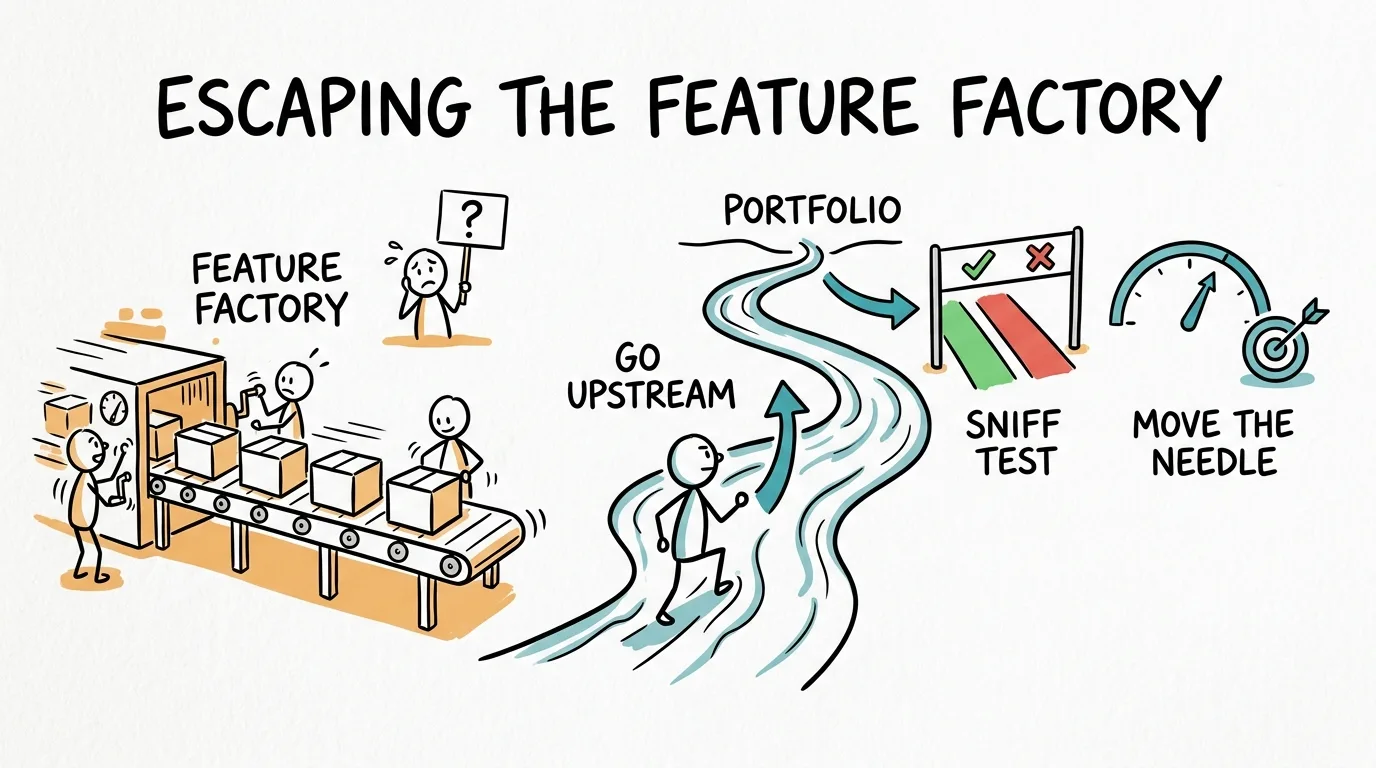
The turning point was deciding to stop pushing that flywheel and look upstream. The metaphor comes from Dan Heath’s book Upstream: a fisherman stops pulling kids out of the river to go find whoever keeps throwing them in. For this organization, going upstream meant fixing the root-cause alignment problems where they actually lived, at the portfolio level.
The Intervention
Working alongside the organization’s portfolio product agility coach, the move was to run the transformation itself as a product rather than hand leaders a rigid playbook. Portfolio leaders and business stakeholders were brought into the room to co-create the rollout. Multi-day theoretical slide decks gave way to on-the-job coaching and localized, portfolio-level conversations. Tools like Portfolio Kanban and epic hypotheses showed up only when a portfolio manager surfaced a problem that needed them, never as mandated mechanics. Leaders became the heroes of their own change, which is what made the ownership real.
The leverage came from small changes to familiar templates that quietly rewired intent:
- Leaner epic hypotheses. The traditional lean business case was stripped to a shorter, punchier format. Epic owners were coached to stop pitching technical tools and start pitching clear business outcomes.
- Mandatory leading indicators. Instead of judging success on lagging metrics after delivery, leaders could watch leading indicators throughout an epic’s life and pivot early when the data fell short.
- A body of evidence. One new field on the intake, “What gives us the right to believe this will work?”, forced the shift from loud opinions to validated customer feedback.
To keep monthly portfolio syncs from turning into status theater, the team introduced a fast qualification heuristic: a sniff test. Portfolio teams quickly check an epic for clarity on the customer, the monetization path, infrastructure cost, and technical feasibility. Clean epics skip deep discovery and go to delivery, because discovering a known, validated space is waste. High-uncertainty epics get routed back for targeted discovery, because pushing those straight into delivery is how you build something nobody wanted.
Underneath it all sat one discipline: fire tracer bullets before cannonballs. Keep the cost of an experiment low until conviction is high on desirability, viability, and feasibility. In one product-validation workshop, an epic owner stopped planning and tested her biggest assumptions directly with end users. Based on what she heard, she reversed the direction of a major portfolio epic. With an empowered portfolio leader backing her, she won the uphill fight against legacy upstream demands and delivered what customers actually needed.
The Outcome
By moving upstream and co-creating the operating-model shift with leadership instead of imposing it, the organization broke out of its post-reorg stagnation. The culture moved off the iron triangle of scope, time, and budget and onto one shared question: “Did we move the needle for our clients?” Governance increasingly happens in the flow of the work, through leaner hypotheses, leading indicators, and a fast sniff test, rather than in slideware. The next horizon is piping leading indicators automatically from core business systems straight into portfolio dashboards, so the operating model steers on live signal instead of manually updated fields.
Structure wasn’t the hard part
The structure was never the hard part. The shift from activity to impact happened when the transformation moved upstream, leaders owned the change as their own product, and small changes to everyday templates started rewarding outcomes instead of output.
Practical thinking on turning AI pilots, adoption, and portfolio work into business impact - by finding the constraint, changing the work, and proving value as you go.
Yuval Yeret helps product and tech leaders move from agile theater to evidence-informed delivery. Work with Yuval →