Finding AI Gold With Lean Startup Techniques
how to find ai gold using lean startup product techniquesMost AI efforts start with tools and demos. Better to use product discovery to aim AI at a real business constraint and test the riskiest assumption first.
 Click image to open full size
 How do we deliver valuable real-world AI impact through solutions that solve problems, using some of what we’ve learned by building products over the last couple of decades?
We’re not seeing the value yet
Unless you’ve been in a cave, you’re aware that there’s a gold rush happening out there. Certain companies are definitely making money building AI hardware and solutions, and a lot of people are heading out to mine for AI gold.
A lot of the conversations inside organizations feel like they’re more about the technology and the solutions than about what we actually do with this. A lot of the conversation is about how do we train it with the right data, how do we rationalize the data from different systems, and not necessarily what’s the outcome we can create.
Whether you agree with the recent MIT research about the number of generative AI projects failing to produce meaningful results or not, it’s pretty clear for anybody looking at what organizations are doing with AI that we’re not seeing the value yet. We’re not seeing the full potential value of this amazing technology. And the problem isn’t necessarily with the technology, the infrastructure, the regulation, or even the talent. It’s around how we approach it. Like any other technology in recent memory, there’s this anti-pattern where we approach it from a solution perspective rather than a problem or outcome perspective.
Most of your organization is still using AI as a better search box
I really like the crossing-the-chasm view of how AI is being adopted across different segments. When you look at the whole marketing world, there are people already talking and experimenting with AI agents and agentic workflows, but those are just the innovators and the early adopters.
The majority are barely using AI as a replacement for search, or as a conversational assistant like ChatGPT, Claude or Gemini, for personal use to be more productive on a task they’re running themselves. A lot of people are still struggling with what AI is, whether we really want to use it, whether it’s a threat to us, whether it can be valuable. And that’s okay.
The same distribution exists in any organization. You will see people using AI for search results, whether the organization is allowing them to or not. There are people conversing with AI, maybe even creating their own Gems or Claude Projects or Perplexity Spaces. And there are very few people trying to use AI for agentic workflows or building autonomous agents. That’s true for marketing, and it’s true for any other function across the organization.
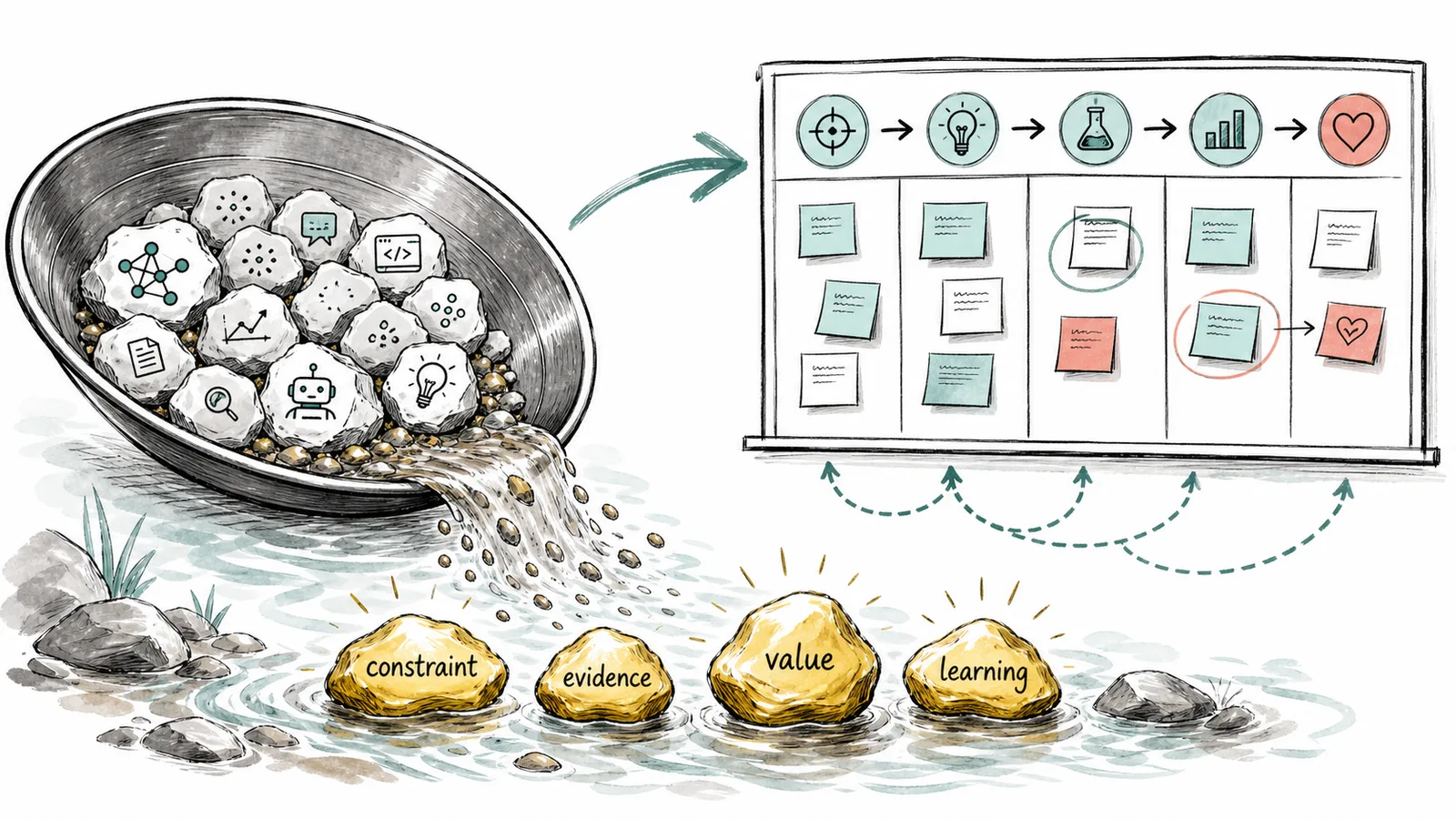
So the challenge is: we want to use AI for more than search results. Where is the gold? If we’re going to search for gold, let’s use the modern replacement of the tools the searchers used. What does it look like to pan or sift for AI gold?
Find the friction in your flywheel
One of the models I like to use for finding AI gold is the customer factory. Every successful company can be seen as a customer factory: a happy customer factory. You can think about your organization as a factory that starts with acquiring customers, then activating them, then retaining them, turning them into revenue, delivering enough value that you create revenue. Ideally the customers are happy enough that they refer others.
If this works well it becomes a flywheel. The better your product, the happier your customers, the smoother it is to bring in more customers, and the rotation of the wheel becomes easier. Business flywheels are the sort of thing Amazon used to grow, and they’re very popular these days as a metaphor for how you think about growing your business and working through your constraints.
Speaking of that, a similar technique that can be used here is the theory of constraints. If you want to do the best thing for growing your business right now, you want to find the friction in your flywheel: the bottleneck in your customer factory. That’s the area you want to improve.
If you don’t have enough customers to even activate, that might be the constraint. It might not make sense to try to extract as much revenue as possible from customers if you’re not even acquiring them. If you’re acquiring them but every second customer churns very quickly, it might not make sense to acquire more. Let’s focus on retention first, and make sure we have a solid customer lifetime value before we throw gas on the fire to acquire more people. If we have happy customers but aren’t seeing enough referrals, maybe that’s the constraint. But let’s not focus on creating more referrals if our customers aren’t happy: it’s not going to work. Addressing the weakest link is the only thing that matters.
Why am I even talking about this? Because when you want to leverage AI in your organization, you want to focus on where it matters.
Here’s how that looks in my own business
If I look at my business, there are acquisition challenges I want to do something about. I know that when I bring on a customer they’re very happy, and there’s a strong lifetime value for the customers I acquire. So at this point I’m focused on acquisition.
How can I convert people who listen to podcasts I’m on, and website visitors, into prospects? Am I converting enough of these people into customers? Is my close rate good enough? Is my average deal close time good enough? That could be another area I focus on. It’s a choice: I need to decide which of these areas I focus on.
By unleashing AI, say using the connection between ChatGPT and my CRM, it can help me analyze and understand where it’s better to invest: bringing in more leads and prospects, or converting more of the prospects I have. That’s something I’ll need to think through. But that’s the first conversation to have. Where am I focused? Where do I want to make a difference? It doesn’t make sense at the moment to go in and improve retention, because I don’t have a retention problem.
Where will you play: internally?
The process you might want to go through, when you’re trying to think where you can get the most ROI for your AI investments, is the strategic question. What is my goal as a business? What’s my growth goal? What’s currently going on in my customer factory? Where are the obstacles?
I need to form a strategy for where I will play. That can be seen as an external view of what audience or market I’ll focus on: for example, I might focus on mid-market companies rather than enterprises, because I have a certain advantage in that space, and how I will win is what I bring to that space that helps me win there.
But another view people don’t often take is: where will I play internally? I will focus, for example, on my sales capabilities, or on marketing, or on establishing expertise, or on my product. Where to play is a choice. It’s a choice that I will focus in that area and not focus in other areas that much for now. I will consider them stable, I will consider them okay.
Once I decide to focus in a certain area, how will I win there? If I decide to use AI for customer acquisition, how do I plan to do that? Is it to unleash AI for cold outreach? Probably not. Is it to use AI to help coach me on my customer interactions, combining best practices from business coaches I follow together with data from my CRM? Maybe that’s one area. Do I use AI to help me cut clips from long-form content I create? There are different approaches. But now AI is not “I can use AI for everything.” It’s very focused on what I’m trying to achieve.
The objective is not that you used AI
Once I decide on a strategy, I want to create a goal beyond my day-to-day mayhem. For anybody like me who has to balance billable work for customers with working on the business (and that’s all of you as well) every organization needs to run the customer factory and deliver value, but also think about how we grow the factory.
We need clear objectives for what we want to see. What’s the future state? What’s the strategic shift I want to achieve through using AI in my business? And what does success look like: how do we measure whether we hit that objective? It’s not that I’ve used AI. It’s that I’ve improved my average deal close time, or my close rate, or I see more engagement.
Take a business owner I talked to yesterday. Their biggest constraint is bringing on board the right talent. It’s very hard for them to find people for their financial services small business, which is growing very fast. Acquisition is not their issue: delivering value is the issue. In order to deliver value, their challenge is how do I find the right people, and how do I get them up to speed with my processes and my value creation as quickly as possible, so I can unleash them to work with customers and they become leveraged rather than a liability.
If the outcome we want is to be able to scale, to deliver more value without our individual involvement, then what is the solution? Here is where we can start talking about where we think AI can help. Maybe it can help filter through the résumés. Maybe it’s only relevant for onboarding people quickly. Maybe we can avoid hiring people, because AI can actually help us deliver more value to more people on our own. Adding people is just one way to achieve the outcome. The outcome we want is to scale, which is a great example of why we focus on outcomes rather than outputs or activities.
Then form a hypothesis, and find the riskiest thing in it
With that in mind, we’ll need to form a hypothesis. We believe we’ll be able to scale this financial services business better if we can more easily hire the right people using AI-based recruiting. Or: we believe we’ll be able to serve twice the number of clients if we gain efficiencies using agentic workflows.
Okay: that’s a hypothesis. Now, what’s the most important thing we need to learn first? What’s the riskiest thing about using agentic workflows to serve more customers? Maybe it’s whether people are willing to let us use AI to work on their financials. Maybe it’s our own conviction that we cannot use AI for that. Maybe it’s the ability to access our customers’ data using AI, and how that works with MCP. Maybe it’s a feasibility challenge, maybe a desirability one.
Let’s look at those different risks and do the minimal amount of work to learn. Are we smelling gold here? Can we sniff out better ideas and get rid of not-so-great ideas at minimal cost?
Goals that are too small or too far away
One of the key conversations at this point is making sure we’re focusing on the right things. A lot of the time our goals are either focused on features (hiring more people is a feature) or on business impact, which is too far away. We want to grow revenue, we want to improve customer satisfaction.
What’s the problem with either of these? The impact level is not as actionable and doesn’t provide strategic choices. Everybody wants to grow revenue. But what are we going to focus on in order to grow revenue, and what are we not going to grow? Focusing on acquisition as a way to drive revenue is a choice.
If you’re running a mattress store, it’s not that useful to have a goal of increased revenue. You need to be a bit more intentional about what the input is that drives it. Yes, revenue is when a customer buys a mattress, but even “customers buy more mattresses” is not a very useful goal.
It’s more useful to convey a strategy for what we’re going to do to drive that. The hypothesis, for example, is that when potential customers lie down on the mattress and bring a partner, they’re more likely to buy. Now that’s useful, because now we can focus on things that are going to move the needle on that. We’re making choices. We’re going to be laser focused and decisive around what we believe is going to move the needle for getting more people to lie down on mattresses.
The features, the outputs, the activities we drive should be focused on that, but we’re not married to any of them. We might put the information for the mattresses on the ceiling, or do something that incentivizes a customer to bring their partner. We will try it, we will experiment, we will sense whether it’s useful, and double down or pivot to something else.
Do you actually need to test this?
It can be wasteful to constantly try to learn and constantly experiment. So one of the things I like to do, after coming up with the strategy and the potential initiatives, is ask: do I need to test this? Is there a lot of risk here? What’s the relationship between the opportunity, the value, and the risk?
If there’s high potential value and high risk, it makes sense to test. If there’s high value but low risk, it’s an easy bet: let’s measure, but let’s just do it. If it’s high risk with low value, let’s probably not tackle that; there are better opportunities. If it’s low risk and relatively low value, maybe I can do something quick and get it off the table, or just put it aside.
The hypothesis prioritization canvas is something I integrate into my own kanban board for thinking through the initiatives in the business. It helps me decide whether I want to test something, and how much time I want to spend testing it, or whether I just ship and measure.
This helps me and the business owners I work with avoid two extremes: analysis paralysis on one side, and just jumping in and throwing technology at things without thinking on the other.
Think about it from a financial perspective. Any hour you invest in working on your business is very expensive. You have a very limited budget of time to work on the business: certainly if it’s an external investment. So you want to minimize the cost of initiatives that are unproven. Think through what the risks are with the initiative you’re considering, and if you don’t have high conviction about it, minimize the cost by running efficient experimentation.
That’s what panning for AI gold actually looks like.
Practical thinking on turning AI pilots, adoption, and portfolio work into business impact - by finding the constraint, changing the work, and proving value as you go.
Yuval Yeret helps product and tech leaders move from agile theater to evidence-informed delivery. Work with Yuval →