Quarterly OKR Planning Without the Theater
quarterly okr planning without theaterQuarterly big room OKR planning often gets dismissed as theater. A practical approach to align teams, surface dependencies, and set goals people believe.
 Click image to open full size
 Why Big Room Planning Fails (and How to Fix It)
Quarterly planning has a bad reputation, and a lot of the time it earns it. Teams spend days locked in virtual breakouts, arguing over task lists and drafting Key Results that read more like to-do lists than business outcomes. The result is planning fatigue, dependency gridlock, and a plan that is already obsolete by the time the quarter actually starts. No wonder so many leaders quietly write the whole thing off as theater.
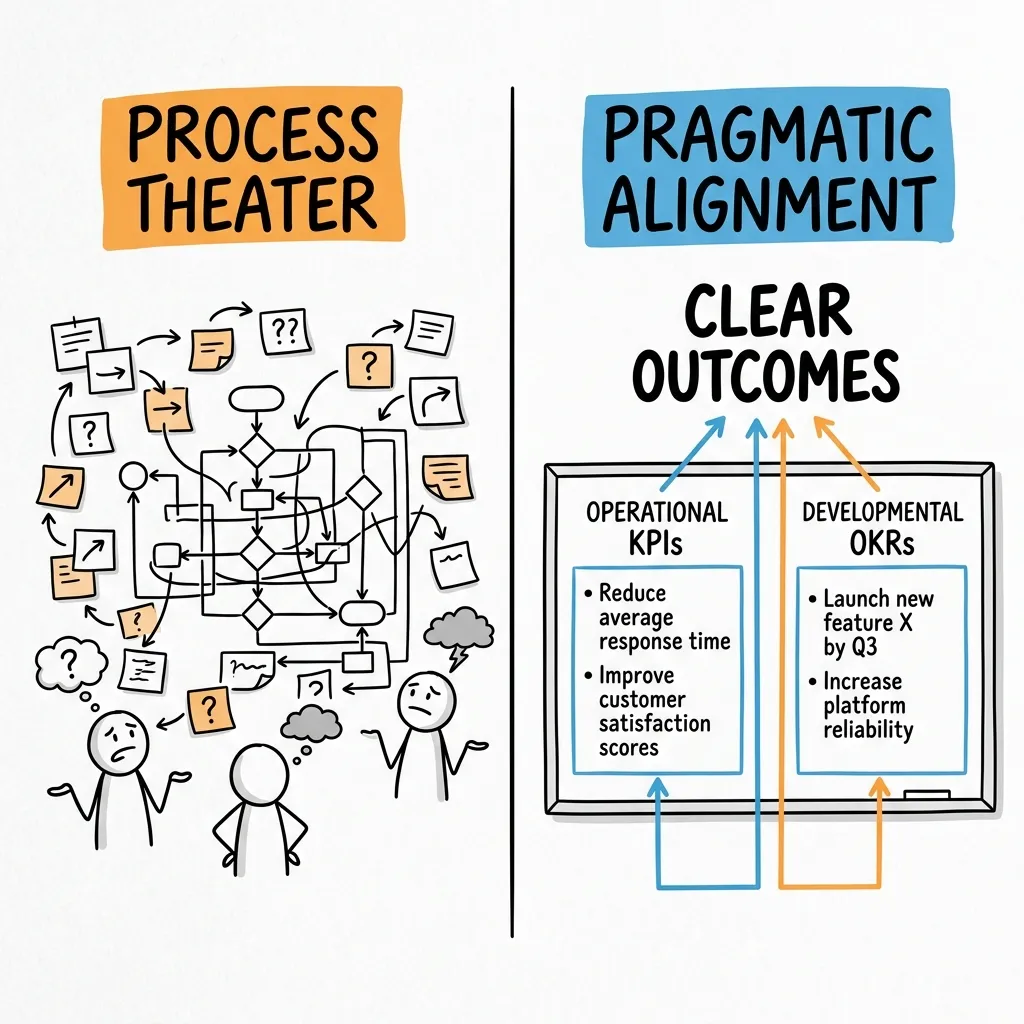
But it doesn’t have to be a waste of time. Run as a lean, empirical feedback loop, quarterly planning is one of the few moments where you can genuinely align team-level autonomy with company strategy in the same room. The difference is in a few specific moves: separate operational KPIs from developmental OKRs, map cross-team dependencies live instead of over weeks of email, and commit based on confidence rather than wishful precision. Do that, and the session stops being theater and starts being the thing that makes the next quarter real.
If you’ve sat through a two-day planning event that produced a wall of sticky notes and not much else, your skepticism is earned. Most big-room planning fails precisely because it tries to lock down a quarter of detailed commitments as if the future were knowable, and that is the version worth killing. The version worth keeping treats the room as a fast alignment-and-dependency loop rather than a commitment ceremony. You leave with shared direction, a handful of confident bets, and an honest view of what is still uncertain: not a frozen plan you will be quietly walking back by week three. Everything that follows is about running the second kind and refusing the first.
The Goal-Setting Lexicon: OKRs vs. KPIs
One of the most common reasons quarterly planning fails is that organizations try to stuff everything they do into OKRs. If a team has twenty OKRs, they do not have focus; they have a glorified task list. We need a clear lexicon that separates developmental work from operational health, keeping our goal-setting focused and manageable.
We define goals across three distinct horizons: Strategic (greater than a year), Intermediate (less than a year), and Tactical (one sprint). OKRs are reserved for intermediate developmental goals - work that changes the business, like establishing a new service playbook or scaling a production line. In contrast, Key Performance Indicators (KPIs) are used to track and maintain the health of ongoing operational work.
For example, maintaining an assembly time of under two weeks is a standard operational KPI. If that KPI is stable and healthy, there is no need to create an OKR around it. However, if the business strategy requires improving that capability, such as reducing assembly time to one week, that improvement becomes a developmental Goal supported by Key Results. By keeping operational metrics separate, you ensure that your OKRs are limited, focused, and truly challenge the status quo.
Mapping and Setting Goals Organizationally
To avoid command-and-control cascading, where goals are handed down from the top without context, goals must be mapped organizationally from company strategy down to team execution. This mapping creates alignment while preserving the autonomy of individual teams to determine how they will contribute.
At the company level, the C-suite sets Strategic Goals (the business and product strategy) and Intermediate Goals (annual objectives and next-quarter company OKRs). At the team level, teams align their own Strategic Goals (the team’s Product Goal) to the company’s direction. They then draft their own Intermediate Goals (Quarterly Team OKRs) and Tactical Goals (Sprint Goals).
Setting these goals is a collaborative dialogue, not a top-down mandate. The Product Owner represents what is valuable from a business perspective, while the Developers represent how much can realistically be achieved in a quarter. A healthy team structure enables teams to write OKRs they can own autonomously, with minimal cross-team dependencies. If a team cannot draft meaningful OKRs without constant external dependencies, it is a signal that your team design itself needs to be refined.
The Quarterly Review Workshop: Close Before You Open
You cannot plan a successful quarter without honestly closing the previous one. An empirical feedback loop requires inspecting where you are before adapting your plans. The Quarterly Review Workshop is designed to do exactly this, creating accountability to the goals we set for ourselves.
Instead of a dry status meeting, it is an interactive session focused on three main objectives: reviewing the actual value delivered against OKRs, grading those OKRs for learning rather than performance evaluations, and running a joint retrospective to solve systemic obstacles. To make grading interactive, teams can host breakout sessions where colleagues circulate the room, review the results, and offer feedback. This prevents OKRs from becoming a pass/fail compliance exercise and turns them into a tool for learning. The output of this workshop is an updated OKR backlog for the next quarter and a set of concrete cross-team improvement experiments.
| Session / Activity | Who Participates | Expected Outcome |
|---|---|---|
| Opening & Overview | Optional / All | Clarity on the purpose and approach to the review workshop. |
| Value Review | Recommended / All | Review high-level value delivered by each team as aligned with their OKRs. |
| OKR Grading Breakouts | Recommended / Teams | Individual team breakouts facilitated by Scrum Masters to grade objectives. |
| OKR Marketplace (Socializing) | Recommended / All | Move freely between team breakouts to share insights and discuss what surprised teams during grading. |
| Grading Conclusions | Required / Teams | Finalize carryover and next steps toward the next quarter. |
| Strategic Context & Vision | Required / All | Leadership shares current business strategy and the company OKRs teams need to align with. |
| Strategy Q&A & Open Space | Required / All | Quick answers to emerging questions and brainstorming topics for planning. |
The Quarterly Planning Event: A Step-by-Step Blueprint
Once the previous quarter is closed and leadership has shared the strategic context, the big room planning event begins. The purpose of this event is to efficiently achieve alignment and address cross-team dependencies in real time so teams can execute unblocked in the upcoming quarter.
Instead of weeks of slow, asynchronous negotiation, the entire group comes together for a series of highly interactive virtual sessions over two days. During the planning event, teams move through structured planning cycles:
- Leadership Briefing: Leadership reiterates the company objectives and priorities, grounding the session in business reality.
- First Team Breakout: Teams draft their realistic quarterly OKRs based on their capacity. A crucial step here is classifying OKRs into high-confidence/committed objectives and stretch/uncommitted objectives.
- Leadership and PO Huddle: While teams draft OKRs, Product Owners and leadership huddle to map cross-team dependencies and resolve immediate prioritization conflicts.
- Lightning Readout & Confidence Vote: Teams present their draft OKRs in 3-minute readouts. The entire room conducts a confidence vote to identify early risks and planning gaps.
- Rework and Finalization: Day two focuses on addressing the feedback, managing risks, and running a final confidence vote.
| Session / Activity | Who Participates | Expected Outcome |
|---|---|---|
| Opening & Overview | Optional / All | Clarity on the planning approach and schedule. |
| Strategic Context Alignment | Recommended / All | Clarity on annual and quarterly company OKRs. |
| Drafting Team OKRs (Iteration 1) | Recommended / Teams | Teams draft OKRs based on capacity. |
| PO & Leadership Huddle | Recommended / POs + Leadership | Align on cross-team collaboration and dependencies. |
| Lightning Draft Readout | Recommended / All | 3-minute readouts from each team followed by a room-wide confidence vote. |
| Day 2: Adjustments & Guidance | Required / All | Leadership shares overnight adjustments and guidance. |
| Finalizing OKRs (Iteration 2) | Required / All | Teams update OKRs; leadership circulates to offer feedback. |
| Final Plan Review & Risk Management | Optional / All | Mitigate outstanding risks and conduct the final commitment vote. |
Pragmatic Options to Scale Down
We must acknowledge that a full two-day planning structure is not always feasible or necessary for every organization. If your time is constrained or your teams are small, you can pair down this agenda using a few pragmatic options:
- Plan with Product Owners first: You can reduce the meeting overhead by planning primarily with POs and tech leads, then bringing the draft plans back to the teams. This saves time but reduces direct team commitment.
- Single-Iteration Planning: Skip the overnight huddle and run just a single iteration of planning, followed by a quick confidence vote and targeted rework.
- Draft-and-Validate: Have Product Owners pre-draft the quarterly OKRs and invite the development teams to review, adjust, and commit to what is realistic.
- Offline Reviews: Run the Quarterly Review and OKR grading asynchronously or offline prior to the planning event to preserve live meeting time for planning.
When establishing team product goals, leadership must be clear about their decision authority style. Using the five levels of authority - Sell (leadership decides and sells the goal), Consult (leadership consults POs then decides), Agree (goals are decided collaboratively), Advise (leadership advises, PO defines and informs), or Delegate (team decides autonomously) - prevents friction and sets clear expectations.
Planning is only theater when we pretend we can predict the future instead of using the session to align our current actions with our strategic intent. Real value comes from having honest conversations about dependencies and constraints rather than blindly checking boxes.
If you’re sick of process theater and want to run a quarterly planning cycle that actually aligns your teams and respects real-world capacity, let’s talk. We can design a lightweight blueprint that fits your organization’s specific context and needs.
A free audio series navigating the product operating model landscape: for leaders building modern product-oriented technology organizations.
Yuval Yeret helps product and tech leaders move from agile theater to evidence-informed delivery. Work with Yuval →