The Org Chart Won't Disappear. It Becomes the Interface to the Company OS.
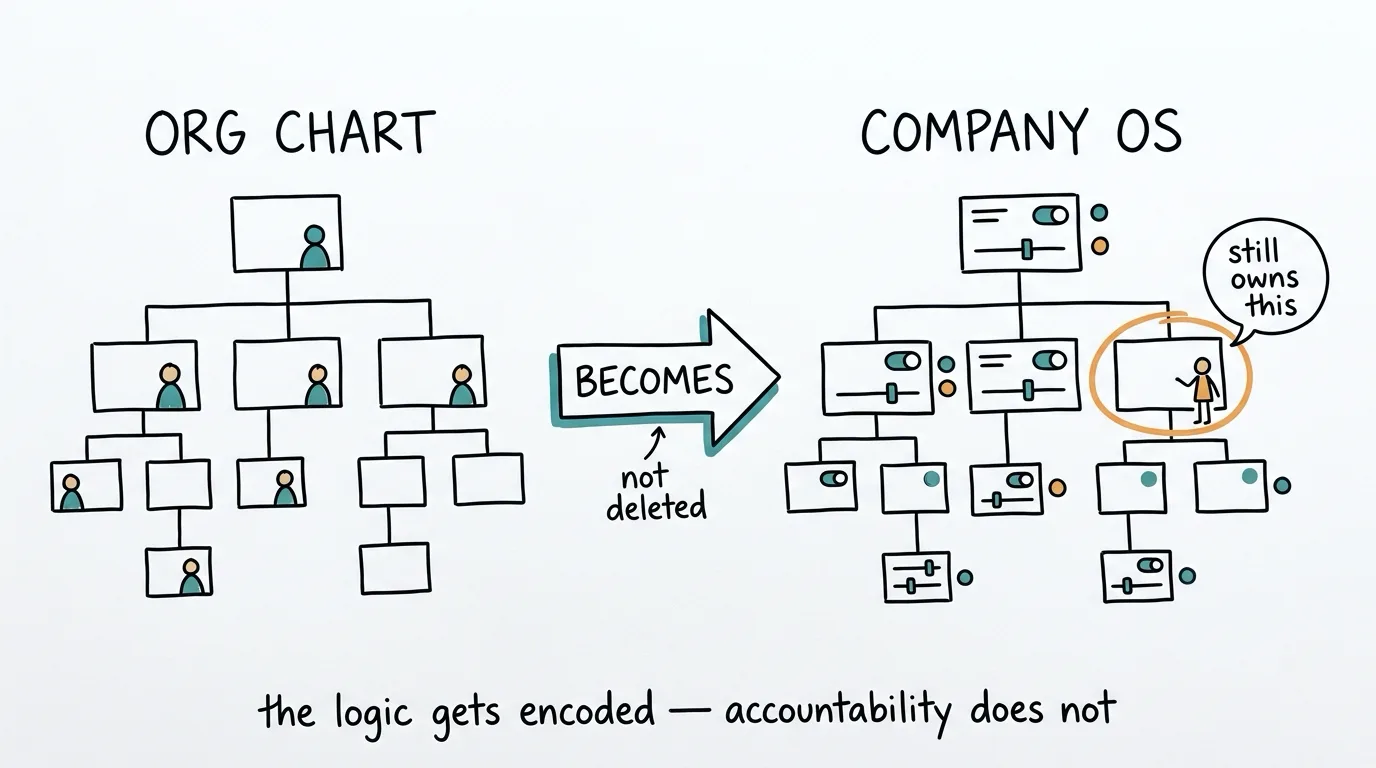
AI will flatten parts of the organization, but it won't remove accountability. The real shift is that more of the company's operating logic becomes encoded, observable, and continuously adjustable, and someone still has to own it.
 Click image to open full size
 From Org Chart to Operating System
A lot of the “AI-native organization” conversation assumes the org chart quietly fades away as agents absorb more of the work. The layers flatten, middle management shrinks, coordination disappears, and eventually the whole hierarchy becomes a relic. I think the first half of that story is roughly right and the conclusion is wrong. The org chart may get simpler, but it isn’t going anywhere, because accountability doesn’t go anywhere. Somebody still owns revenue, finance, security, legal, and the promises the company makes to the market, and agents in the workflow don’t change that. If anything, when the system starts shaping decisions and acting on the organization’s behalf, ownership matters more, not less.
Yes, a lot of the day-to-day work will shift to agents: both the individual agents people create, own, and evolve, and the shared agents that act as the new “shared services.” All of them run aspects of the company operating system.
But that only works if we codify the context and skills that used to live in people’s heads, in watercooler conversations, and in Slack and Teams threads: the de facto “this is the way” that was rarely the same as what’s written down in the playbook.
And it goes beyond enabling agents. Ambient AI (chatting with Claude, ChatGPT, or Gemini while you work on something) has huge potential to uphold and enact the company OS by nudging people to think the right way, but only if that OS is visible to it: the real values, principles, decision filters, and heuristics. That’s why investing in creating and evolving this OS is such high-leverage work, and why it’s crucial to scaling AI from local activity to business-level impact.
The old scaling model created dependency as a side effect
For decades, organizations scaled the same way. You added people, you grouped them into teams, you grouped teams into functions, and then you added coordination machinery to manage the dependencies you’d just manufactured. Need legal review, a financial analysis, customer data, or a security sign-off? Each one meant going to the function that owned it and waiting your turn in its queue.
That topology made complete sense when expertise lived mostly in people’s heads, in documents, in meetings, and inside functional teams. But it had a predictable side effect: centralized expertise, overloaded specialists, long queues, frustrated teams, and a lot of expensive humans spending their days routing work through the machine rather than doing the work. Most organizations have simply learned to live with this as the cost of scale.
A great deal of what I’d call AI Theater happens when companies bolt agents onto exactly this topology and expect magic. They add AI to the existing mess and then wonder why the demos impress while the business impact stays fuzzy. The reason is structural. AI doesn’t create new value; it creates new speed, and speed is indifferent to direction. Everything moves faster: the good and the bad alike. If ownership is fuzzy, AI spreads the fuzziness faster. If the real constraint is decision-making, AI will happily generate more analysis, more options, and more polished recommendations while the actual decisions get no better. Pointing new speed at an unclear operating model doesn’t clarify it. It just makes the lack of clarity travel faster.
The real topology shift: expertise moves into the system
The cartoon version of AI org design has humans vanishing and agents quietly running the company. The practical version is more interesting and more demanding: specialized expertise starts migrating out of centralized functions and into centralized agents, workflows, policies, and evaluation systems.
The legal expert may stop reviewing every routine contract by hand and instead become accountable for the legal review agent: its context, its risk boundaries, its escalation rules, its evaluation criteria, its performance over time. The HR expert may stop answering every manager’s policy question one at a time and instead own the HR guidance agent that helps managers handle routine situations and knows when to escalate the sensitive ones. The finance expert may stop building every analysis from scratch and start owning the assumptions, models, templates, and decision logic that let teams understand tradeoffs earlier and on their own. The security expert may stop manually inspecting every workflow and start owning the guardrails, access patterns, threat models, and exception logic encoded into the delivery system itself.
In none of these cases does the expertise disappear. It gets encoded, monitored, improved, and governed. That is a very different operating model from “everyone has ChatGPT now,” and it’s also a very different model from the traditional centralized function. The center doesn’t vanish: its job changes. Instead of manually handling every request, experts increasingly define, maintain, and improve the systems that let good decisions happen closer to where the work actually is.
# Company OS Policy Example: Routine Commercial Contract Review
policy:
  owner: VP of Legal & Compliance
  agent: commercial-contract-screener-v2
  autonomous_threshold: 'Standard terms, ARR < $50,000, no uncapped liability'
  escalation_rules:
    - condition: 'Custom indemnification clause or liability > 2x ARR'
      action: route_to_queue(legal_senior_counsel)
    - condition: 'International data residency clause present'
      action: route_to_queue(security_privacy_lead)
  eval_harness: tests/legal/commercial_terms_eval.jsonl
  cadence: 'Weekly false-positive review and boundary update'
The expertise didn’t leave the building; it moved from living in a person’s head to living in something the organization can see, test, and keep getting better.
Agents scale execution. They do not eliminate ownership.
This is where the “AI replaces the org chart” argument gets sloppy. Agents can do a remarkable amount. They can execute work, coordinate it, summarize and analyze it, generate and route it, run tests, and even decide within boundaries you set. But every meaningful agentic workflow still traces back to an accountable human or an accountable organization. Sometimes that’s a person inside the company. Sometimes it’s an external product vendor, a services partner, or a contractor maintaining a specialized capability. The accountability chain doesn’t break just because part of it is now software.
This isn’t a new idea so much as a familiar one wearing new clothes, and the proof is already sitting in how technology capabilities work today. If Salesforce mangles your revenue process, you don’t blame “the system” for very long. Someone owns the configuration, someone owns the process, someone owns the data quality, someone owns adoption, and someone owns the business outcome. If your deployment pipeline ships production risk, you don’t stop at “the tool did it.” Someone owns the pipeline, the controls, the release policy, the reliability. We already run real, consequential systems this way, with humans accountable for configuration, governance, adoption, and outcomes even when the machine does the executing.
AI doesn’t remove that accountability. It raises the stakes on it. The system is no longer just storing data or moving a workflow from one queue to the next: it’s shaping decisions, generating work, interpreting context, and acting on behalf of the organization. So the leadership question quietly shifts from who does the work? to who owns the system that does the work? That second question is harder, less glamorous, and far more useful. Agents scale execution. They do not eliminate ownership.
Evolving the AI Orchestration Layer
A traditional org chart is a slow-moving artifact. It encodes reporting lines, authority, budget, functional boundaries, and a certain amount of wishful thinking, and it changes only during reorganizations, leadership transitions, budget cycles, and moments of real pain. That slowness is partly a feature: it’s the stable accountability skeleton everyone navigates by.
The AI orchestration layer underneath it moves at a completely different speed. Prompts, policies, agents, evaluation harnesses, and escalation paths all change. So do context, data access, decision rights, guardrails, workflow logic, and memory: sometimes weekly, sometimes daily. This is why “company OS” is a useful metaphor, not in the consulting “operating model” sense, but more from the perspective of an evolving codebase that AI refers to when it helps us run the organization. It means more and more of the organization’s operating logic is becoming explicit, encoded, testable, observable, and adjustable. Not all of it: companies are still human systems, and power, trust, politics, fear, incentives, judgment, and culture don’t dissolve because an agent entered a workflow. But a growing share of the work system becomes something leaders can actually inspect and change directly rather than only influence through structure and persuasion.
Management / Leadership requires an Engineering stance
For decades, leaders have run organizations through a familiar toolkit: structure, process, incentives, meetings, dashboards, projects, and budgets. None of that is going away. But in an AI-native operating model it is no longer sufficient, because there is a new thing to manage: the logic of how human and artificial intelligence interact. That logic is a stack of design decisions: where AI acts autonomously, where a human approves before anything happens, and where a human only reviews the exceptions. It is about where judgment sits and where accountability sits once the two are split across people and agents, which decisions need rising confidence as they move through phases, and which risks are better burned down through deliberate learning than up-front analysis. And it is about which workflows to automate, which to augment, and which to leave completely alone because they were never the constraint in the first place.
This suggests a new approach to leadership. If we can manage the company OS like it is code, it makes sense to specify, develop, test, and evolve it using software engineering practices. That framing is especially attractive because it turns the company OS into exactly the kind of thing AI already knows how to work with: a codebase.
The Company OS Becomes the Bottleneck
Getting anywhere near the promised 10x or 100x means working through a sequence of shifting bottlenecks. How fast you accelerate is a function of how quickly you sense the bottleneck moving, how long you take to respond, and how quickly you can converge on an OS upgrade that actually addresses it, which usually takes a few iterations. So the real bottleneck, increasingly, is how fast and how well you can upgrade the company OS itself. If the only speed you have is the pace of the org chart, you are either moving too slowly or running people at a pace they cannot sustain.
That is the case for decoupling the two. The org chart stays the slow, stable accountability skeleton humans still need, even in the AI age, while the OS underneath it evolves at the speed AI now makes possible. Keep them welded together and you get the worst of both. Pull them apart and each can finally do its own job.
The org chart tells you who is accountable. The company OS is what they are now accountable for, and how fast it improves is becoming the whole game.
Practical thinking on turning AI pilots, adoption, and portfolio work into business impact - by finding the constraint, changing the work, and proving value as you go.
Yuval Yeret helps product and tech leaders move from agile theater to evidence-informed delivery. Work with Yuval →