De-Risk Product Development w/ Leading Indicators
using leading indicators to de risk product developmentOutcome OKRs that track business impact are still lagging. Steer by the customer outcome (a change in behavior) using leading indicators instead.
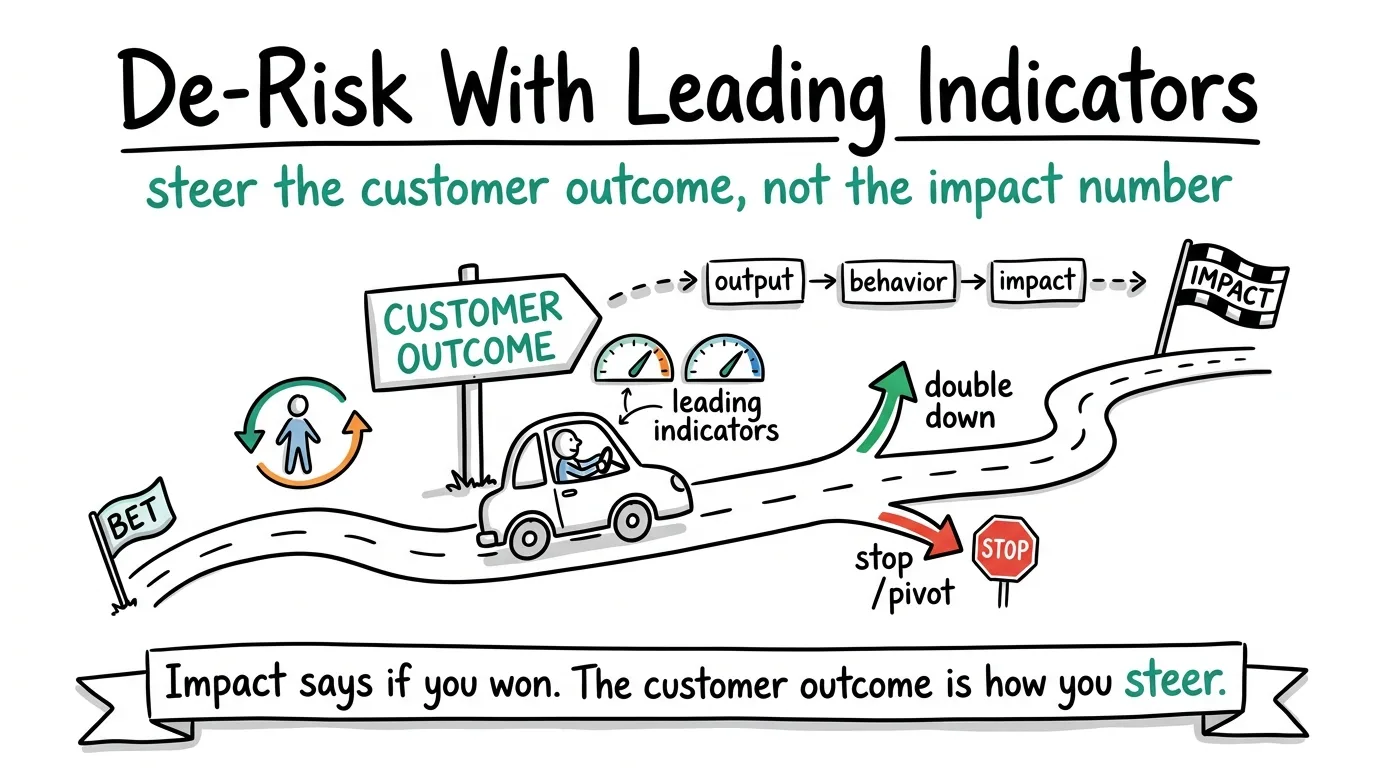 Click image to open full size
 Outcome OKRs point you the right way. They don’t help you steer.
We spend a lot of energy moving teams from output OKRs to outcome OKRs, and that shift genuinely matters: it aligns people to the real goal and leaves room for discovery instead of locking in a plan on day one. But here’s where it quietly goes wrong: when most teams write an “outcome” OKR, what they actually write down is a business impact metric: grow revenue in this segment, improve retention, cut cost to serve. Impact is the thing the business ultimately cares about, and it’s almost always lagging. By the time it moves, the quarter is mostly over and the big decisions are already behind you. If the only thing you’re steering by is the impact number, you haven’t really escaped waterfall. You’ve just relabeled it. You set a direction, you disappear into delivery for three or six months, and you find out at the end whether the bet paid off. That’s waterfall with better labels, or, if you prefer, agile lipstick on a stage-gate pig.
The way out starts with being precise about what an “outcome” actually is, because the word is doing two jobs at once and that overload is the root of the confusion.
Output, outcome, impact: why the middle one is where steering lives
I lean on Josh Seiden’s taxonomy here, because it cuts the knot cleanly. Output is what you build: the feature, the model, the workflow. Impact is the business result you’re after: revenue, retention, cost to serve. And in between sits the outcome, which Seiden defines as a change in customer or user behavior: customers start doing something they didn’t do before, or stop doing something that used to cost you. They adopt the new flow, they self-serve instead of calling, they come back next month, they finish the thing they used to abandon. That behavior change is the outcome, and it is not the same thing as the business result it eventually produces.
This distinction is the whole game, because the customer outcome is the part you can actually focus on and steer toward. It sits between your work and the business result, and it moves earlier. You can watch a behavior start to change weeks or months before it shows up in the P&L. Impact tells you whether you won. The customer outcome is how you steer toward winning. So when I talk about steering a product bet, I don’t mean staring at the revenue line. I mean watching whether the customer behavior you bet on is actually changing, and that’s where leading indicators come in.
Leading indicators are a hypothesis, not a dashboard
Here’s why this is harder than it sounds. A lagging business impact is usually easy to name: grow revenue in this segment, improve retention, reduce cost to serve. A leading indicator is a claim about cause. You’re saying: if we change this specific thing, for this specific customer, then they’ll start behaving in this specific new way, and that behavior change should eventually move the business result. That’s not a metric you pull off a shelf. It’s a hypothesis about how value actually gets created in your problem space, and you can only write a good one if you have real intimacy with that space.
I think of this as the value architecture of a bet: the causal story underneath it. Not a dashboard, not a list of metrics someone asked you to track, but a chain you can say out loud: we ship this change (output), so customers start doing this differently (outcome, the behavior change), and over time that shows up as this business result (impact). Take AI-assisted proposal drafting as the bet. The causal story might be: we give sellers a usable first draft on demand (output), so they actually start drafting proposals themselves and reusing approved language instead of queuing for a specialist (the behavior change, the customer outcome), and over time proposal turnaround drops without the win rate slipping (impact). The leading indicators live on that middle layer: first-draft time, reuse rate, how often sellers go it alone. That’s the behavior you’re betting will change. The moment you can articulate that chain, you have something concrete to steer with. When you can’t, you’re back to watching the lagging impact number and praying, which is exactly the position outcome OKRs were supposed to rescue you from.
When does it make sense to build leading indicators?
This is the question I keep chewing on. Good leading indicators require deep insight into the problem, but you’d really like to know you can steer with feedback before you commit serious money to a bet. You want the intimacy up front, and that intimacy is partly what the investment is supposed to buy you. So which comes first?
Where I land, for now, is to treat the leading indicators as part of how you decide what to fund, not an afterthought once the work is already approved and in flight:
- Prioritize on the business impact. Consider and rank potential investments based on the impact you’re after, which is the lagging result. That’s the “is this even worth wanting?” filter, and it’s fine for it to be lagging.
- For real bets, name the customer outcome and how you’ll steer before you greenlight. For investments that genuinely require discovery (the bets, not the known work), decide which change in customer behavior you’re aiming for and what leading indicators would tell you it’s happening. If you can’t sketch that causal story and a way to read the signal, that’s a finding in itself.
- Make steerability a selection criterion. Weigh the customer outcome and the steering approach when you prioritize and approve the bet. A bet you can steer is worth more than a same-sized bet you can only watch. Treat “can we actually steer this?” as a real factor alongside value and cost.
- Slice the investment so each slice moves a behavior, not just a feature. Break the bigger bet into smaller pieces that each aim to move the needle on a leading indicator, some real change in customer behavior, however small. This is the hard part, and it’s where the magic is. It’s the same muscle as slicing a meaty outcome into intermediate outcomes, or driving a thin tracer bullet end to end to prove the path before you build the whole thing.
- Steer during delivery, and stay willing to pivot the indicators too. Use the leading indicators to steer through discovery and delivery, and be open to pivoting both the bet and the indicators you’re managing it with as new information arrives. Sometimes the behavior you thought mattered turns out not to be the one that drives the impact. That’s information, not failure.
Don’t forget the signals that tell you to stop
Most teams, once they buy into leading indicators, set them up to answer a single question: are we winning? That’s only half the job. The other half is knowing when to stop. Before you commit, it’s worth defining two things in plain language: what a Home Run Success looks like (“customers are behaving this differently, and it’s moving the business this much”), and what a Fast Failure looks like, the leading indicator that would tell you the behavior change just isn’t happening and you should pivot or kill the bet. Annie Duke calls those kill criteria, and most portfolios are starved of them. They’re rich in “continue” signals and status updates, and almost empty of pre-agreed conditions that would give a sober team permission to walk away. I’ve written more about the cultural hacks that make this evidence-informed mindset stick, because the practice is usually less about analytics and more about getting people comfortable deciding before all the data is in.
This matters more than it looks, because the honest reason leading indicators are hard isn’t analytical. It’s emotional. A lot of leaders say they want evidence-based steering. What they actually want is certainty, and a real bet doesn’t give you that early on. Leading indicators are how you manage the uncertainty instead of pretending it isn’t there: you replace “trust me, it’ll land” with a body of evidence that builds, or doesn’t, while there’s still time and money to do something about it.
What changes when this is actually working
When a team has this in place, the conversation in the review changes shape. You stop asking “are we on track to deliver the scope we committed to” and start asking “is the customer behavior we bet on actually changing, and what did we learn?” You come off the iron triangle of on-time, on-scope, on-budget and onto whether the outcome that drives impact is genuinely emerging. The bet gets smaller and more frequent. The leading indicators give you permission to double down early when a behavior change is clearly taking hold, and permission to stop early when it clearly isn’t, both of which are worth a fortune compared to finding out at the very end of the quarter, when only the impact number is left to tell the story. This is the same shift I keep pushing in the broader OKR reset: align on the impact you want, but manage the work by steering the customer outcome that leads to it. Steer with evidence, not a Gantt chart wearing a costume.
None of this is free. Building leading indicators forces you to make your assumptions explicit, and explicit assumptions can turn out to be wrong in public, which is uncomfortable. But that discomfort is the point. A bet you can’t express as a causal story (output to behavior change to business result) is a bet you don’t understand well enough to be spending real money on yet, and that’s exactly the kind of thing it’s far better to learn in week two than in month six.
Common questions
Aren’t a customer outcome and a business result the same thing?
No, and the gap between them is where steering lives. Borrowing Josh Seiden’s taxonomy, a business result (the impact) is something like revenue, retention, or cost to serve. A customer outcome is a change in customer behavior: they adopt the new flow, they self-serve, they come back, they finish what they used to abandon. The behavior change is what eventually produces the business result, but it happens earlier and it’s far more within your influence. Focus your steering on the customer outcome, and treat the business impact as the thing it’s meant to move.
What’s the difference between a leading and a lagging indicator?
A lagging indicator is the business impact you ultimately care about: revenue, retention, cost to serve. It only moves after the work has largely played out. A leading indicator is an earlier signal, usually a change in customer behavior, that you believe sits on the causal path to that impact. Lagging tells you whether you won. Leading lets you steer while the game is still on.
How many leading indicators should a bet have?
Few enough that you can hold the causal story in your head and act on it. One or two strong leading indicators with a clear sense of what would make you continue, pivot, or stop beats a dashboard of ten metrics nobody actually steers by. If you can’t say what a given indicator would make you do, it’s decoration, not a steering signal.
What if we can’t find a good leading indicator for a bet?
Treat that as a signal in its own right. It usually means you don’t yet know which change in customer behavior would drive the impact you’re after, which means you don’t understand the problem space well enough to be making a large, committed investment. That’s an argument for a smaller discovery slice, a tracer bullet aimed at building the insight (and the indicator itself), rather than for funding the whole thing on conviction and hoping the impact shows up at the end.
Aren’t leading indicators just vanity metrics?
They degrade into vanity metrics the moment they stop being tied to a causal story and a decision. Usage counts, activity, and pilot tallies are the usual culprits: they go up and to the right and tell you nothing about whether a meaningful behavior change is happening. The test is simple: would a change in this number actually make you continue, pivot, narrow, or kill the bet? If the honest answer is no, it’s theater.
Business impact tells you where you want to end up. The customer outcome you steer toward, and the leading indicators that track it, are how you find out, in time to do something about it, whether you’re actually getting there.
Get the AI prompt swipe file for diagnosing and rewriting broken OKRs: practical prompts for leaders who are done with OKR theater.
Yuval Yeret helps product and tech leaders move from agile theater to evidence-informed delivery. Work with Yuval →
- 01 Fix Your OKRs - Back to First Principles 11 min
- 02 Hacking your way to an Evidence-Informed Mindset 2 min
- 03 OKR Implementation Tips 6 min