Why Do So Many Business Transformations Flop?
why do so many business transformations flopMost transformation programs fail not because people resist change, but because they're run like projects instead of learning systems. Here's what works.
 Click image to open full size
 Listen on the episode page.
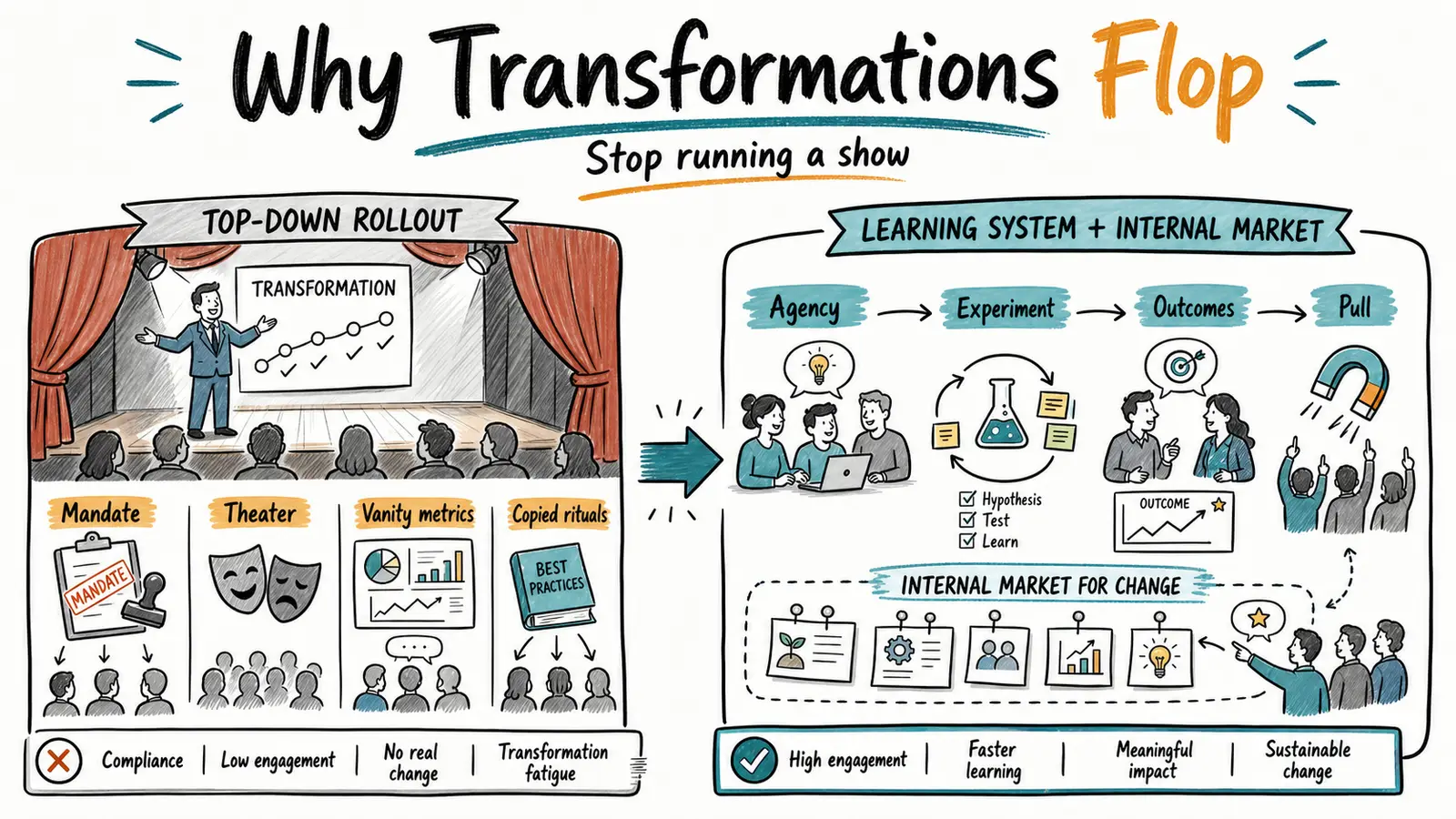
Transformations flop when they are managed like rollouts
In this solo episode of Scaling With Agility, I walk through why so many agile and digital transformations fail. I have seen this pattern repeatedly: organizations try to scale change by copying and pasting frameworks instead of addressing the actual friction on the ground.
When you look closely at failing initiatives, you usually find too much work in flight, dense dependency networks, and leadership behaviors that reinforce the silos they claim to be breaking down. Instead of doubling down on top-down mandates and agile theater, treat organizational change more like a product. Validate desirability. Iterate. Learn whether the new way of working solves a real problem before rolling it out everywhere.
If you force a solution that is not ready for the mainstream, you kill its credibility. Sustainable change does not come from checking boxes or putting on a show. It comes from creating an internal market for change where teams want to adopt new ways of working because those ways solve problems they already feel. That means looking at flow, cycle time, and work in progress at the portfolio level, not just the team level.
Ask yourself: Are you actually changing how work gets done, or are you just putting on a show?
Listen to the episode
This came out of an episode of Scaling AI: From Activity to Impact.
Listen on the episode page or directly on Spotify.
If this is the problem you are trying to solve, start with the Scaling w/ Agility Crash Course.
Practical thinking on turning AI pilots, adoption, and portfolio work into business impact - by finding the constraint, changing the work, and proving value as you go.
Yuval Yeret helps product and tech leaders move from agile theater to evidence-informed delivery. Work with Yuval →
- 01 The Agile Theater 3 min
- 02 Time to close the curtain on the Agile Theater 3 min
- 03 From Agile Theater Doom Loop to Agility Flywheels 2 min