3-4 Person Supercells vs. 7-8 Person Scrum Teams: What Actually Compresses When Agents Code
3 4 person supercells vs 7 8 person scrum teamsInside Progress Software, 3-4 person teams with high context and autonomy are outperforming 7-8 person Scrum teams. Here is what actually compresses, what stays, and where brownfield reality pushes back.
 Click image to open full size
What happens to agile teams when agents do the coding?
When it is just Copilot assist or modes where engineers are just doing their work faster, I am not seeing that much change to ways of working if I am honest. When it is a fully agentic process, that is where things start to become interesting.
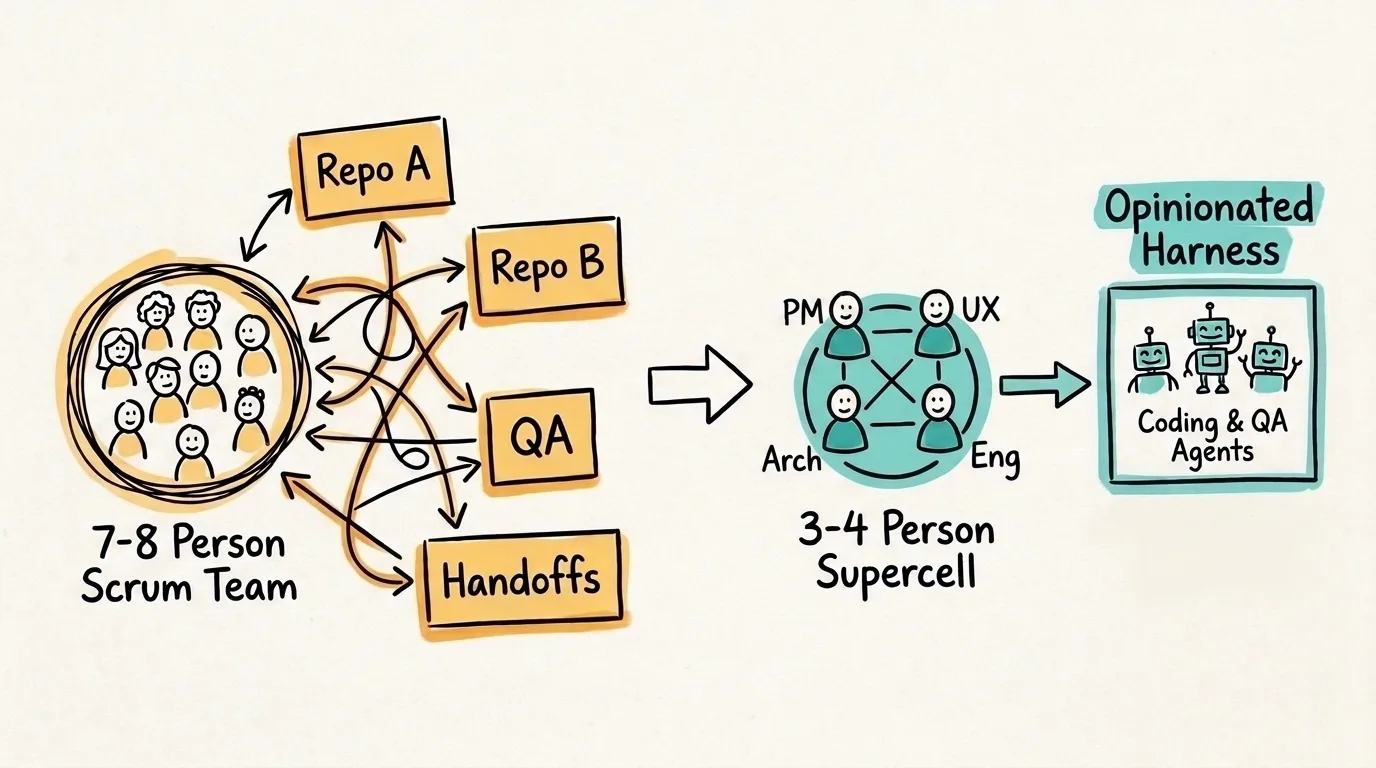
I got into this with Ed Keisling, the Chief AI Officer at Progress Software. Progress is a billion-plus software company with over 20 products including WhatsUp Gold, Flowmon, Chef, Sitefinity, LoadMaster, and Telerik tools. Progress has near 100% adoption across multiple surfaces within GitHub Copilot and twice-weekly voluntary enablement with Microsoft. They are also prototyping an experimental AI SDLC where humans manage fleets of agents to do all of the coding on their behalf. Smaller, more tightly aligned teams of three or four people that are rapidly sharing context and have high levels of autonomy are significantly outperforming traditional seven-to-eight-person Scrum teams.
Context and autonomy create 3-4 person supercells
There is almost only so much that you can do through incremental efficiencies. The way to scale an engineering team, and what Progress is building towards with their AI SDLC, is an engineer managing a fleet of agents:
“You can imagine an engineer is managing a fleet of agents, each of which is fixing security bugs or security vulnerabilities or enhancements or other defects on an ongoing basis, and all of those are getting batched and returning in the morning. Now you have one person basically doing the work of 10 or 15 or 20 people. That is when you really start to see the orders of magnitude.” : Ed Keisling
The feedback cycles are much shorter today than they were a year or two ago, and one of the constraints that gets introduced are handoffs, either between people or between people and AI. Those really start to introduce delays into the system. On one axis you have context: all of these ceremonies that we are trying to provide are intended to give the teams context so that they have more information about what we are trying to accomplish and why it is important.
In the course of any given day, there are dozens, if not hundreds, of micro decisions that individuals and teams need to make. If they have context, they can make a lot of those decisions in line with where you are trying to go. On the X-axis, you have autonomy or competency: now that I know where I need to go, I need to have the ability or the lane to execute against that work. You want everybody to be in the upper right-hand corner in terms of having both the context and the autonomy to execute.
“I think what we have seen, and we actually have a lot of data on this, and I was actually just looking at some of this data this morning, is that smaller, more tightly aligned teams that are rapidly sharing context that have high levels of autonomy are significantly outperforming some of the other teams in the organization. You may not necessarily need a team of seven to eight on a Scrum team anymore. A Scrum team might be three or four people, because you can augment some of that with agents. And the more consistently that those people are leveraging AI, leveraging their plugins, leveraging their skills, the more consistent that they are using similar slash commands within the CLI, those teams that are more tightly aligned are clearly outperforming the rest of the organization. You can get these supercells of teamwork.” : Ed Keisling
Why did we have 7-10 person teams in the first place?
That has been true for more than a decade. It is not anything new about AI. I worked with companies and I have seen teams that are one-pizza teams or half-a-pizza teams, and the question has always been how can you get to these very small teams? How do you build the T-shaped people, or make the system simpler, or slice the product to create a team that is small on one hand and empowered on the other? How do you get a team that can own value end to end, because if it is not, it will get stuck when it needs a handoff to another team?
There was a limit in terms of what two or three people could do three or four years ago. Now with AI, those things are on an exponential. With small teams we are not talking about 20% or 50% more effective; they are orders of magnitude more effective than they were.
There is one aspect of how they are more effective, which is the speed: they are running agents, agents run faster, great. The other even more important aspect, from the perspective of a small team owning something and delivering it quickly with minimal handoffs, is the versatility. Why did we create seven, ten person teams? Why did Daniel Vacanti in his original Kanban teams use 25 people on a team? The reason was that there was no one person that knew everything about all of the systems needed to deliver value in a complex system, so you ended up with islands of knowledge.
The hypothesis of the tiny teams direction is that AI can know much more about the codebase and can help people have much more breadth of the systems and the codebase that they can touch. You do not need five engineers on a team just because you have five repos or five systems or products and nobody touches someone else’s code because dragons be there. If you created an agent for your product and you are the steward of that agent, you trust what that agent is doing and evolve that agent. Then I can leverage that agent on a different team. You do not need to be on the team on a day-to-day basis, and we do not need an engineer from every team in the organization every time we build a feature.
Compression happens in engineering and QA, not PM and UX
Ed is still on team specialization. As much as AI helps lower the barrier to doing other skills, if you do not know the right question to ask AI, you are going to be unable to validate whether you are getting a good output.
“When I think about these smaller teams, where I am seeing the compression is basically on the engineer side. A team might have a UX person, a PM, and might have an architect, and then you would have three or four engineers, you might have a couple QA people, you might have three or four devs. The QA aspect can be largely done by AI today, so you could argue that is something that AI can accommodate. And then having fleets of agents that an engineer can manage, one engineer can really be multiple engineers if they are using agents appropriately on the back end. I still think you need that tension between UX and PM and engineering, and that translates to a better requirement and a better output.” : Ed Keisling
Product managers today are using deep research to figure out what competitors are doing, what they are charging, and how new capabilities within the models are going to impact the roadmap. Even before you actually build a single production line of code, you can prototype something and get fast feedback from customers to smoke test whether it is interesting to them or not.
“Do not discount that though, because there are so many people that are just pulling the wrong thing faster today.” : Ed Keisling
The whole reason we were talking about scaling in the past is because we could not do that. The whole reason for an agile team was because one person could not do it. The whole reason for an agile release train or a team of teams was because we had products, valuable things, features that were too big for one team to handle. The whole reason in SAFe we talk about a feature as something that might spread to stories in different teams is because of that challenge. If you can build your teams to be feature teams, stream-aligned, and for PI planning to be a very boring thing that just sets high-level context, with almost nothing left when you get to discussing dependencies between the teams, that is great.
Scaling requires an opinionated harness, not individual prompt heroics
Scaling AI to a large, global, multicultural organization is extremely difficult, and there are a lot of inconsistencies in terms of how individuals, product teams, or even regions are implementing AI. You may have several hundred people in your development organization. It is very likely that those several hundred people have slightly different understandings and slightly different implementations of how they are handling that within their own instruction set in AI.
“The reason that we believe that you need an agentic SDLC or some sort of harness to manage this process is that scaling AI to a large organization is extremely difficult. You may have several hundred people in your development organization, but it is very likely that those several hundred people have slightly different understandings and slightly different implementations of how they are actually handling that within their own instruction set in AI. We are saying we have an opinion on what this story needs to look like before it goes to the code. We have an opinion on the types of tests that it needs to run. We have an opinion on the codebase that it needs to run. We have an opinion in terms of what we are going to be accepting for definition of done.” : Ed Keisling
The challenge is that this is a fundamental change in terms of how engineers work. Engineers like to be in the weeds, they like to change the code, and now we are trusting the AI to do the majority of the code changes. Instead, engineers are asked to shift left in terms of really thinking about what needs to be built and what success looks like. At the end of the process, they review the code to make sure it is in alignment with standards and something the organization can support over time.
Based on my conversations and coaching, many engineers are frustrated by this process and feel like they are babysitting agents, dealing with walls of markdown and walls of code, when they prefer writing over code reviewing. One dilemma I am wondering about is whether it is about shifting left or shifting up. From an engineer perspective, I do not need to specify necessarily the requirement; I need to specify the technical requirements, the technical best practices, and what we have learned over the years. That way, the agent can figure out the technical requirements for this specific feature because I have built the opinionated digital twin of myself that the agent refers to. And similarly, when you do code review, ideally you do not even need to be in the loop for that over time because you have taught the agent how to review like you.
Either way, it is impossible without really good engineers. If you are trying to deliver enterprise software, all of that secret sauce is in the engineer’s head: what to look for, when to look for it, the experience, the nuance, and the intuition. That is all the difference between getting something that is just okay and something that is actually enterprise ready.
Where do greenfield supercells hit the brownfield wall?
Are all of those handoffs and dependencies disappearing across an entire portfolio, or is it not there yet?
“On the simplest side, have we assembled small teams like we just articulated to do greenfield new development to bring new products to market or to run market experiments? Absolutely. Have we been able to do those things at a speed that was never possible before? Absolutely. It gets more complicated though the more that you have to integrate with legacy codebases or with technical debt, where things have evolved over decades in terms of how they work. Some of that may not be well documented, so the AI is starting cold just like a human would in terms of what does this code do, why is it important, what are the handoffs. There is a lot of institutional knowledge that has been built into the codebases themselves. Making a logical change does not necessarily result in an expected output.” : Ed Keisling
Progress is not trying to boil the ocean today. It is easier than ever for bad actors to use AI to find security vulnerabilities and take action on them. For an older application that has a lot of third-party libraries and code that may be less secure, there is a huge opportunity to use AI to scan that and identify the security vulnerabilities. Those are the classic, extremely well-defined work that AI can make a meaningful dent in for those legacy applications, rather than trying to use it for an entirely net new capability within that product. Once you actually get the trust that it can do small things well, as it does small things well, it can document all those sections of the code that it is touching. Over time, it is going to self-document how the system works and position you better to build some of these more complex things later down the road.
You can set a North Star of tiny teams, one-pizza teams, whatever you want to call it, and realize that it requires work and investment. There is an AI runway, just like what we call the architectural runway, that you need to invest in to bring that future to life.
Listen to the full conversation
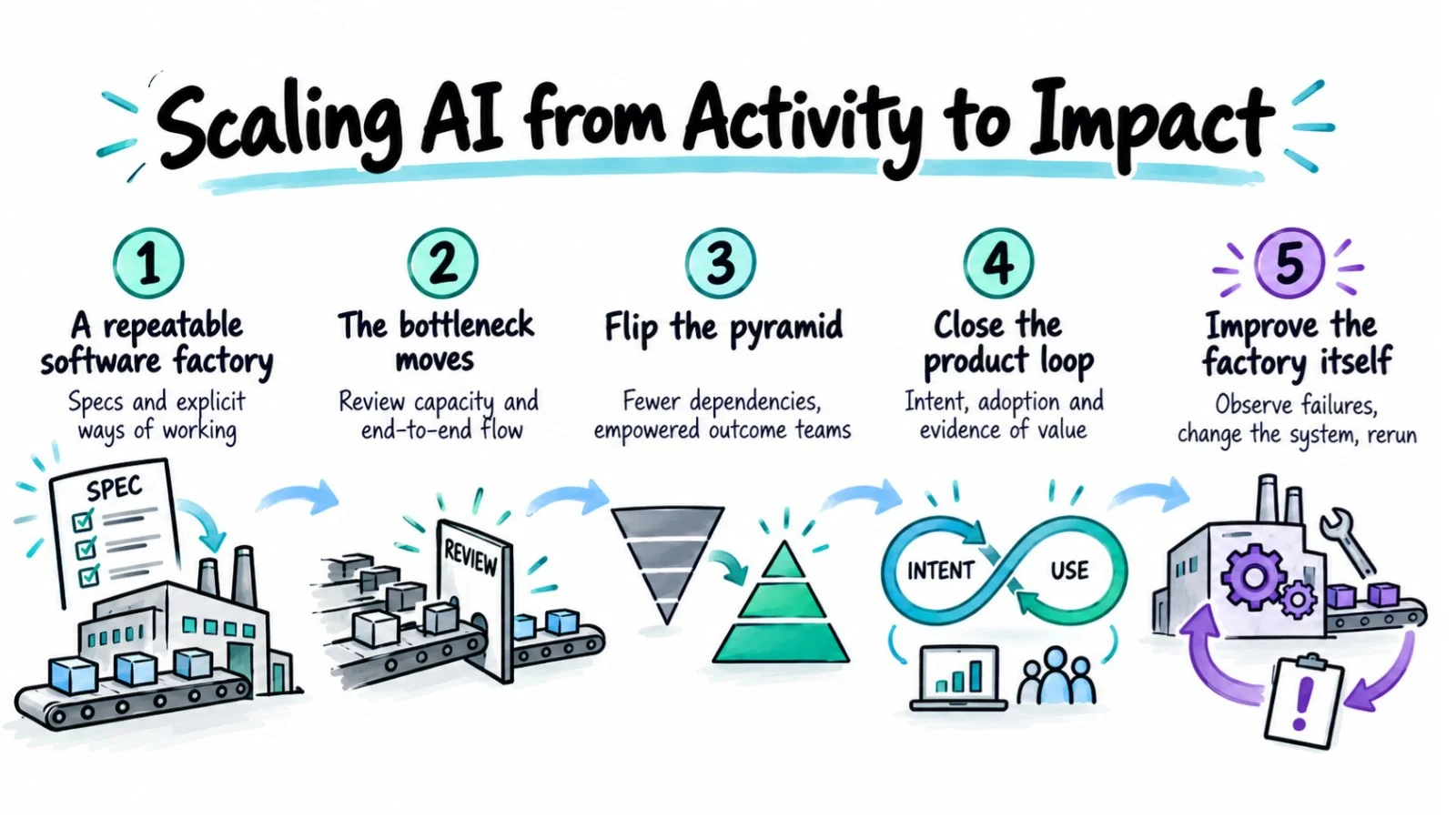
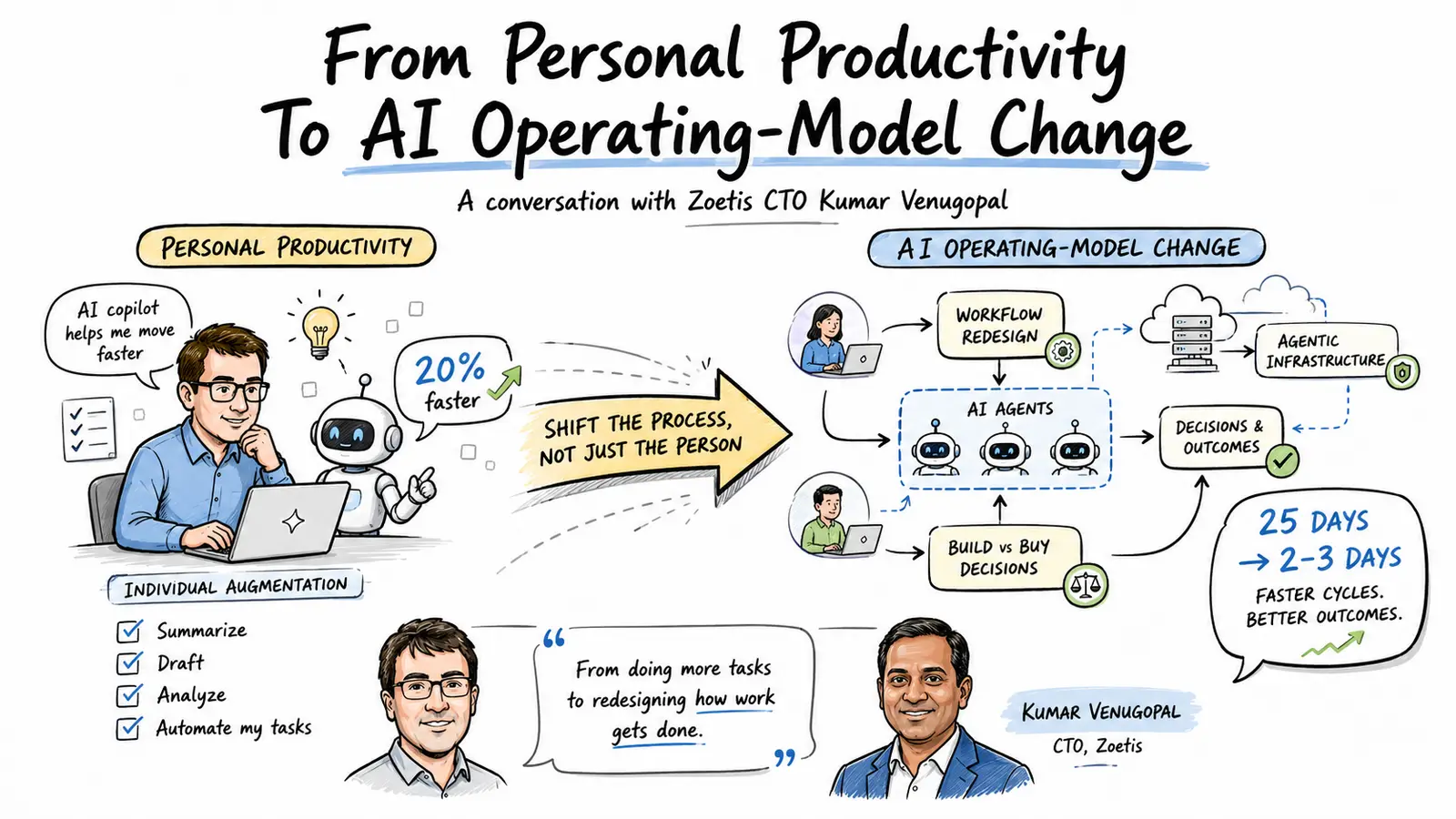
This article is drawn from my conversation with Ed Keisling, Chief AI Officer at Progress Software (Ed Keisling on LinkedIn), on the Scaling AI: From Activity to Impact podcast:
- Episode page: Evolving role of Engineering in the age of AI w/ Ed Keisling CAIO at Progress Software
- Listen on Spotify: Evolving role of Engineering in the age of AI w/ Ed Keisling
Small teams only outrun big Scrum teams when you compress the engineering and QA work inside an opinionated harness, keep the product and architectural tension intact, and build the runway your legacy systems still demand.
Yuval Yeret helps product and tech leaders move from agile theater to evidence-informed delivery. Work with Yuval →