Should SAFe Strategic Themes Have Key Results?
dont follow okr best practices when setting safe strategic themesSAFe Strategic Themes are not OKRs, and treating them like OKRs creates confusion. When to use gradable Key Results vs directional strategic themes in SAFe.
 Click image to open full size
 Strategic Themes in SAFe represent strategic choices at the Enterprise/Portfolio level that should guide decisions throughout the portfolio.
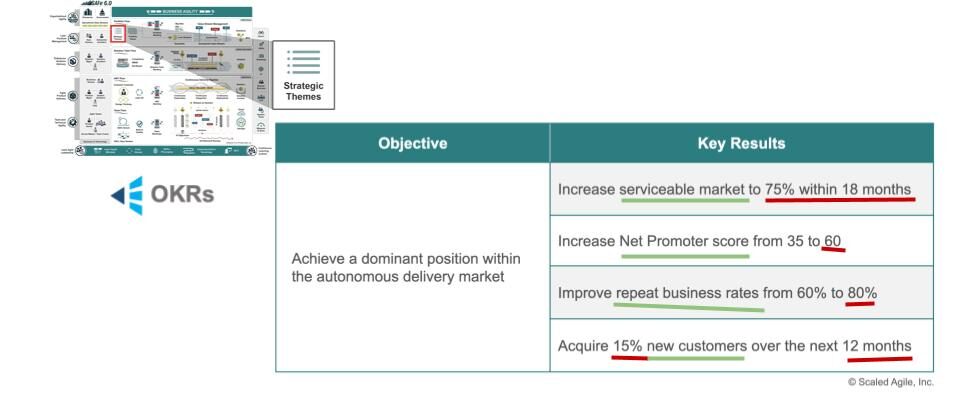
A qualitative Objective accompanied by a quantitative, valuable, and measurable evidence-oriented Key Result connected to a portfolio KPI is a great way to make sure the strategic theme is pointing toward desired outcomes without going into too much granularity. So far, so good.
These OKRs are supposed to be gradable - including specific expectations of what success would look like. For example: improve Net Promoter Score from 35 to 60. This raises an interesting question: how does the LPM team know that this specific target is achievable? When we set Strategic Themes, we might know how far we want to go, but we do not know how realistic that is. We might want to get to a Net Promoter Score of 60, but is that realistic? At all costs?
If we commit to Strategic Theme Key Results prematurely, we risk business predictability and losing people’s connection and motivation. It is similar to the dynamic in PI Planning: ART teams are given direction, but they figure out how far they can realistically go in that direction.
Back at the portfolio level, higher confidence in the target should be based on some involvement from a reasonable representation of the development value streams that will be involved in working toward it. Keep this lightweight unless there is something material about a specific Key Result.
With this in mind - If you want to create better alignment, respecting the people in the portfolio, here are some tweaks to try:
-
Consider drafting Strategic Themes with valuable, measurable, but not gradable Key Results. To use an example from the SAFe article - Instead of “Improve Net Promoter from 35 to 60,” use “Improve Net Promoter Score from 35 to X (60?).”
-
Draft Strategic Themes as described in the current guidance - but consider the Key Results in draft status - to be confirmed based on bottom-up cascading back from Teams to ARTs to the Portfolio.
-
My favorite approach is to build quicker confidence and alignment around Strategic Themes through a strategic planning workshop. Use draft Strategic Themes as input, then use a structure similar to PI Planning to inform value streams, ARTs, and teams as they draft their own objectives and key results, integrate the work, and validate the Strategic Themes. Participants could include the LPM group plus Solution ART, ART, and stakeholder representatives across the portfolio.
Beyond the specific fixes, go back to first principles. In this case, that means SAFe principles such as assuming variability and preserving options, decentralizing control, unlocking intrinsic motivation, and using cadence and synchronization.
Are you seeing this dysfunction in your organization? The real test is whether Strategic Themes help the portfolio steer with evidence, or whether they become premature promises dressed up as strategy.
OKRs work best when they’re connected to how teams actually operate. Explore OKR advisory or let’s talk.
Get the AI prompt swipe file for diagnosing and rewriting broken OKRs: practical prompts for leaders who are done with OKR theater.
Yuval Yeret helps product and tech leaders move from agile theater to evidence-informed delivery. Work with Yuval →