Organizational Traction w/ an OKRs Kanban
Treating OKRs as a Kanban system: visualizing strategic work, limiting WIP at the leadership level, and using Kanban cadences to review and adapt strategic priorities.
 Click image to open full size
 The OKR Swamp
What gets measured gets managed. But setting OKRs is not enough. The flow and traction of OKRs need to be managed as well. Otherwise, leaders end up with a swamp: too many objectives in motion, unclear ownership, stale updates, and a quarterly grading ritual that tells everyone what already went wrong.
If you want to pull your OKRs out of that swamp, you need to manage their flow. Here is how treating your OKRs as a Kanban system can actually help you see the work, limit the noise, and gain real strategic traction.
The First Act of Focus: Finding Your Real OKRs
If everything is an OKR, nothing is. Before you try to manage the flow, you need to figure out which OKRs actually belong on the board.
A common dysfunction is that an organization tries to run its entire operation through OKRs. The business-as-usual (BAU) work, the standard KPIs that just need monitoring, the basic operational health checks—they all get dressed up as OKRs. The result is a backlog that looks like a chocolate factory assembly line with no pacing.
To fix this, put everything you currently call an OKR on a board and run a filter. Separate the true strategic bets—the disruptions, the new capabilities, the shifts in your operating model—from the KPIs and the BAU work. This pruning is your first act of focus. You will find that your actual OKR count drops significantly.
Visualizing the Flow: The OKR Kanban
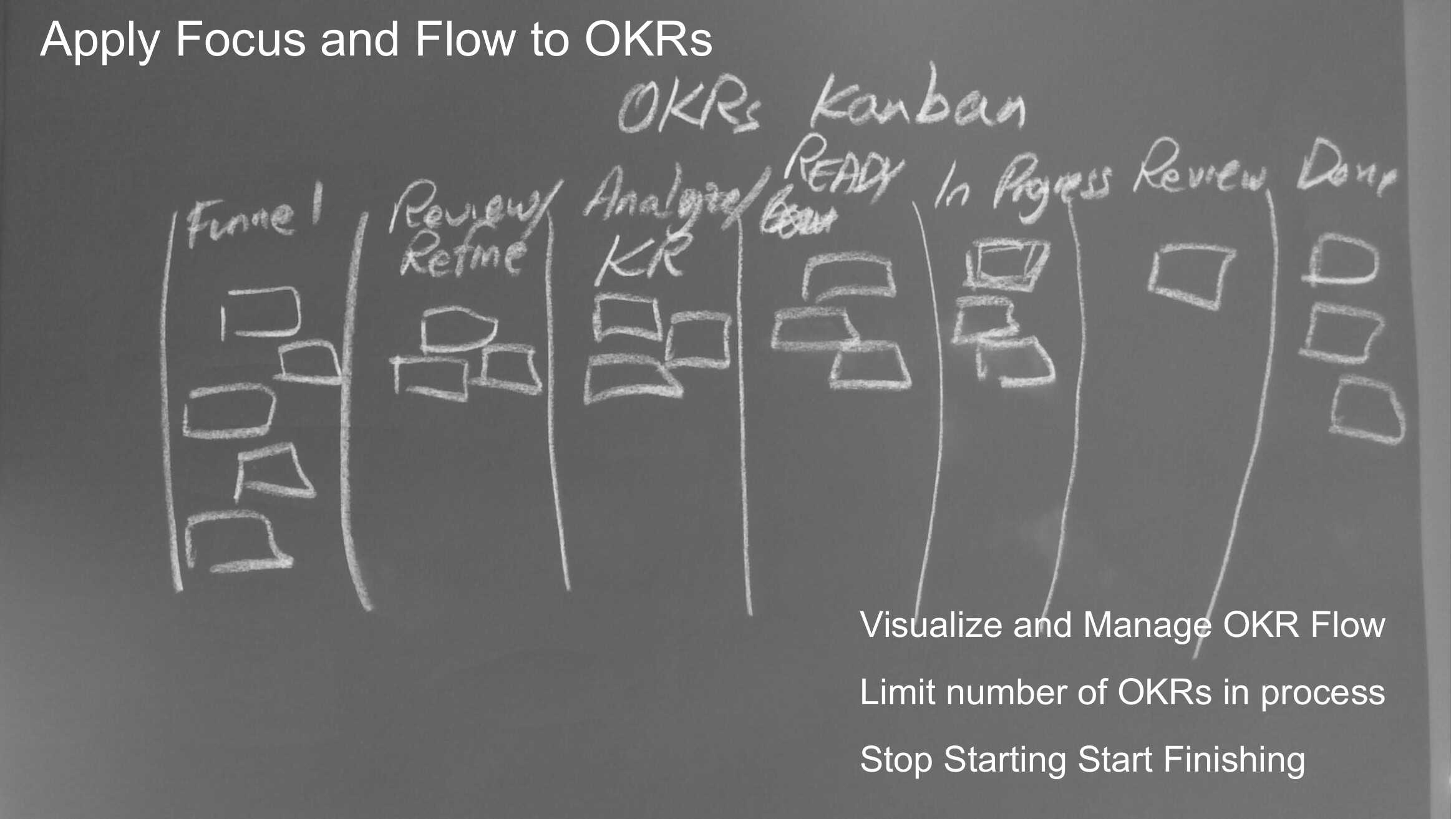
An OKR Kanban makes the strategic flow visible. It helps leadership teams see which objectives are being considered, which are committed, which are actually moving, and which are stuck.
When you set up your OKR Kanban, build it around a real workflow. A typical flow looks like this:
- Considering/Exploring: Ideas for strategic interventions or bets.
- Planning/Committing: Refining the objective and key results, and having conversations with the people who need to be involved.
- In Progress: The actual experimentation and execution toward outcomes.
- Review/Adaptation: Checking traction on a cadence, regardless of whether the OKR is “done.”
- Done: The objective no longer requires active focus.
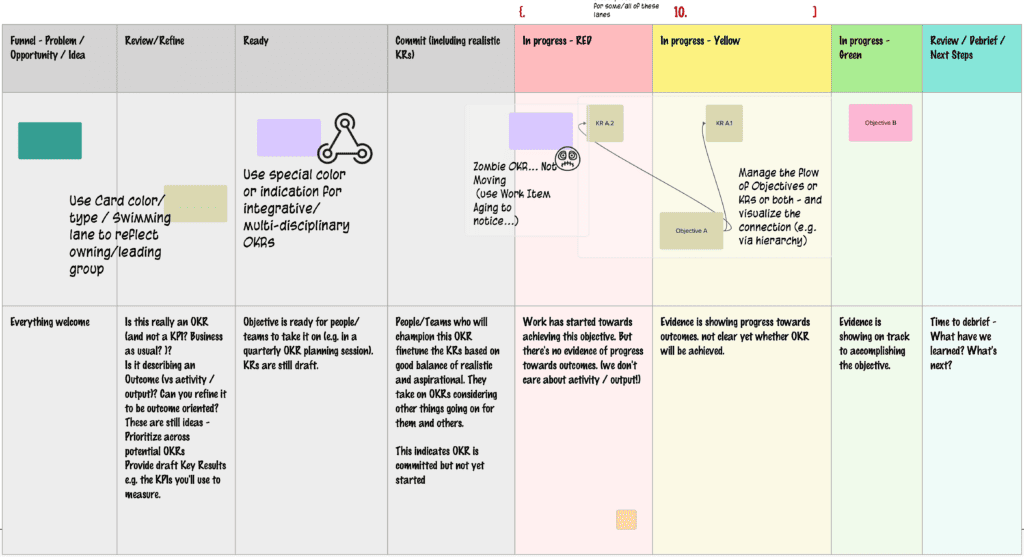
Here is what this looks like in practice:
The Case for One Common Board
I strongly recommend keeping one OKR Kanban board for the entire organization or portfolio, even if you are scaling.
It is tempting to divide and conquer by giving every department its own board. Do not do it. OKRs are cross-functional by nature. When you split them up, you lose the transparency that makes OKRs valuable in the first place. You can use colors or horizontal swimlanes to denote different groups, but keeping them on the same board reinforces alignment and exposes misaligned priorities immediately.
Managing Traction: Red by Default
How do you know if an OKR is actually moving? One of my favorite patterns is the Red/Yellow/Green traffic light system—but you have to use it with a “watermelon approach” (assuming red by default).
When an OKR starts, it should be Red. You have started the work, but you do not yet have evidence that it is affecting the key results.
OKRs must earn their movement to Yellow (we are seeing some progress toward outcomes, not just output) and Green (we have strong evidence this is on track to accomplish the objective). I do not care if you have spent money, written 100 stories, or held a bunch of meetings. If there is no evidence of an outcome, it is not green.
This turns subjective status updates into objective flow conversations. If an OKR has been sitting in Red for a month or two, that is a signal. In Kanban terms, that is Work Item Aging. It tells the leadership team that something is stuck and needs attention.
Limit WIP and Preempt the Swamp
Once the work is visible, limit the number of OKRs in progress and in consideration. Focus drives traction. If your board is too busy, that is a clear signal that your strategic capacity is overbooked.
A great exercise when you first map out your board is to “fast-forward.” Ask the team: Let’s fast-forward a month, or a quarter. What do we think this board will look like?
People will quickly anticipate where things will accumulate, where dependencies will block progress, and where reality will interrupt the committed OKRs. Use that foresight to preempt the blockers before they happen.
The Real Question
The useful question is not whether you have OKRs. It is whether your leadership system is managing their flow.
Can you see which objectives are stuck? Can you tell when too many strategic bets are competing for the same capacity? Can you adapt while the quarter is still alive?
If you want a practical next step, the Organizational Traction Trail Map is designed to help leaders of scale-up and midsized organizations break free from scattered priorities and bring more flow, focus, and clarity to strategic work.
Practical thinking on turning AI pilots, adoption, and portfolio work into business impact - by finding the constraint, changing the work, and proving value as you go.
Yuval Yeret helps product and tech leaders move from agile theater to evidence-informed delivery. Work with Yuval →