Keep Calm and Scrum (With Kanban) On!
why i decided to stop being a pstI decided to pause my membership in the PST program. I still believe in the heart of Scrum and Flow.
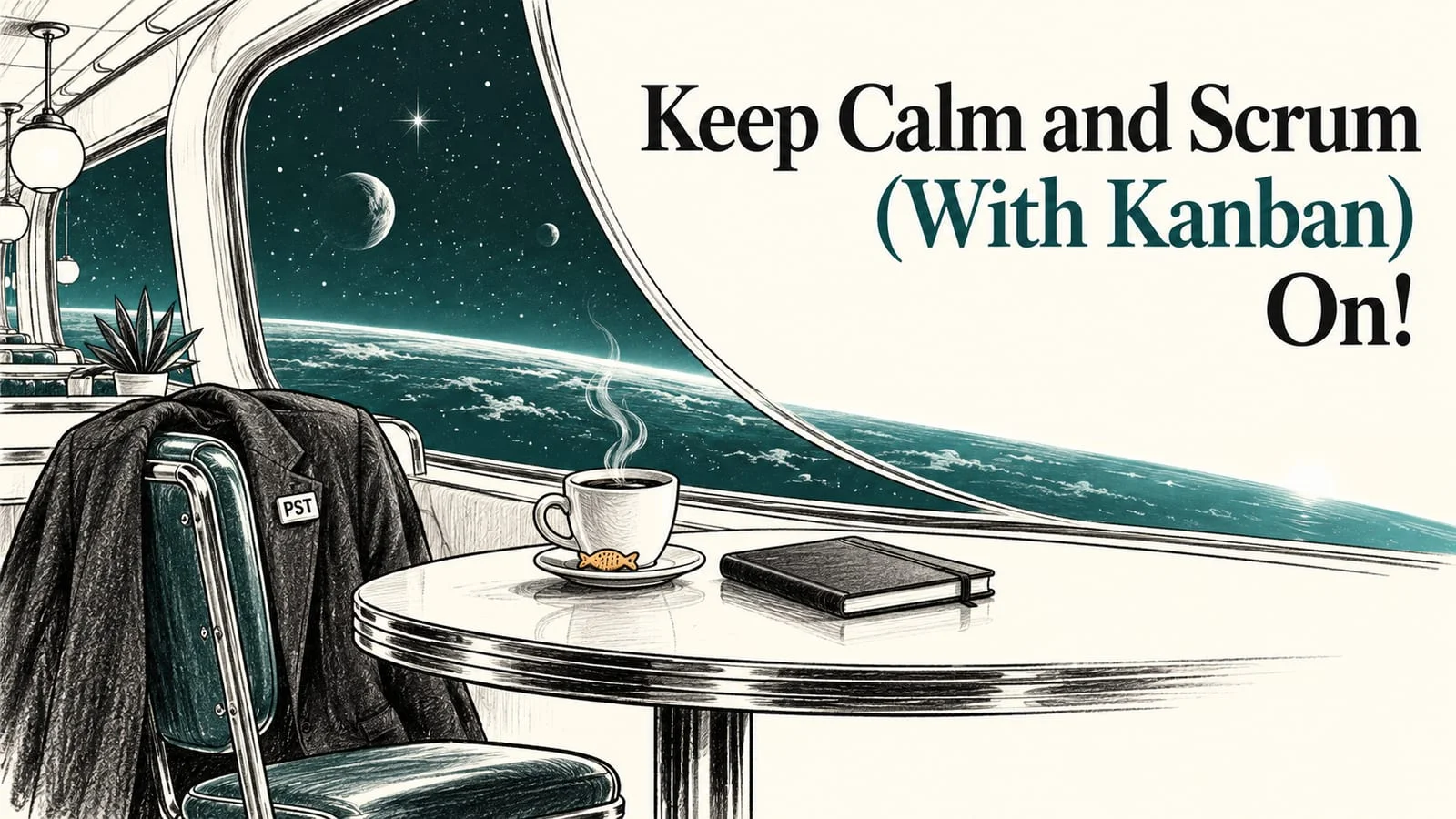 Click image to open full size
I’ve been struggling with a major dilemma for a while. The long story short is that I decided to pause my membership in the PST program. This wasn’t and isn’t an easy decision. And I wanted to take this opportunity to reflect on the arc of my journey with Scrum.org and where I think this is going.
2017–2018: bringing flow into Professional Scrum
I joined Scrum.org as a PST at Dave West’s request to help bring flow and Kanban into the Professional Scrum community.
Creating the Professional Scrum with Kanban class and Kanban Guide for Scrum Teams together with Daniel (Vacanti) & Steve (Porter) and then working on getting it to market in a professional way (how else?) with the Scrum.org staff has been a great experience. It reinforced my love for true Scrum.
A few of the posts from that work are still very popular on the Scrum.org blog:
Scrum beyond the team
I’ve always been focused on scaling Scrum and agility. As the only SAFe SPCT/Fellow who’s also a PST, I’ve tried to shift the conversation from the methodology wars to synergies and collaboration to help bring the ideas of Professional Scrum to a wider audience. I partnered with Dave West to write the Scrum Guide Companion for Leaders, helped practitioners and leaders Compare Nexus and SAFe and explored How to Fix OKRs with Evidence-Based Management and Scrum.
For more on my work as a PST throughout the years, check out my conversation with Ryan.
More recently, my focus was on helping leaders shift towards a more product-oriented agile operating model:
- Project to Product Operating Models in a Portfolio Context
- The Irony of Managing a Product Operating Model Transformation Like a Project
- Cross-Product Initiative Ownership
In 2025, Dave and I explored how to leverage Scrum and agility as a business operating system to develop your company as a product, in AI and the Implications for Your Organization’s Operating System.
Scrum Theater is Dead. Long Live True Scrum?
In recent years, we’ve seen the landscape of agile training shift dramatically. We’ve seen Scrum and Agile in general become “Voldemort” in some organizations, as a result of the horrors of Agile Theater and the Scrum Masters and coaches becoming the agile police. The economy is in a very different place, and the Agile FOMO has turned into Agile JOMO (Joy of missing out).
At some point, the Scrum community, and especially our conversations in the PST community, started to feel like The Restaurant at the End of the Agile Universe.
Agile was an amazing platform for so many of us. But now it’s tempting to declare defeat, hide your Scrum and Agile badges, and move on.
I don’t think Scrum is dead. I still believe in the heart of Scrum and Flow. I believe agility and product thinking have a major role in the future of product development and knowledge work. But I won’t surprise many of you when I say that Scrum and agile ways of working need to shift to underground guerrilla warfare in the foreseeable future.
When you’re fighting guerrilla warfare you don’t wear your dress uniform and your rank. When you’re trying to help organizations become more agile, despite their distaste for the Agile/Scrum brand, being a PST can unfortunately be a liability, rather than an asset.
What does the future of Scrum/agility look like in an agentic software/product development world?
If you’ve been following me on Scrum.org, LinkedIn, or this blog, you’ve seen how my focus evolved towards AI-adjacent scaling and agility challenges and how I recently dove even deeper into the shift towards AI spec-driven development, SDLC and PDLC. In a sense, real agility might have been waiting for AI.
Recent threads on the Scrum.org blog include AI Didn’t Kill Agile. It Moved the Bottleneck, Spec-driven Development Isn’t Waterfall (Unless You’re Using It That Way), and How to Leverage Flow Metrics to Accelerate Your Agentic Development Lifecycle.
Developing Your Company Like a Product - The Case for Scrum beyond IT / Software
My work in the trenches as a PST continuously explored new frontiers for Scrum: developing razors at Gillette and approaching the company using an agile product model at biotech firms such as Dyno Therapeutics.
The quest for company-level AI leverage in knowledge work is a continuation of this work. Empiricism/flow/continuous improvement/self-management are needed for the complex technical and human challenge of scaling AI from local activity to enterprise leverage.
I’ve talked for a while about developing your company as a product. AI and how it invites/requires organizations to standardize work as context for agents make this vision for “company operating system as code” much more tangible. We can now develop our operating systems and processes iteratively like products, realizing that true adoption doesn’t happen through mandates. It happens through choice and motivation.
It’s a fascinating frontier I’m spending more and more of my attention on, including a new venture I’m joining to help explore that space. (Stay tuned for more details…)
Where’s the future of Scrum? My prediction is that it’s in this blue ocean of reimagining how knowledge workers tackle complex work such as how to effectively leverage AI.
I hope Scrum.org will pivot towards this direction. And I’ll be the first to come back and help with this shift.
Keep in touch
But for now, I decided that the right move for me is to pause my PST. Which means I won’t be able to share my insights on the Scrum.org blog. I will miss the opportunity to bring my point of view to the Scrum.org community…
If you want to stay in touch while I’m away on a break, here’s where you can find my work on scaling AI from activity to impact using agility and product thinking:
For now, so long, and thanks for all the fish…
Keep calm and AI on! (with Scrum/Kanban inside…)
Practical thinking on turning AI pilots, adoption, and portfolio work into business impact - by finding the constraint, changing the work, and proving value as you go.
Yuval Yeret helps product and tech leaders move from agile theater to evidence-informed delivery. Work with Yuval →
- 01 The Two-Word Check-in: A Minimal Daily Meeting 1 min
- 02 The Fixing OKRs Live Stream Series 1 min
- 03 Fixing OKR Theater Using Scrum 8 min