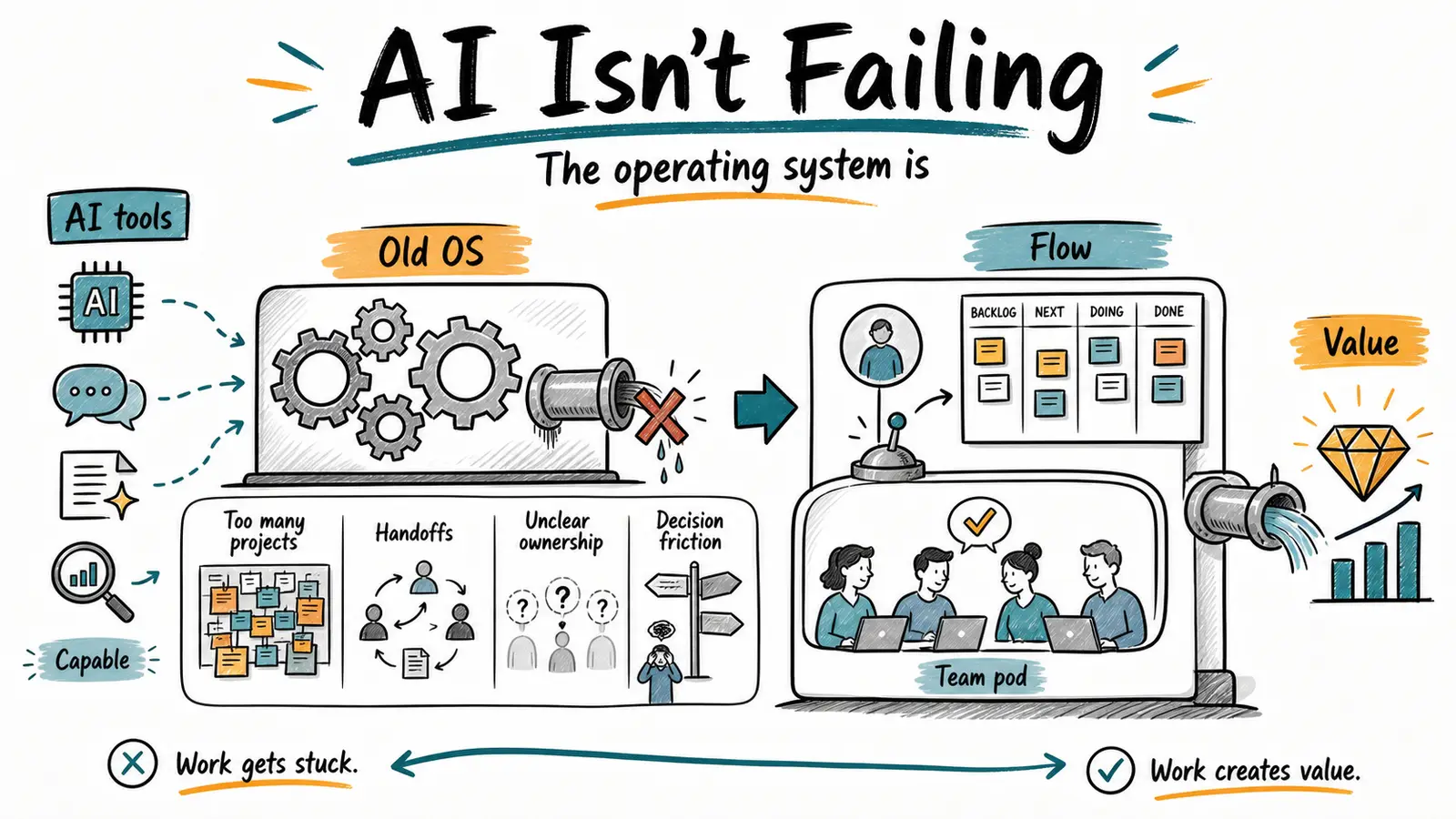
Stop Pushing AI Change. Build a Product People Pull.
stop pushing ai change build a product people pullGiving everyone AI access produces people talking to AI, not meaningful organizational change. Why absorption capacity, pull-based change, and the employee pot of gold decide whether AI sticks.
 Click image to open full size
Why Giving Everyone AI Access Still Leaves the Organization Unchanged
For a while now, I have been seeing the connections between product management and organizational change, whether inside software development or across finance, marketing, sales, and how the organization manages itself.
If we talk specifically about AI, it is a great use case for the challenge with organizational change. The technology is great. There are a lot of things we can do, and the models are amazing. Yet if you look at the organizations trying to really get meaningful results from this technology, most of them are not getting the results. Even organizations that are giving everybody access to AI are getting the result of people talking to AI, not really doing or changing meaningful things in their organization with it.
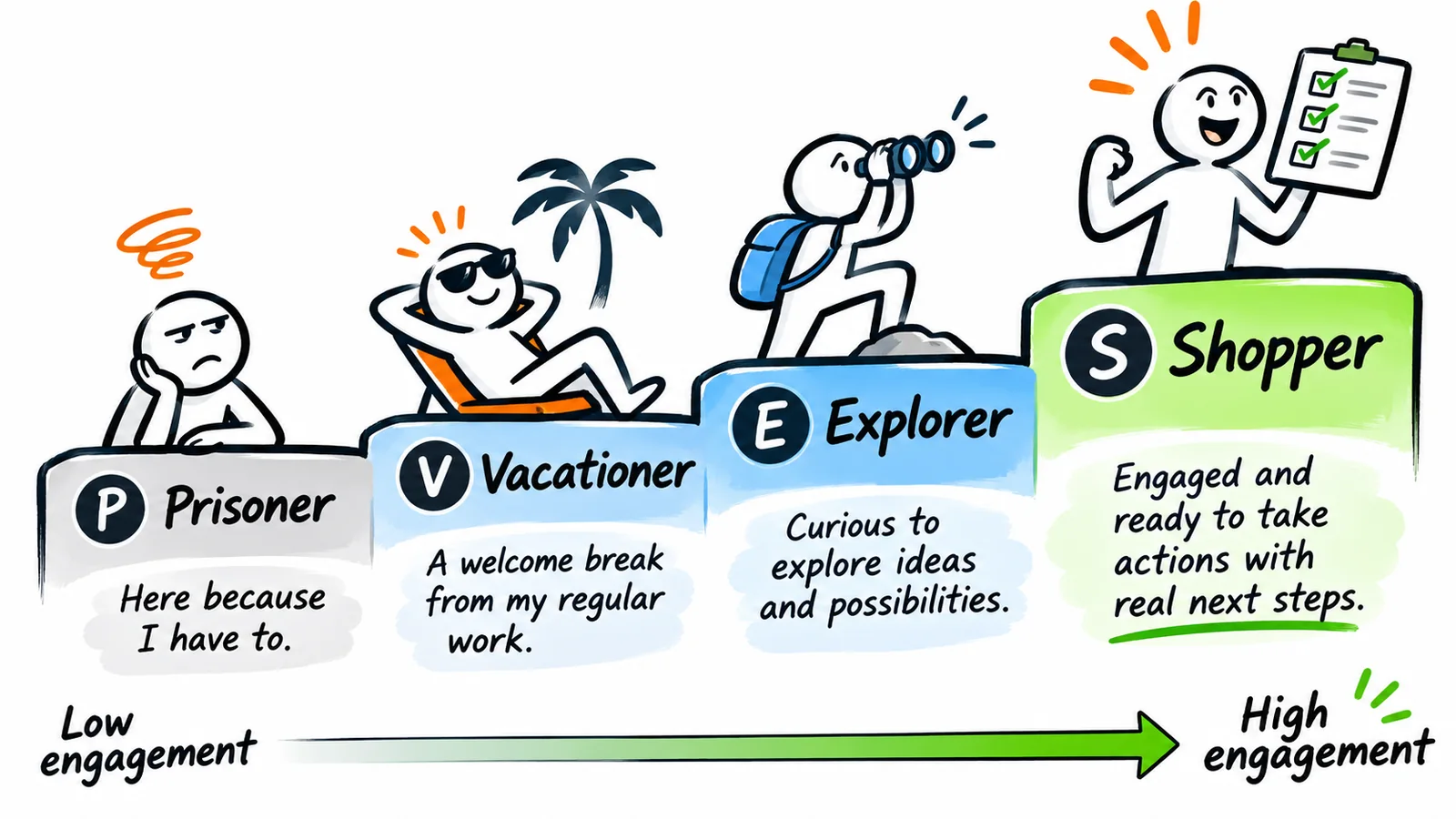
There is a model we look at in change that starts to explain why. In any session or organizational change, people show up in one of four stances: Explorers who are curious about ideas and possibilities, Shoppers who have seen concrete problems and want to figure out what to do about them, Vacationers who treat it as a welcome break from regular work, and Prisoners who feel forced to be there. When I go into an organization and help with change, we see prisoners. We see people who are not really engaged and not really committed to what we are doing. Let’s explore some of the reasons that’s the case…
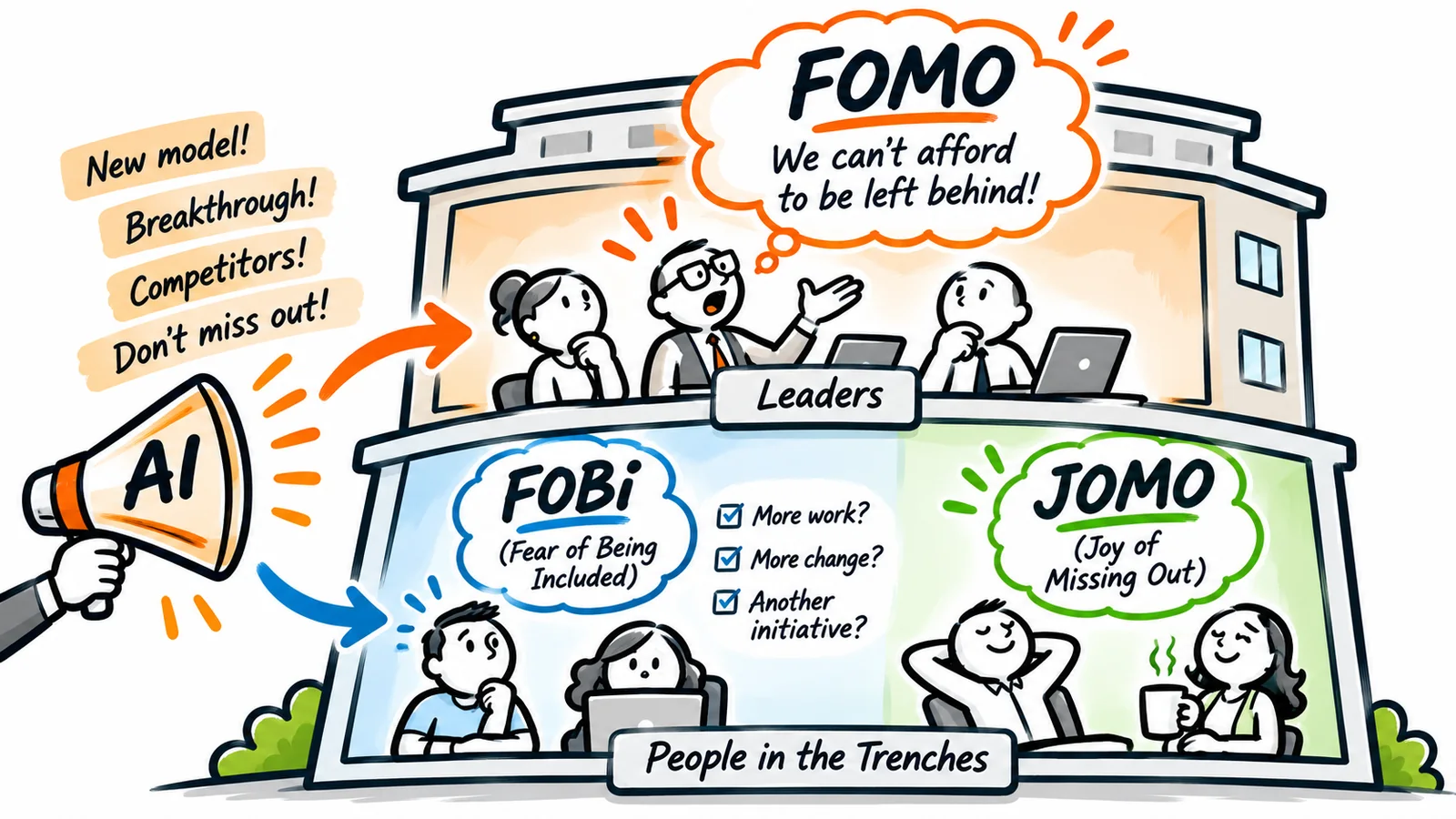
Leaders Are in FOMO. The Trenches Are in FOBI and JOMO.
AI is going through all organizations right now, and it is creating a lot of FOMO, a lot of fear of missing out, especially among leaders. They feel like they cannot afford to be left behind. AI is not the first time FOMO has hit an organization. Every couple of years there is a thing organizations feel they need to do because their competition is doing it: the quality movement, TQM, CMMI, ITIL, Lean, Six Sigma, Agile, product transformation.
If you go to the people in the trenches, they look at this thing and all they see is more work. It is something else to take care of beyond the work they are already doing. They are not in FOMO mode; they are in FOBI mode, the fear of being included. They want somebody else to be the guinea pigs for this new thing. They actually enjoy missing out on the change. They are in JOMO while their leaders are in FOMO.
(At this point, you can probably see why people feel like prisoners… or enjoy a vacation to hide out from the change/transformation work… )
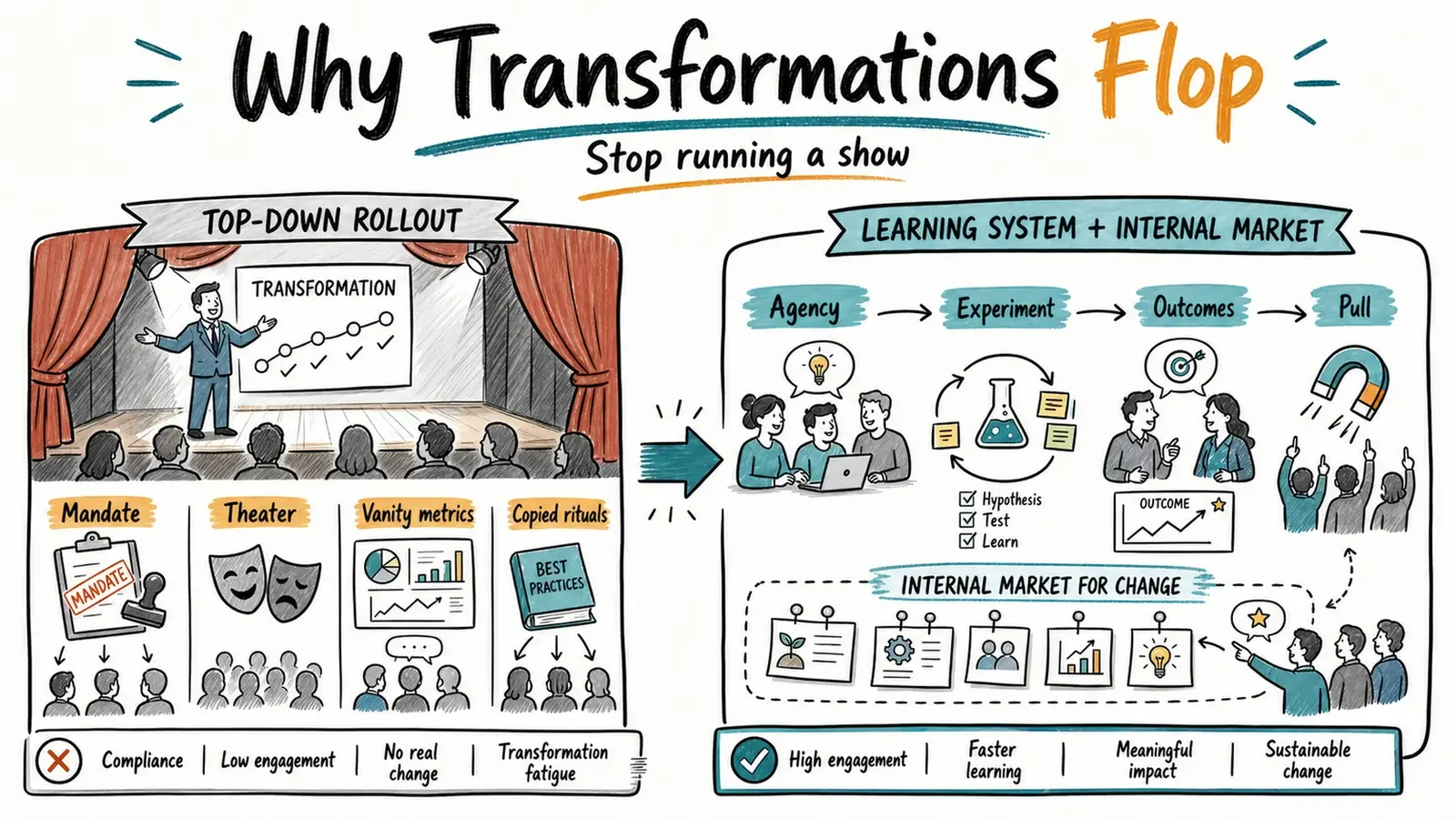
A lot of the time, when change comes in through FOMO, it looks like the South Park Underpants Gnomes episode. There is a goal at the end: profit, shareholder returns. We want to do AI, we want to do Agile, we want to do Lean Six Sigma. Then we ask the people in the trenches to do something, like collecting tons of underpants, and nobody (especially not the people in the trenches) understands why. We talk about the end goal, and then we go straight to the theater of the work we expect people to do, without connecting it to the purpose or mission.
When you do that, you get a top-down rollout that creates theater and cargo cult behavior. Like the Pacific islanders during World War II who saw airplanes and supply drops, and after the real airplanes left, built wooden airplanes and wooden tanks hoping to get the same results. That is theater, vanity metrics, and copied rituals without the essence. What you want instead is a hypothesis on cause and effect: we believe if we change this, it will lead to that, and that is a belief we need to test in a scientific fashion.
Pushing More Change Slows the System Down
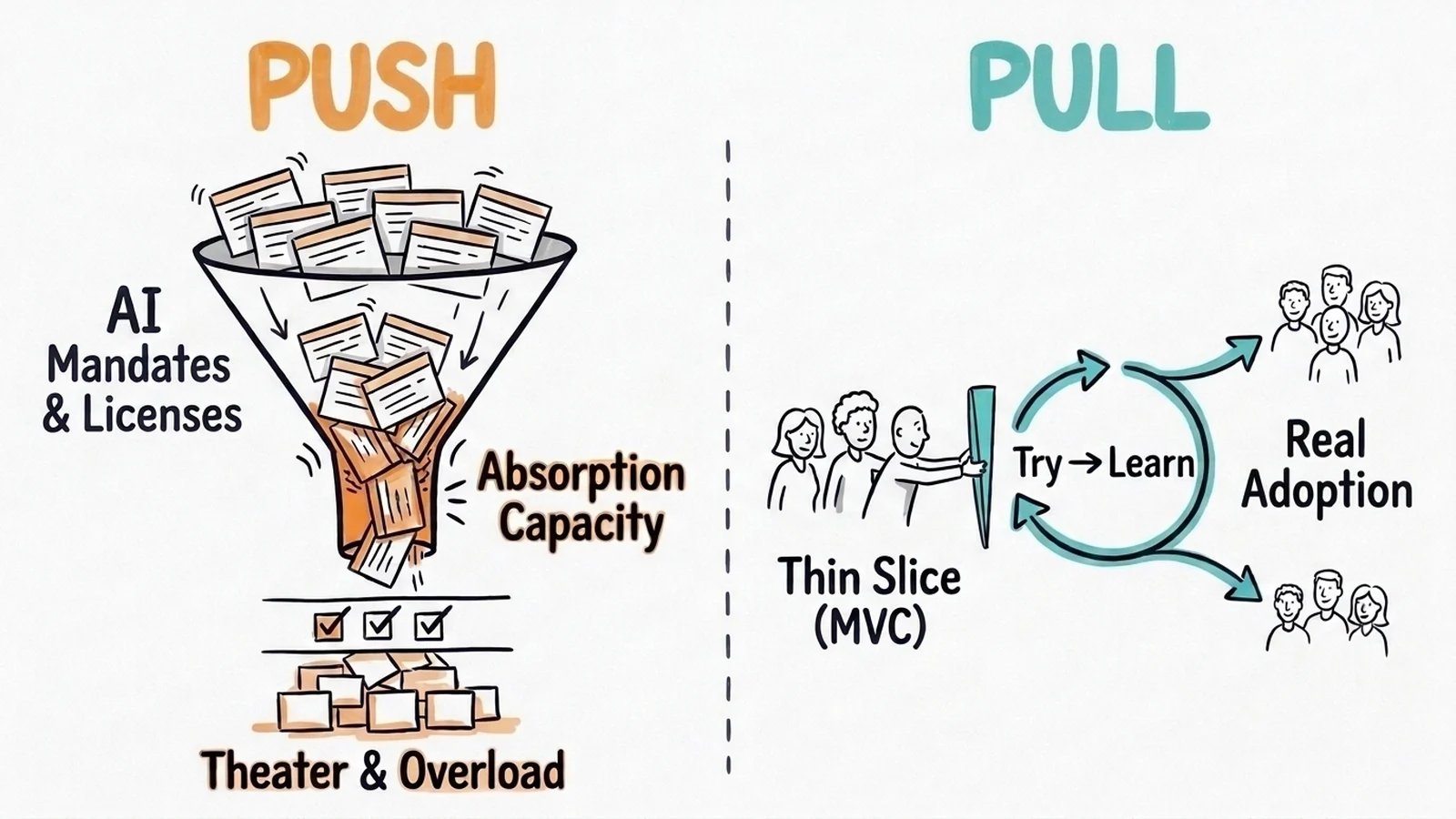
Another pattern I often see is that the organization just pushes, pushes, pushes change. Let’s do AI, let’s do digital transformation, let’s do OKRs. Everything is a goal, an endless number of goals, and nobody pays attention to the capacity of the organization to actually deal with the change. People have a limited capacity for change, and it is a very limited capacity.
In the I Love Lucy chocolate factory scene, the kitchen is disconnected from what is actually going on. The people in the kitchen keep creating chocolates and expecting Lucy and Ethel to pack them, and they cannot keep up. In most organizations it is not very safe to say, “Hey, we can’t keep up.” So people try to do what they can, and the quality of the change and the quality of the work drops until it becomes unsustainable.
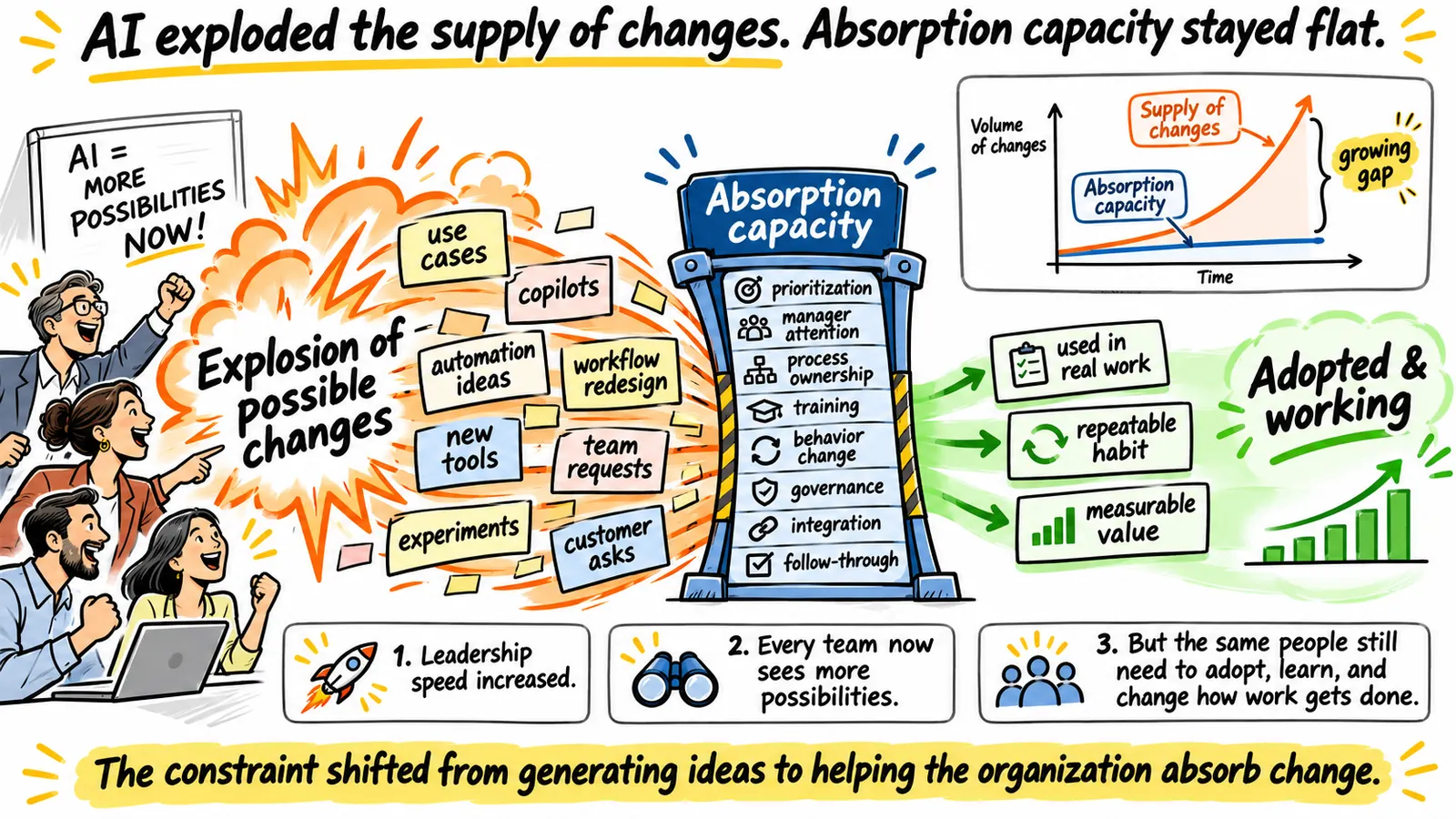
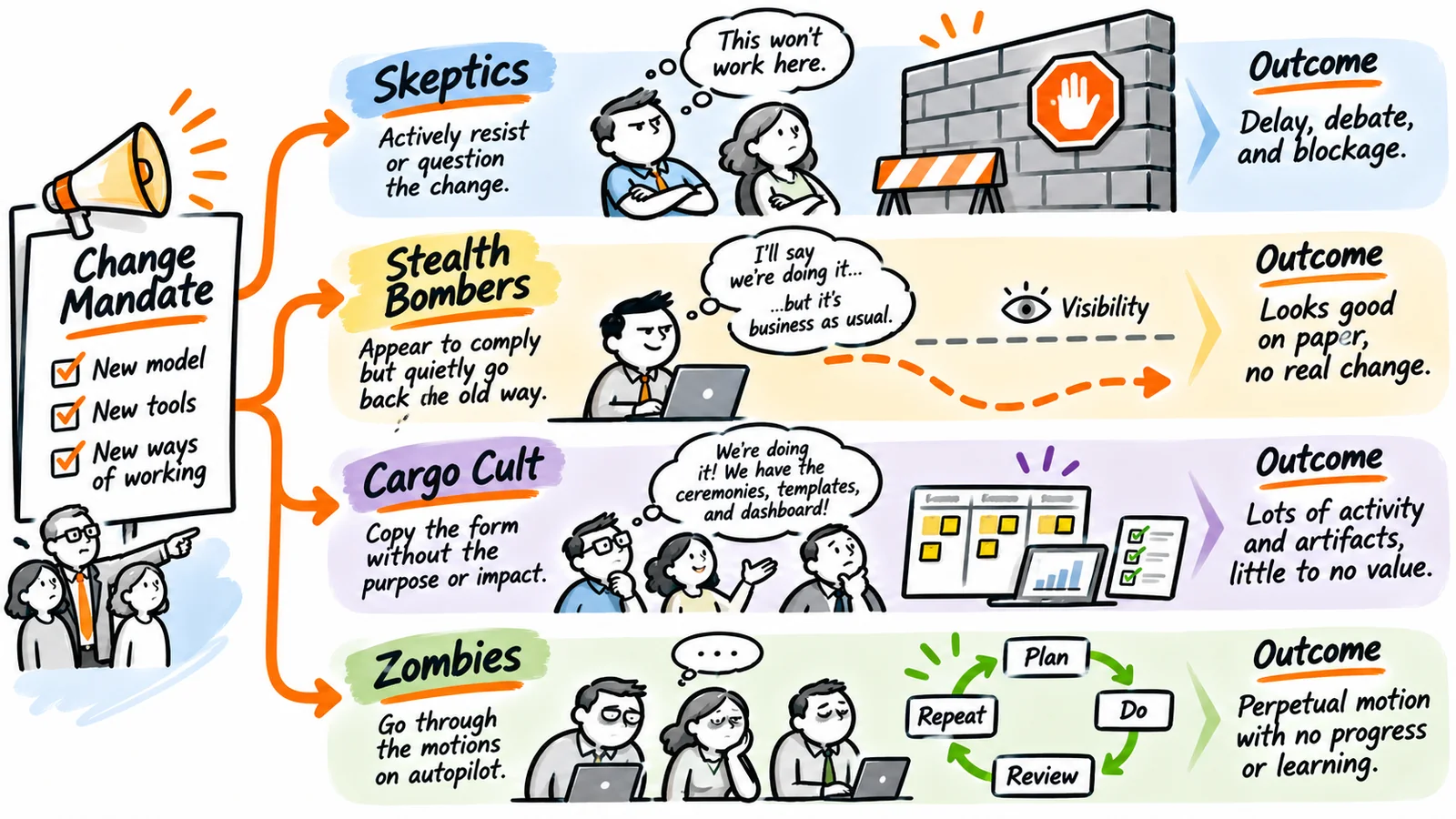
It is like pushing paper into a printer. If you keep pushing paper into a printer, it is not going to print faster; it is still going to print at the pace it prints. If you keep pushing cars onto I-90 or I-93, the highway does not become faster; it becomes slower. Whenever you give in to the change mandate under that kind of overload, you start to see at least four patterns:
- Skeptics, who push back openly.
- Stealth bombers, the people who appear to comply but quietly go back to the old way (and sometimes even sabotage).
- Cargo cult, copying the form without understanding the purpose.
- Zombies, who just go through the motions and never change anything meaningful.
In the world of AI, there are so many opportunities and so much change that is possible, yet the absorption capacity is the constraint. That is where the 95% of enterprise generative AI projects failing to produce meaningful results (as MIT’s 2025 State of AI in Business report found) lose out. The constraint is the organization’s ability to drive and absorb change.
What Pull Looks Like at Scale: Amdocs and CME Group
Look at a real example from about 14 years ago at Amdocs, in a delivery group of more than 4,000 professionals. Just after the 2008 recession, telecom customers were waking up and asking for more and more projects, and Amdocs was facing problems delivering them. Having seen the problems with classic top-down change in previous transformations, we decided to do this differently. The first thing we did was nothing: we exposed a couple of leaders to a flow-based approach (Kanban) without forcing anyone.
A VP running their biggest division had enough problems with how her projects were going. With the first iPhone rolling out, a major telecom customer was demanding constant billing changes, and her current methodology was lacking. She had an urgent, real problem that her current way of working was not good enough for. That is what we call pull: an urgent need where current options are lacking. Instead of mandating anything, we met in her office and sketched a different way to think about it on her whiteboard. Within two weeks, we installed the system and she started managing the work that way.
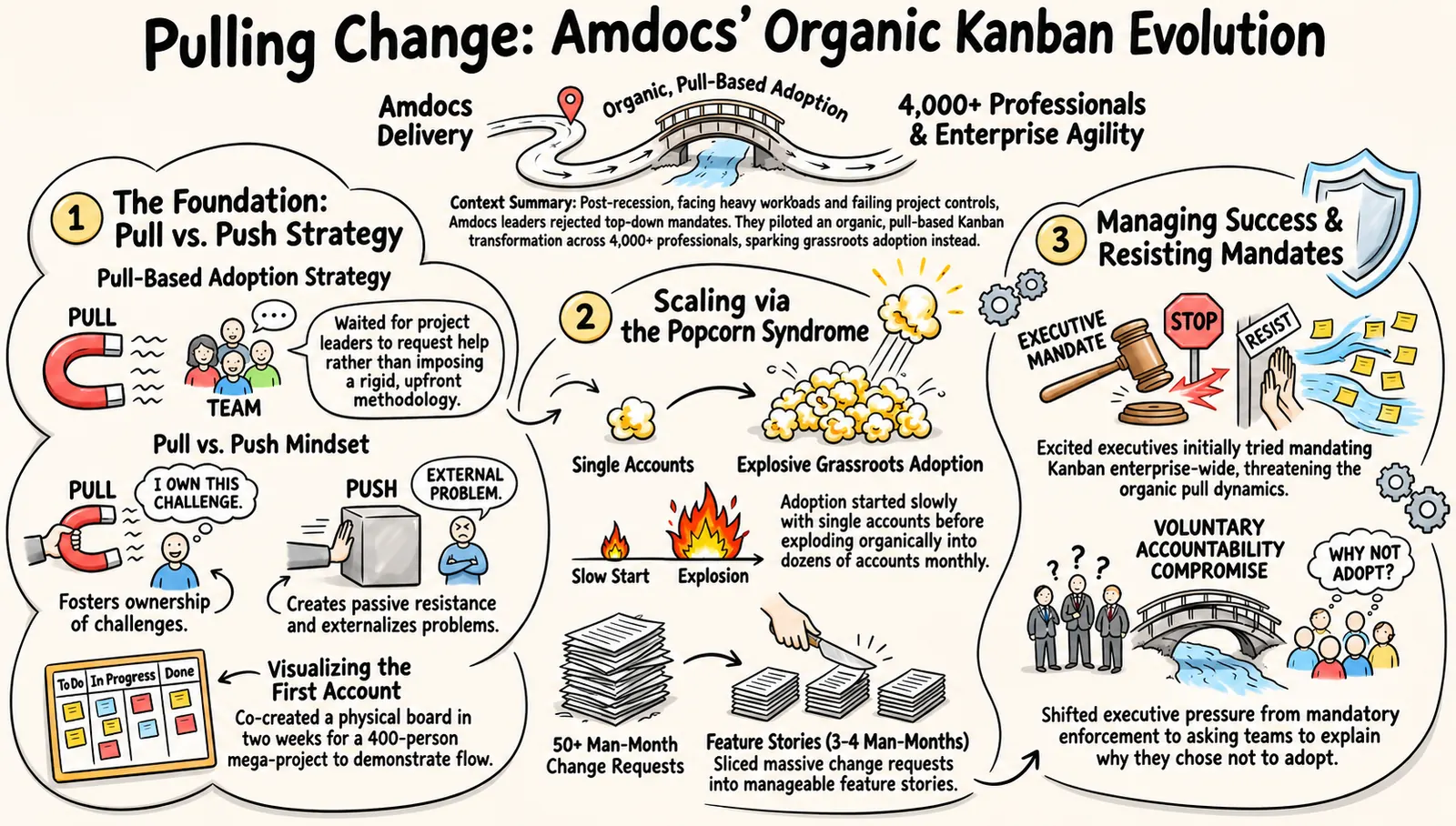
Then she talked to other VPs who had similar problems across other carriers. We did not tell them they had to change, but we prepared to help them change. We took what she was doing, created a case study from it, and marketed it to the rest of the organization. That internal marketing worked. More and more groups came to the transformation team asking to do things differently. It almost became like popcorn, pops of new places wanting help all the time. In product development, that is the feeling of product-market fit: suddenly there is so much demand you can barely keep up.
In parallel, senior leadership noticed the success, and we faced the risk of them mandating it for everybody. We feared that moment because we knew that the moment you start forcing people to change, the dynamic changes forever. Change spread faster because managers pulled it to solve their own problem, while keeping the autonomy to decide when and how to change.
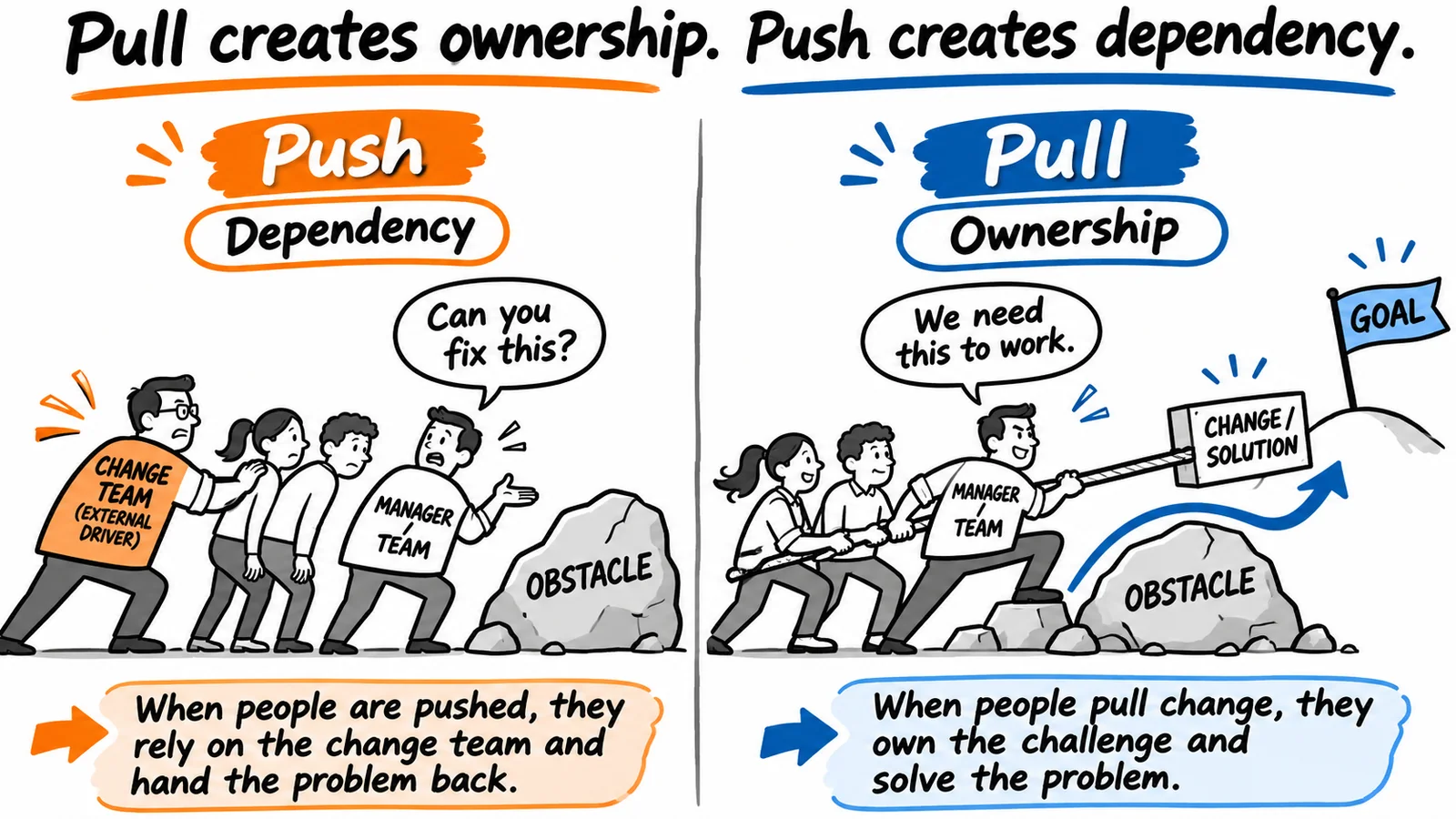
A common question about this approach is: how do you get an early-adopter leader to publicize their success across the company? It is similar to a product company getting early customers to share testimonials. People like to share their successes, and it feeds intrinsic motivation and mastery. More importantly, there is a natural overlap between early adopters (the people willing to work with you while the change is still clunky and before full playbooks exist) and the people willing to share. Your role as a change agent is to enable them: interview them, feature them internally, and put the spotlight on them. As an internal leader of change, you need to be a marketer.
Making Business Leaders the Heroes
Let’s explore another example at a global futures exchange. When we first saw product transformation efforts there, the organization had not had the patience to use pull, so all of those compliance patterns showed up. A big rollout had produced slick presentations and processes that worked great on paper, without the impact yet. When we shifted to engaging portfolio and business leaders directly and involving them in designing the change, everything moved. Leaders are people: they are motivated by autonomy, by having choices, and by connecting to a real mission. Working one-on-one with a portfolio leader there, I reached a point where I barely had to speak on calls with other leaders because he was driving the conversation himself. He became the hero of the change. The transformation team does not need to be the hero; we need to be the shepherds and enablers, while the leaders in the trenches are the heroes.
People Do Not Resist Change. They Protect Their Mermaid.
In Eliyahu Goldratt’s Isn’t It Obvious? story, people argue over whether everyone naturally resists change. The answer is no: people only resist changes they have a good reason to resist. Every person weighs four forces before changing:
- The pot of gold: the upside of changing, from their perspective (not yours).
- The alligator: the pain of staying where they are.
- The crutch: the effort, time, and risk of making the change.
- The mermaid: the pluses of not changing, the things they like and would have to give up.
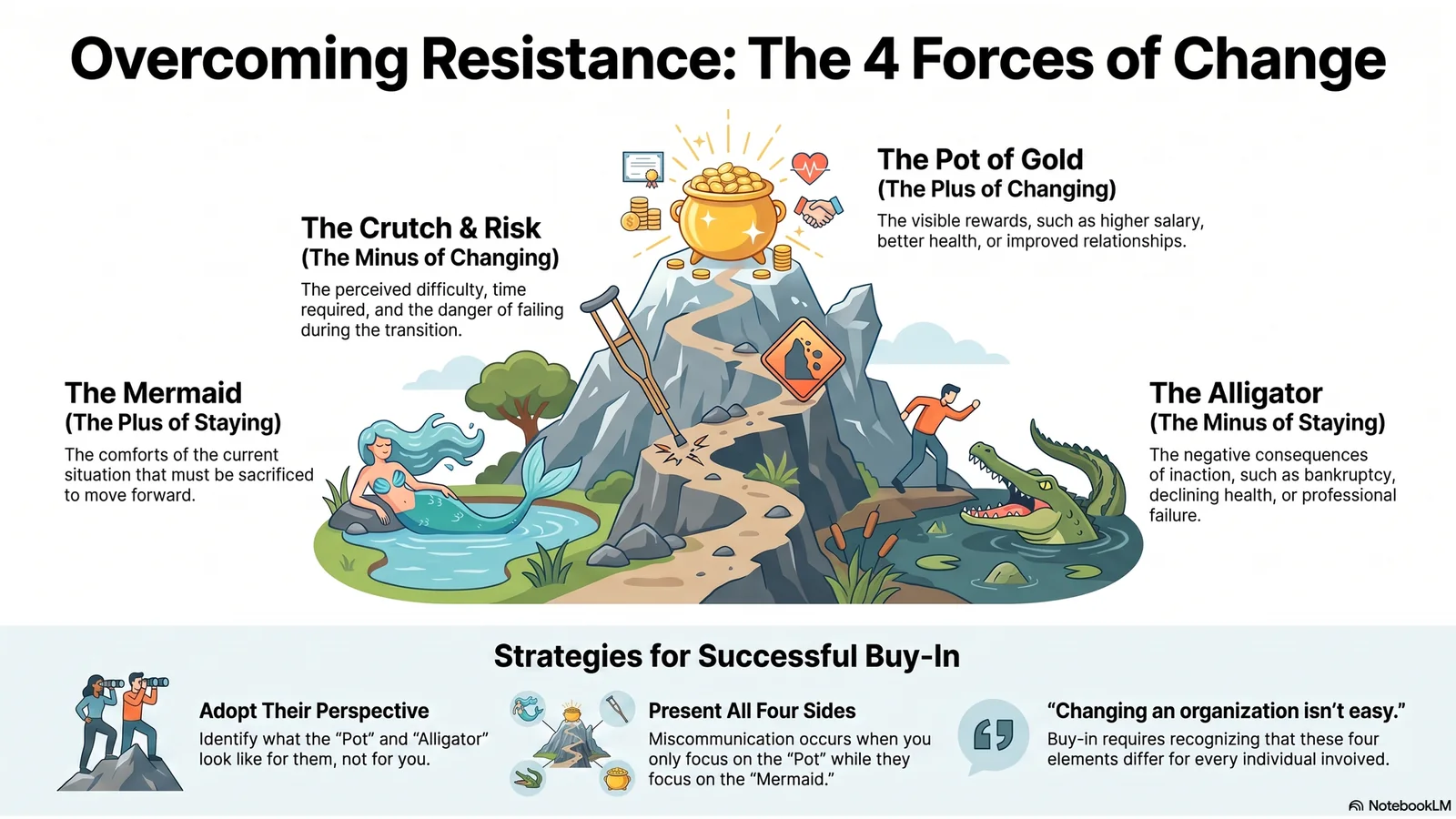
People will not change unless the pot of gold is big enough, the alligator is sharp enough, the crutch is manageable, and they do not have to give up their mermaid. When you apply this to an AI transformation from the employee’s perspective, a very real concern comes up immediately: losing my job, becoming redundant.
I see that as the mermaid of the current way of working. As long as my organization is not going into AI, I have my mermaid: I have my job and the way I know how to work. Once we start moving into AI, I have to leave that behind, and it is not clear whether there is a pot of gold for me as an individual. The problem we are seeing right now in most organizations is that the mermaid is very big, and the pot of gold for the employee is small to nonexistent.
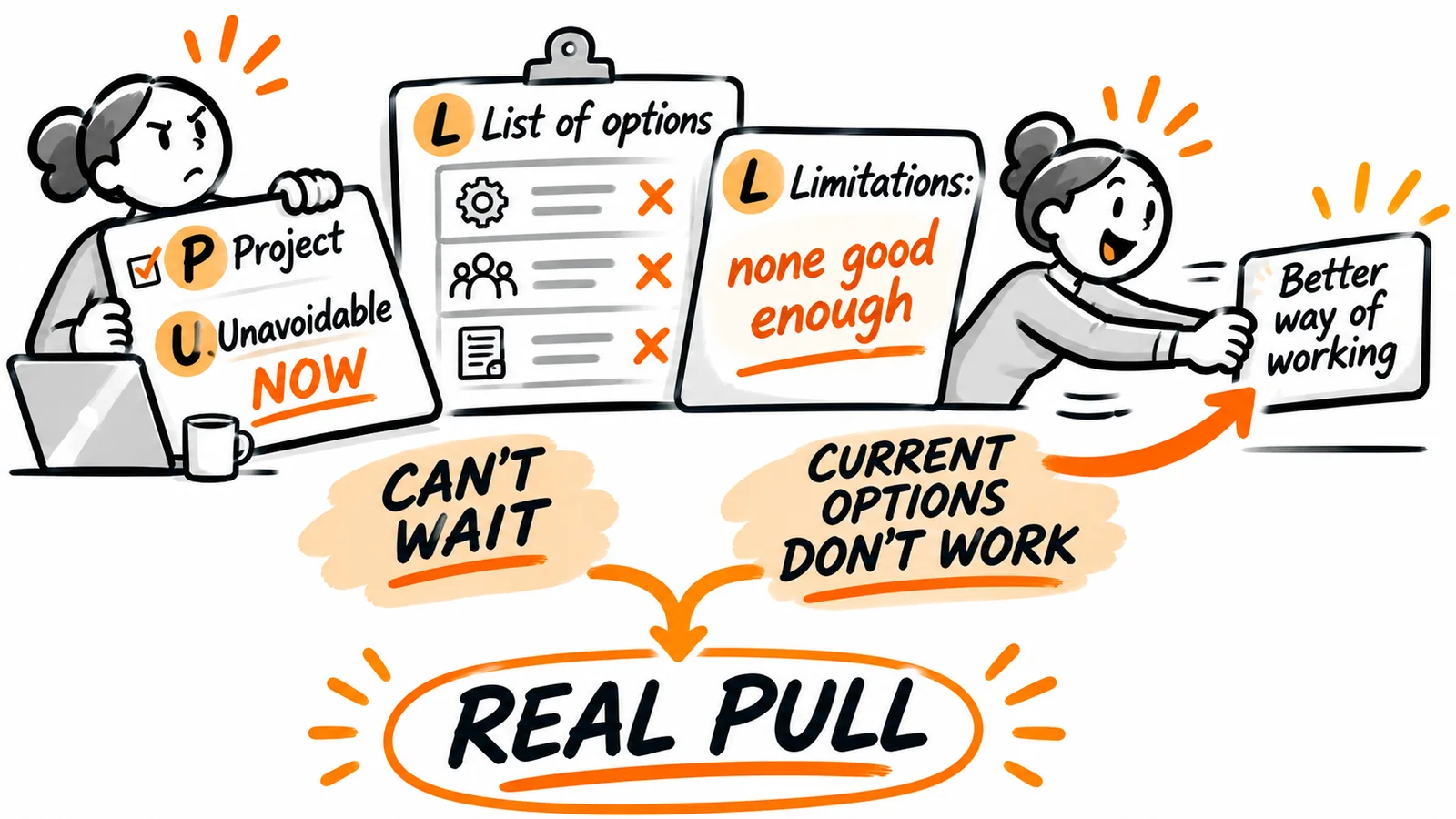
Part of what I try to do with the organizations I work with is make that pot of gold real: working with leaders who see the point of AI as helping people spend less time in toil, more time fulfilling their potential, and building more scalable organizations. That is not trivial. Many organizations do not see things that way, and in those organizations it is very hard to motivate people to adopt AI because they feel like they are cutting the branch they are sitting on.
Slice the Change Thin and Measure Adoption, Not Activity
When you do not know for sure whether your assumptions about a change are right, modern change management borrows from Lean Startup. You do not plan every detail for the entire organization up front and assume people will come. You run a small test: a Minimum Viable Change. Instead of pushing an elephant of a change, you slice it into smaller vertical slices, elephant carpaccio, a small valuable slice of change that delivers early value, creates demand, and teaches you what actually works. You try something, observe, learn, and improve the change for the next cycle until it is ready for the broader internal market.
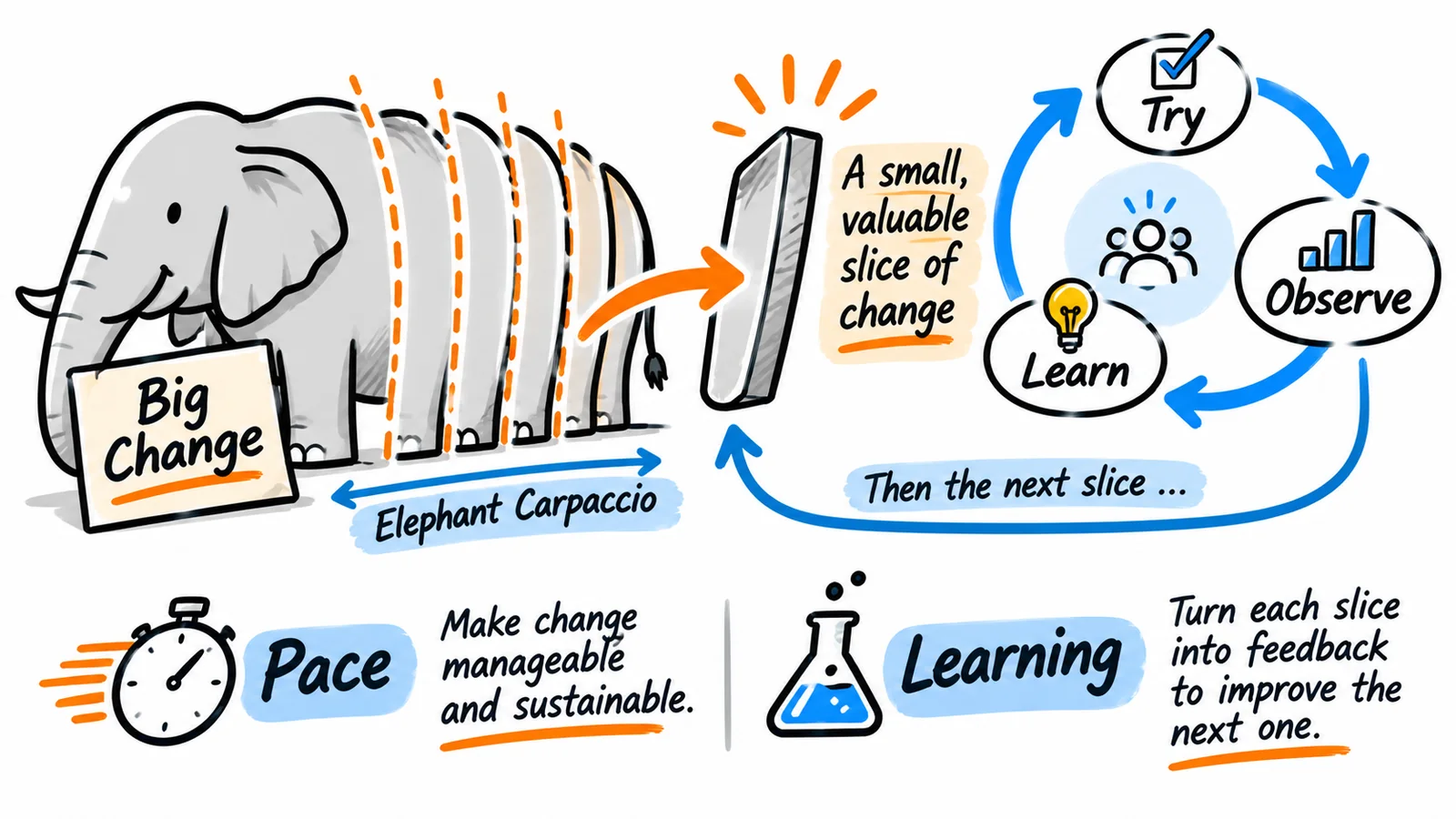
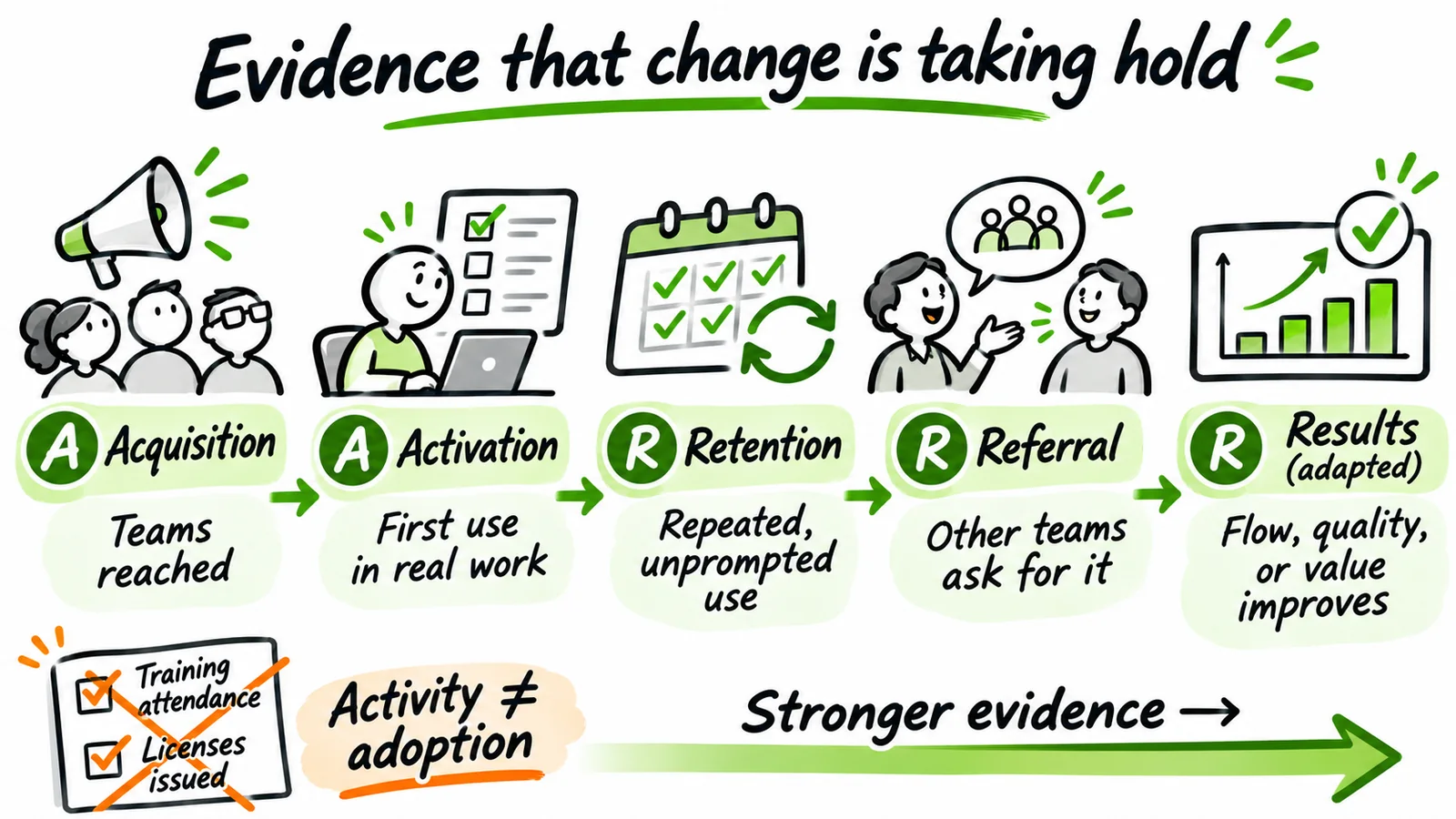
All along, you stop measuring activity: how many people attended training, or how many AI licenses were issued. That is measuring cargo culture. You measure adoption, the same way you measure a product:
- Acquisition: how many teams you reached that are working with you.
- Activation: how many people actually use the new way of working the first time.
- Retention: how many people keep doing things the new way without being chased.
- Referral: how many talk about it and pull others in when they do not have to.
- Results: whether the actual business outcome moved.
I am seeing this right now with a growing organization I am helping with internal AI adoption. To fuel their growth, they need to collect the money their customers owe them much better; otherwise, growth actually costs them cash. There are plenty of AI opportunities, and an obvious temptation is to just deploy a system or an AI agent. Doing that well is not just about implementing a tool; it is about changing the behavior of the collections team.
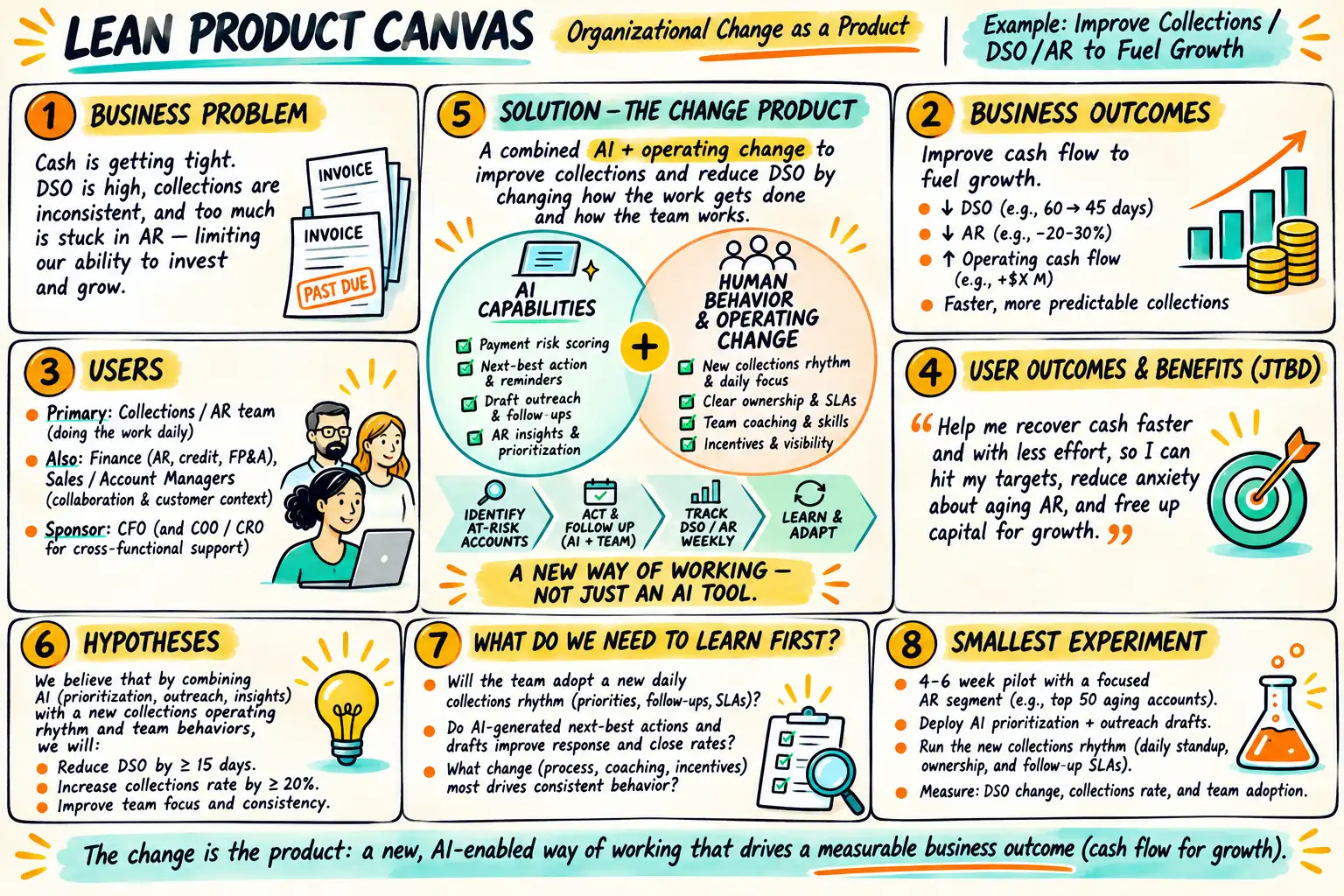
We have assumptions about how the collections team needs to work, and I am not sure all of those assumptions are right. Before planning months of change for those people, we include them in building the assumptions and hypotheses, and we run a small pilot to test changes to their standard operating procedures, processes, and AI capabilities, always respecting that the constraint is the human capacity to change.
There is a lot of uncertainty and complexity in how this is going to play out, and we need to navigate it one step at a time.
Yuval Yeret helps product and tech leaders move from agile theater to evidence-informed delivery. Work with Yuval →
- 01 Pull-Based Change Management: Invite, Don't Push 14 min
- 02 From FOMO to JOMO 3 min
- 03 Amdocs: Thousands of People to Kanban, No Big Bang 4 min