Uncomfortable Truths: Agile's Vanity vs Outcomes
uncomfortable truths about the agile industrys focus on vanity vs outcomesThe agile industry teaches outcomes over outputs, then measures itself in certifications and butts on seats. Why that is economics, not character.
 Click image to open full size
 Why Does an Industry That Teaches Outcomes Keep Selling Activity?
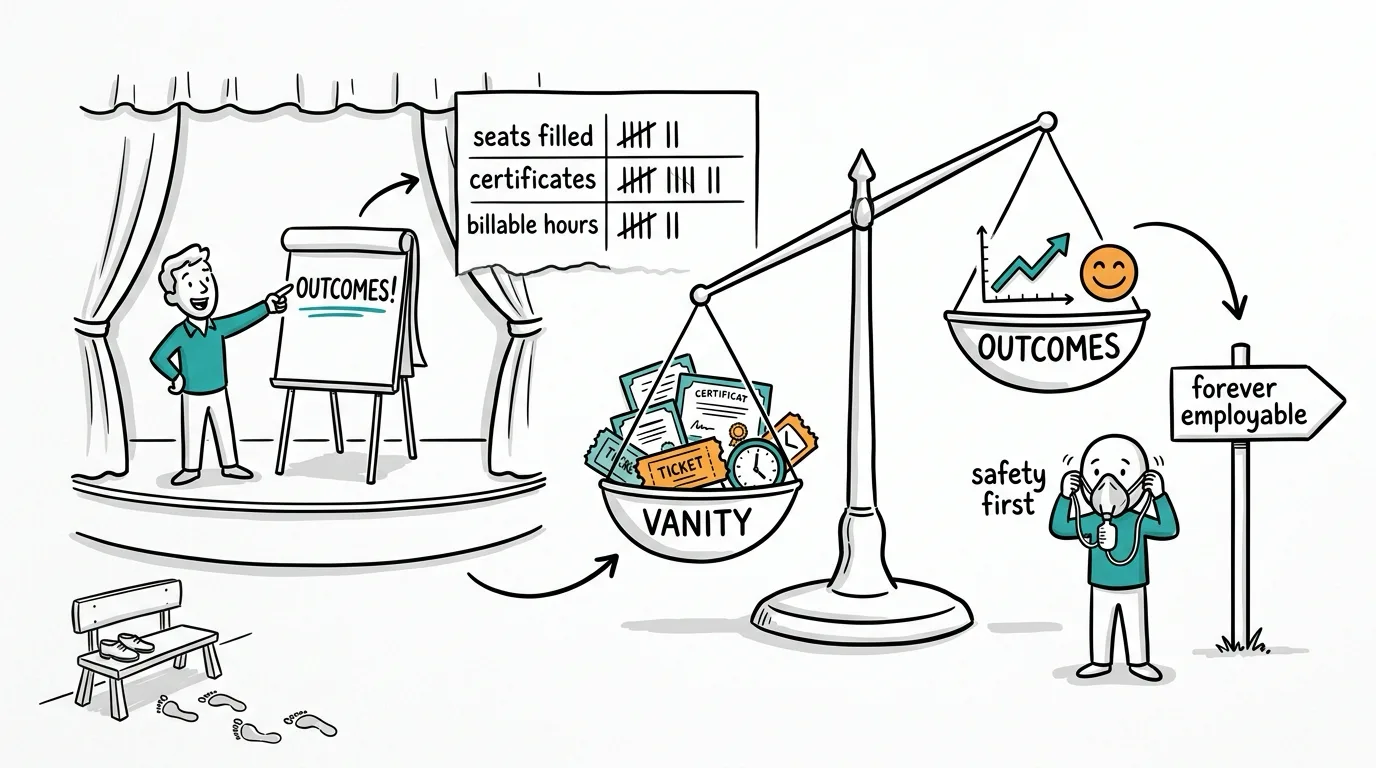
The agile industry has an irony problem. We stand in front of rooms teaching outcomes over outputs, evidence-based management, and OKRs that measure behavior change rather than activity. Then we go home and measure our own success in certifications issued, butts on seats, and billable days delivered. In this special crossover between Mastering Agility and Scaling with Agility, Jim Sammons, Rich Visotcky, and I turned that mirror on ourselves: are we the cobbler’s children walking barefoot?
The honest answer we landed on is that the drift toward vanity metrics is not a character flaw. It is economics. When trainers are paid per class, coaches are paid per hour, and staffing firms earn revenue share on filled positions, everyone in the system has a reason to generate activity and almost no one is rewarded for producing outcomes. The courage to break that pattern turns out to depend on something uncomfortable: how safe you are financially and reputationally when the client walks away. That is why the path out runs through what Jeff Gothelf calls being forever employable, and why the shakeout currently reshaping the agile industry may be the healthiest thing to happen to it in years.
Updated July 2026: this companion article was originally a short episode summary. I rewrote it as a full essay drawing on the ideas the three of us worked through.
The cobbler’s children problem
The conversation started from a confession all three of us recognized. As a Professional Scrum Trainer, a SAFe practitioner, and a Sense & Respond certified training partner, I regularly teach for organizations whose flags literally say outcomes over outputs over activities. And yet, what does the training business actually measure? How many people got certified. How many seats were filled. Whether the workshop was delivered and the invoice was paid.
All we can really promise is that people will have an experience and maybe a certificate at the end of it. Whether they have been changed by it, whether we will see different behaviors, whether it will have an impact on the business: hopefully, but that is not what we commit to. I put a version of this on LinkedIn a few weeks before we recorded, arguing that we are guaranteeing the wrong things, and it became one of my most engaged posts in a long time. The reaction split in a telling way. A lot of people pushed back that you cannot hold a trainer or a Scrum Master accountable for results, because results are outside their control. That objection deserves a real answer rather than a shrug, and the conversation kept circling back to it.
What would outcome-accountable training look like?
The practical version starts before the class is ever scheduled. When a client asks for a specific certification class, the useful first move is to ask what they are actually trying to achieve, how they would know the training had worked, and what would help them check it. Sometimes the class they asked for is not the class they need. Sometimes training is not the intervention they need at all.
When a client engages with those questions, the work shifts toward the changes they want to see: how people behave, how products get managed, how often releases happen, what happens to escaped defects. There will be observable signals that the training had impact, and you can agree up front to check them, even something as simple as a conversation three months later about what actually changed in behavior.
And sometimes the client is simply not interested. They want the class they ordered, and if you insist on asking about outcomes they will find a trainer who does not ask questions. That response tells you a great deal about how they run their organization. It is also where principles meet the mortgage, and all three of us admitted to taking those gigs anyway, because the money is real and the bills are real. Pretending that tension does not exist is its own form of theater.
The death spiral nobody designed
The same pattern showed up in a story from the staffing side of the industry. A recruiter calls needing two senior Scrum Masters, fast, job descriptions already written. Ask the obvious consultative questions about what the client is trying to accomplish and why a Scrum Master is the answer, and the reaction is irritation. They already handed over the twelve bullet points. The job is to fill the reqs as cheaply as possible.
This is the pattern that worries me most, because it compounds. Fill roles from a checklist, and people end up unhappy with the result, which discredits the roles, which commoditizes them further, which drives rates down, which makes it even harder for anyone in those roles to push back. Think about what any of us would do if compensated purely on hours, or on holding a salaried seat. You would create more and more activity. You would make sure there are plenty of agile events, plenty of agile theater, and that you remain visibly needed. Play it smart and you keep people attached to you. Have too much integrity and you engineer yourself out of a job.
None of the individuals caught in that spiral designed it, and very few of them enjoy it. But an ecosystem where trainers are paid for classes, coaches for hours, and staffing firms for placements is an ecosystem that structurally rewards activity over outcomes. Expecting individual heroic integrity to beat structural incentives is exactly the kind of wishful thinking we would call out immediately in any client organization.
The economics of courage
So do we really expect the Scrum Masters and agile coaches embedded in struggling organizations to be courageous, to coach the leaders, to name what is not working? At this point the conversation got personal, and the most useful thread was about how psychological safety and courage actually relate. The honest account was that courage shows up most reliably when the other needs are met: when you feel safe, respected, valued, and confident. Two lines came up that have stuck with me since. One is that the unemployment line is full of people with strong principles and values. The other is that a dead coach serves no one, which translates neatly into the airplane rule about putting your own oxygen mask on first.
A story from an oil and gas client made it concrete. A senior executive there sought out one-on-one advice and said something none of us could shake: he could finally do the right thing. The reason he finally could was that he was retiring within the year, and nothing could be wielded against him anymore. He had almost certainly known what the right thing was for a decade. He needed exit-level safety before he would act on it.
The counterweight the discussion needed came immediately: there is no courage in safety. If you are already safe, what do you need courage for? Both things are true, and the tension between them is the honest heart of this episode. Courage without any safety is martyrdom, and martyrdom does not compound, because you make one principled stand, lose the engagement, and help no one afterward. But safety pursued as an end state becomes its own trap. If putting your own mask on consumes forty hours a week, every week, what you are actually doing is administering the tool and calling it self-care.
Forever employable is the real prerequisite
The way I have come to think about it is closer to a portfolio strategy than a personality trait. What worked for me over the years was building a reputation specifically for focused interventions and outcomes, rather than for selling big transformations or forcing organizations to create dozens of new roles. That reputation created word of mouth, which created a pipeline, which created the safety to keep asking uncomfortable questions. Steve Chandler describes a mindset of going into every coaching conversation already at peace with losing the client. You ask the pointed question, you refuse to live with the theater, and if that is too uncomfortable for them, you part ways and you are still fine.
That “still fine” is doing all the work in the sentence, and it is what Jeff Gothelf’s forever employable idea is really about. I offered what I admitted at the time was a controversial take: forever employable is a good outcome for agilists to strive for, because it may be the only way to be a real agilist. If your network is one team and one manager, getting fired for telling the truth erases you. If your reputation travels through past clients, community, and published thinking, then losing one engagement is a setback rather than an ending. My warning was that this flywheel is weakening for a lot of people right now, and that is exactly what makes this moment dangerous: the industry needs courage most at the moment its practitioners can least afford it.
The shakeout is already here
Here is where I will plant a flag. Agility itself is not in trouble. People are working in agile ways and will continue to, regardless of what happens to the roles and certifications built around it. What is in trouble is the agility advisory industry: fewer agile roles, less appetite for agile consulting, and a buying market that has learned to distrust activity dressed up as progress. The theater, the vanity metrics, the focus on certifications. The bill for all of it is coming due.
I think that is ultimately healthy, even though it is painful for people I care about. The advisors who thrive through this shakeout will be the ones who show up focused on outcomes and willing to say hard things, because they built the safety that makes that courage sustainable. It also means telling some hard truths to people asking how to break into a Scrum Master career: do not enter this space expecting the role to protect you. The honest advice is to build toward being forever employable first, so that when the moment comes to say the quiet part out loud in front of a leadership team, you can afford to say it.
If you recognize your own organization in this, with plenty of agile activity, certifications on the wall, and no one quite able to point at the outcomes, the same diagnosis applies internally. The fix is not more theater and not another framework rollout. It is redesigning what you measure and what you pay for, so the people you hired to challenge the system can afford to do their job.
Listen to the episode
This was a special crossover episode of Mastering Agility and Scaling with Agility. The thinking above came out of the three-way conversation between Jim Sammons, Rich Visotcky, and me, and it is worth hearing in their words rather than my summary of it. We sketched a follow-up thread as well, on what putting your own mask on actually looks like in practice.
Listen on the episode page or directly on Spotify, and find more from the hosts at the Mastering Agility Podcast, Jim Sammons on LinkedIn, and Rich Visotcky on LinkedIn. The forever employable idea comes from Jeff Gothelf’s book of the same name.
The uncomfortable truth is not that the agile industry lacks principles. It is that principles are priced in courage, and courage is priced in safety. Build the safety, then spend it on your clients.
Practical thinking on turning AI pilots, adoption, and portfolio work into business impact - by finding the constraint, changing the work, and proving value as you go.
Yuval Yeret helps product and tech leaders move from agile theater to evidence-informed delivery. Work with Yuval →