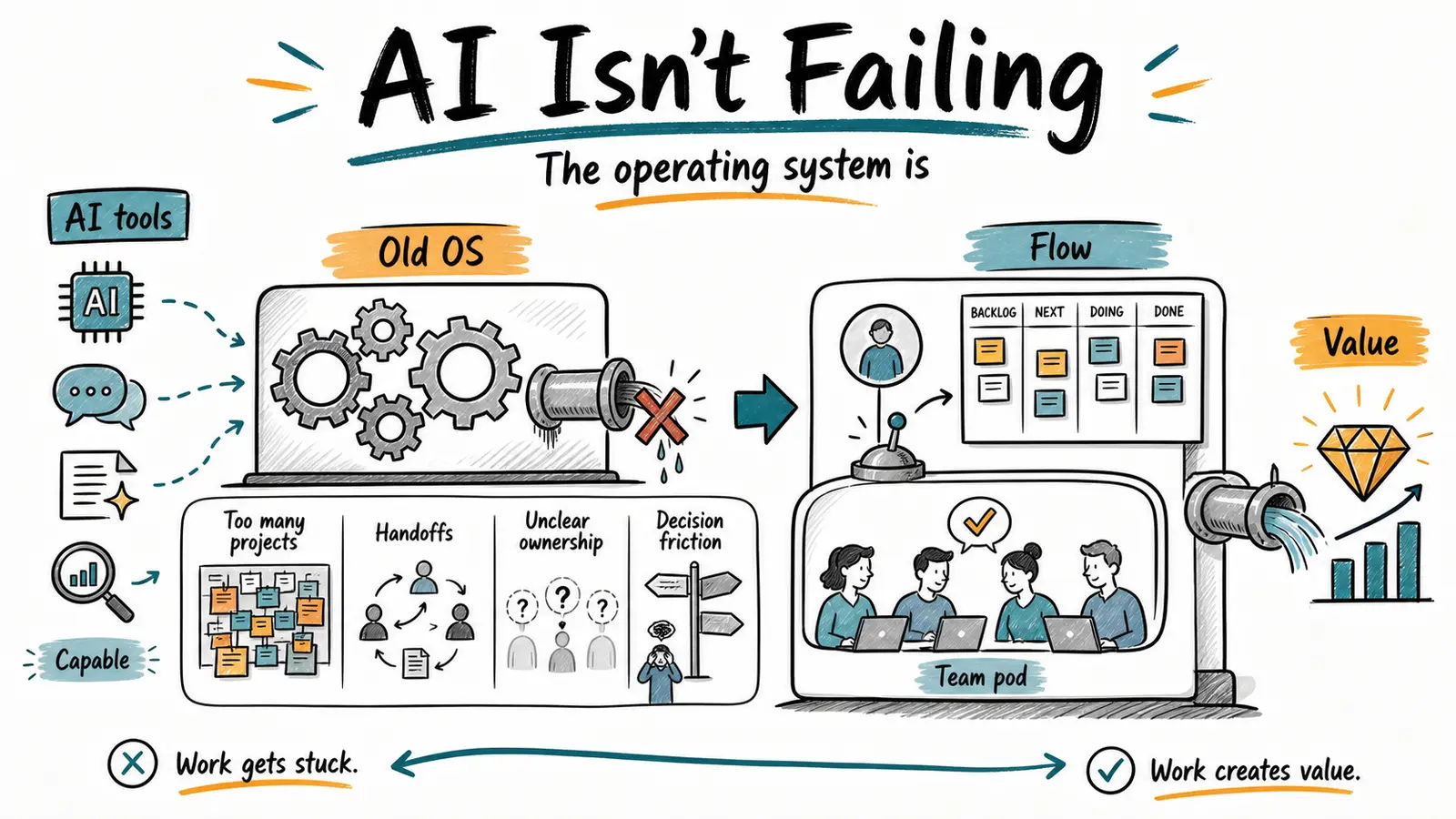
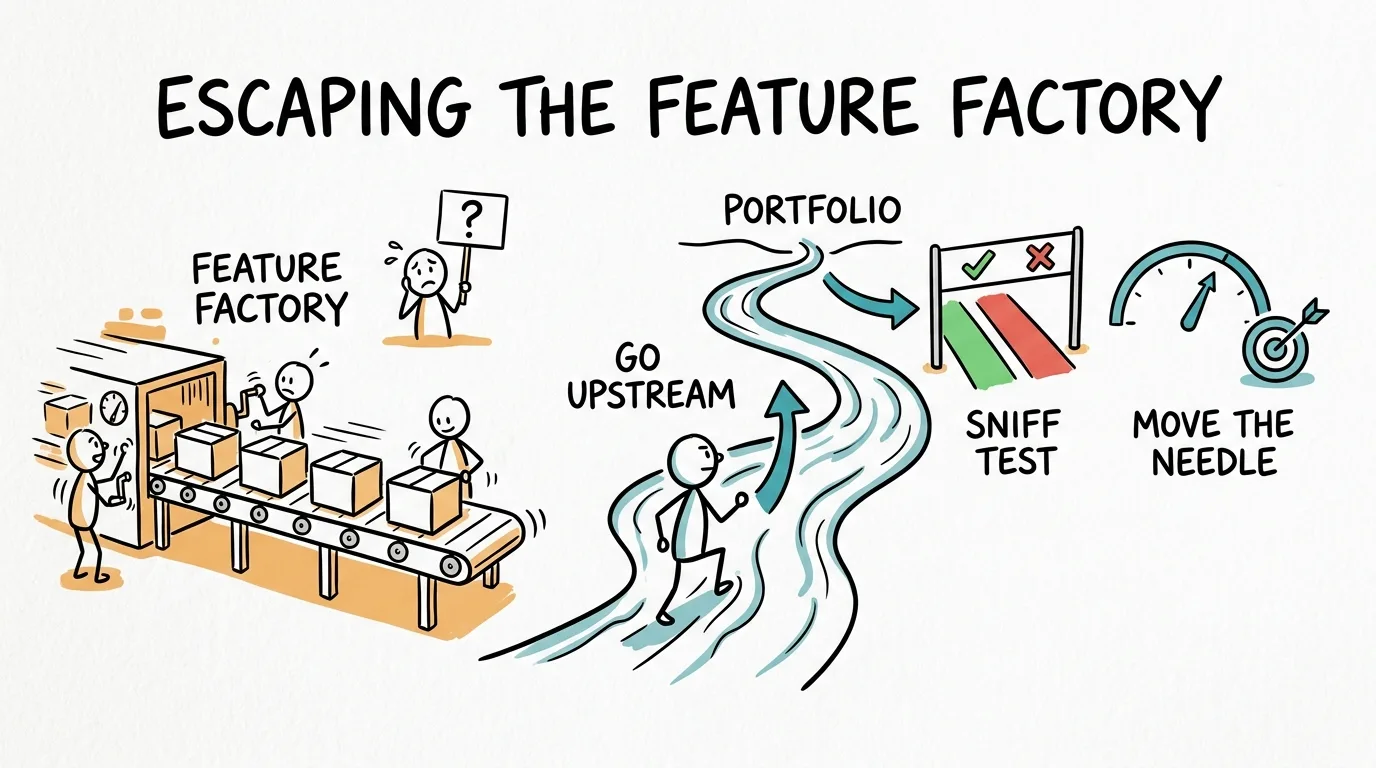
Your Kanban Board Ends Too Early
your kanban board ends too earlyDoes your board stop at deliverable and output, or does it go towards outcome: the changed behavior for somebody? Most boards stop at deployed, and that is what teaches people deployment is success.
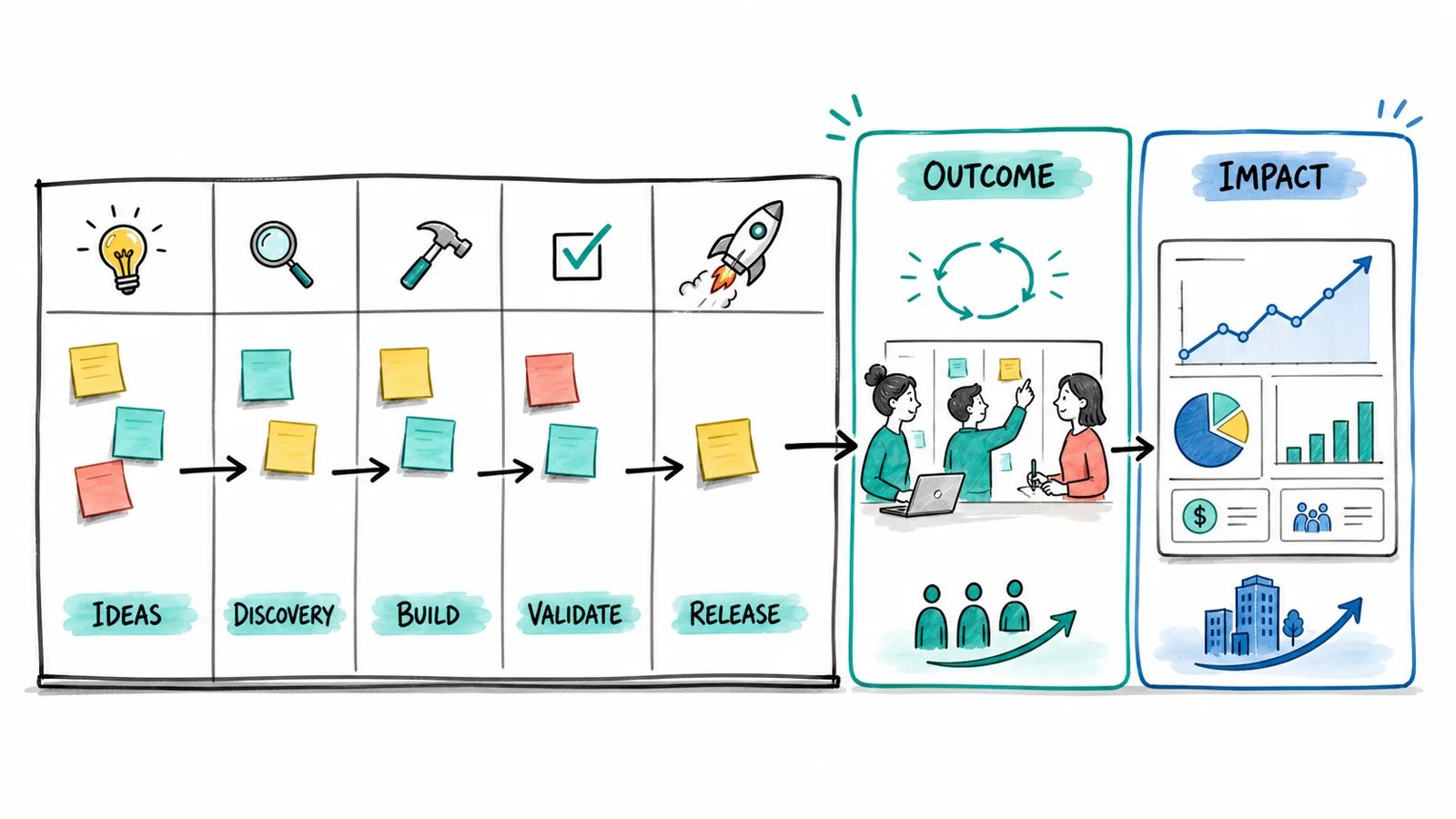 Click image to open full size
 Why is nobody using the AI agents you shipped?
People are deploying a feature and calling it a day, essentially. The problem is that while the feature might be working, it might not be useful. Or even if it’s useful, it might not be used. One specific scenario I’m seeing when working with AI enablement leaders is that they’re working on AI use cases: they are deploying agents, deploying Gems, and nobody’s using them. It’s not really useful that way.
What follows from treating deployment as done is that nobody pays attention to whether people are really using it. Nobody’s really working on getting value, getting an impact from the thing. The card left delivery, so the important part is over.
What I typically do in these cases is suggest adding a column to the board, where the criterion for entering it is that we believe the thing is useful and we believe it’s ready to be used, and the criterion for leaving that lane is that we have evidence that people are actually using it. That’s very simple. It’s not a huge change. And what I’ve seen in organizations where we’ve added this (the marketing team that added real learning to their flow is the written-up example) is that just adding that lane forces the interesting conversations.
What your spec board asks, and what it leaves out
If I was an engineering leader today, I would take this opportunity to revisit everything. So when I see these teams relying only on GitHub PRs to see and manage flow, I’m worried. While PRs can give you insight into DORA metrics, they don’t give you the full flow picture.
My go-to view when I’m joining an engineering team to see what’s going on and help them navigate the shift to AI-native development lifecycle is a spec-level kanban. How many are still being implemented? How many have moved into code review? How many have been merged but not released? How many are live but still haven’t told us whether they helped the customer?
The first three are on every spec-level board I get shown. The fourth one has no column behind it.
What “Done” on your board is really telling the team
Where a board effectively ends reflects a mental model of siloed thinking, I would say. Take the column names off and just look at the last state. It doesn’t take into account the realization that real value crosses value streams, or crosses multiple functions throughout the value stream.
With AI enablement work this shows up in a starker form, because a lot of it has never been given a lifecycle at all. What I see with a lot of AI enablement situations is that they don’t even look at the end-to-end picture. They don’t even consider the end-to-end lifecycle of an AI use case. They don’t yet apply the product lifecycle, or something like a product lifecycle, to this work. And if they did, it would be just focused on delivering the AI agentic lifecycle capability, including anything related to adoption or fine-tuning.
Most boards have no Learn stage after release
When I walk into an organization and ask to see the board, the thing I rarely see is a Learn stage.
What makes that expensive is not that the organization is guessing. The organization is not even seeing it as guesswork. They’re just moving on. The fact that this stage is missing means that, essentially, they’re moving on to other things. So the feature might be deployed, but it’s not really providing the potential value.
Somebody is still carrying that risk, and it’s the users. They’re getting features that aren’t necessarily fit for purpose for them, which means they’re not necessarily using them. And the team is not necessarily getting closer to the outcomes that they are responsible for, assuming that they’re responsible for outcomes. In other cases the teams are not responsible for outcomes, but the organization is responsible for outcomes, and it’s not really seeing those outcomes.
How to tell whether adoption is actually happening
If you feel you have an adoption gap and you want to focus on it, it’s really the telemetry. From the moment there’s telemetry, we’re in the stage of understanding where the friction points are, and it could be that there’s an actual sprint where you don’t develop anything, only telemetry, and you go and watch the users and try to understand what’s blocking them.
Here is how that plays out. I was recently working with an AI enablement lead running an agentic development lifecycle across a set of teams. The technical side was working, and this is exactly the stage where, beyond the technical solution, we’ve passed the point where the technical works and we’re now in the hypothesis of whether the users are using it. So concretely, what are you doing about it? First of all, do you have adoption measurements? They didn’t. They knew how it was going from what people told them.
The backlog aimed at adoption was demo sessions, showing examples, giving people an incentive to use it, and usability improvements to the framework. All of that pushes the capability at people. None of it says whether anyone is pulling. So alongside the telemetry, on every feature, both the ones you’ve already done and the new ones, make sure that as part of the lifecycle, there’s an adoption stage.
Why faster engineering doesn’t show up in the business
You’re not going to get anywhere close to the 10x if you’re just improving output in a certain area. Organizations right now are aiming to improve, and there’s the promise of the 10x, so organizations that want to fulfill the promise of AI leverage need to look end-to-end. Otherwise, all they’ll be able to show is local improvement.
The main thing is that AI accelerates some stages dramatically. Because of that acceleration, there’s the potential to create bottlenecks even faster, or more and more stuff to pile up in between the stages. You can see both halves of that on a cumulative flow diagram. Since implement keeps growing and growing, it means I have extra implementation capacity that isn’t reaching Done. It keeps sitting there in progress, and if I split the statuses a bit more I’d have implement and waiting for code review. And another pattern: when I do manage to send things out, I don’t really manage to close the loop in adoption, in monitor-adapt-learn. Things get stuck at that stage a lot of time too.
That same AI enablement team had planned the next quarter on a twenty to thirty percent velocity gain that was assumed rather than observed, because adoption was still partial. That’s wishful thinking.
Their leaders don’t care about that local improvement. Maybe for right now they are able to get away with it, and that’s part of what we’re seeing right now: people are getting away with local improvement. But over time, leaders will become smarter and start to expect the actual outcome, the actual impact. They’ll expect it end-to-end. It won’t be enough to just say development is faster and we’re creating much more code and we have many more PRs and maybe even we’re code-reviewing the PRs. That’s not going to be enough.
Where to put the lane so it actually holds
Concretely, what I usually do is create an epic lifecycle, a Kanban board of the epics that manages the life of the epic. We prioritized it, and now it’s in planning, and now it’s in work, and we released it, and now we’re working on adoption. And we don’t close it until we’ve made sure that the adoption is as we want it. Putting that state specifically in the lifecycle really helps to focus on it. Keep it on the epic rather than the story, because with a harness a story can open and close inside an hour, which is the wrong altitude to hold an adoption question.
A limit on that state also sends a signal: don’t start new features, take care of adoption before starting new things.
And it can be interesting to look now, in hindsight, at the things you closed that are Done, and see whether there is already adoption of this feature, of this epic, or not. Even to move things and say: we have things that are fine, we have things we don’t know, and we have things we know are not. That can be an interesting exercise.
The learning is worth doing at more than one point, too. You can do compound learning at the stage of having working software, and also at the stage after adoption.
Doesn’t another lane just add overhead and slow flow?
Too many states is a real cost, and it’s usually the first thing I cut. Looking at a board with too many states for that team, where another team’s is simpler, the move is to simplify: every organization and its Jira. So this is one lane, on one class of work, not a board redesign.
Is there enough risk and uncertainty to justify the overhead of frequent feedback loops? Whether the people you shipped it to will actually pick it up is exactly that kind of uncertainty.
And the limit on that state does not mean sitting idle. I can work the board right to left: review telemetry for a live feature, unblock review, help test, release something, or close the learning loop on work that is already in flight. Starting another feature should come after those options, not before them.
In some cases, what I hear is simply “we don’t have time to manage a more complex board. We don’t have time to worry about adoption and impact”. That’s a great signal that something much deeper is going on. What the “system” is telling us is that it was designed and finetuned to generate activity, not to ensure impact.
Adding a lane to the workflow and using its presence on the kanban board to drive different conversations is one great way to start to reprogram your “system”.
Impact Corner
I packaged the whole move as a skill you can run in your own agent, against your own board:
extending-kanban-from-output-to-outcome.
It carries the diagnosis questions, the lane with its entry and exit criteria, and the altitude
argument. The backfill exercise, the answers to the overhead objection, and the coaching prompt
and preference snippet are in there too.
/plugin marketplace add yyeret/ai-impact
/plugin install ai-impact@ai-impact
If you would rather just have the lane, this is it:
Released -> Adoption / Learn -> Outcome Confirmed

Entry: we believe the thing is useful and it's ready to be used.
Exit:  we have evidence that people are actually using it.
Does your board stop at output, or go all the way to outcome?
Does the setup of your board ensure that what you’ve done has moved the needle on behavior, or has just delivered?
Practical thinking on turning AI pilots, adoption, and portfolio work into business impact - by finding the constraint, changing the work, and proving value as you go.
Yuval Yeret helps product and tech leaders move from agile theater to evidence-informed delivery. Work with Yuval →